
Mapping the Discourse of Developers
Hacker Atlas, a new project launched on Hacker News, offers a novel way to visualize the vast landscape of topics discussed on the platform. It transforms the daily deluge of links and comments into a navigable, interactive map, allowing users to explore the connections between different subjects and understand the underlying currents of developer and tech community interest.
The project aims to go beyond simple topic aggregation. Instead of just listing popular keywords, Hacker Atlas attempts to map the relationships between them. This means that when a user explores a topic like "artificial intelligence," they don't just see related terms; they see how those terms are connected, perhaps showing that "AI ethics" is frequently discussed alongside "large language models," or that "web development" often intersects with "serverless computing." This approach provides a richer understanding of the community's focus, revealing not just what is being talked about, but how different ideas are being synthesized and debated.
Understanding Community Trends
The core of Hacker Atlas lies in its ability to track and visualize the evolution of these topics over time. By analyzing the titles and content of submissions to Hacker News, the project can identify emerging trends, sustained interests, and even fading discussions. This offers a unique perspective on the collective consciousness of a significant segment of the tech industry.
For instance, a developer might use Hacker Atlas to see if a new programming language is gaining traction, or if a particular security vulnerability is becoming a widespread concern. Founders could use it to gauge interest in emerging technologies or to understand what challenges their target audience is discussing. Researchers might find it a valuable tool for identifying areas ripe for further investigation, or for tracking the adoption of new methodologies.
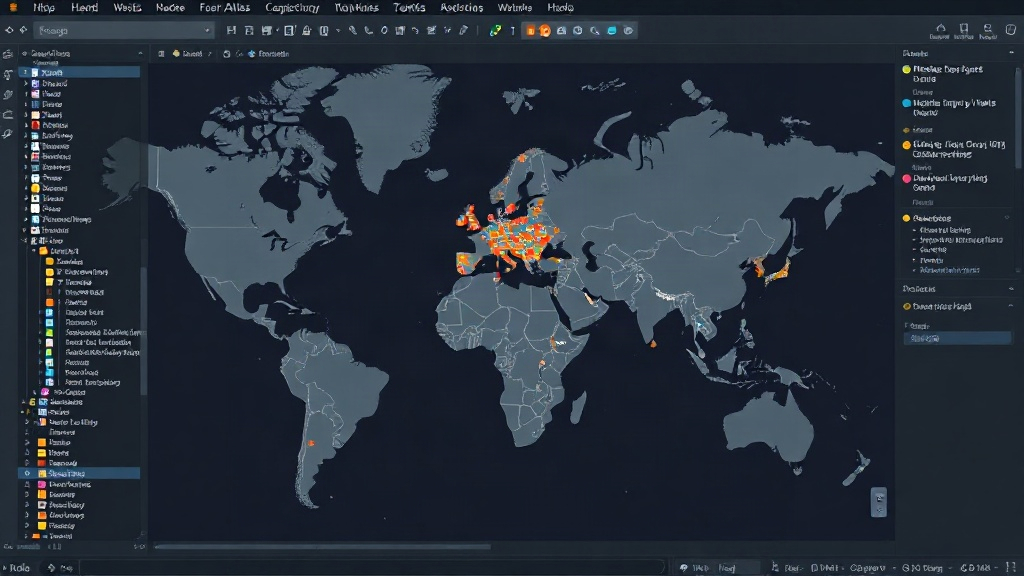
The visualization itself is designed to be intuitive. Users can typically expect to see clusters of related topics, with nodes representing individual subjects and lines indicating the strength of their association. Clicking on a node might expand it, revealing more granular sub-topics, or lead to a feed of relevant Hacker News posts. This interactivity is key to making the data accessible and actionable, transforming raw information into meaningful insights.
The Technology Behind the Map
While the specifics of Hacker Atlas's implementation are not detailed in its public-facing announcement, such projects typically rely on a combination of natural language processing (NLP) techniques and graph database technologies. NLP models would be used to parse the text from Hacker News submissions and comments, identifying keywords, entities, and semantic relationships. These extracted entities and relationships would then be stored in a graph database, which is optimized for representing and querying complex interconnections.
The process likely involves several stages: data ingestion from the Hacker News API, text preprocessing (cleaning, tokenization, stop-word removal), topic modeling (e.g., using Latent Dirichlet Allocation or similar algorithms), and then the construction of a knowledge graph or network visualization. The real-time or near-real-time updating of this map would also be a significant technical challenge, requiring efficient data pipelines and robust infrastructure.
The choice of visualization library is also crucial. Libraries like D3.js, Sigma.js, or Vis.js are commonly used for creating interactive network graphs that can handle a large number of nodes and edges without becoming unwieldy. The challenge is not just in generating the map, but in making it performant and user-friendly, especially as the dataset grows.
Implications for the Tech Community
Hacker Atlas offers a powerful lens through which to view the collective mind of the tech world. It can serve as an early warning system for trends, a tool for understanding community sentiment, and a resource for discovering new areas of interest. For individuals, it can guide learning and career development. For companies, it can inform product strategy and market analysis. For researchers, it can spark new avenues of inquiry.
What remains to be seen is how widely this tool will be adopted and how its features might evolve. Will it become a daily reference for developers, or will it remain a niche exploration tool? The success of Hacker Atlas will likely depend on its ability to provide continuous, actionable insights that are difficult to obtain elsewhere. If it can consistently surface the signal from the noise, it has the potential to become an indispensable resource for anyone engaged with the fast-moving world of technology.
The project, by its very nature, is a reflection of the Hacker News community itself. Its success and utility will be co-created by its users, who will explore, engage with, and implicitly shape the map through their continued participation on the platform. It’s a meta-commentary on how we discuss and disseminate knowledge in the digital age, rendered visually.