The On-Premise GPU Compute Decision
AI startups building large-scale machine learning models inevitably confront a significant financial inflection point. The choice boils down to two paths: continuing to pay substantial monthly fees to cloud providers for GPU compute, or making a large upfront capital investment to establish an in-house GPU cluster. This decision, however, is often oversimplified, with critical factors in the total cost of ownership (TCO) being overlooked.
A GPU, even a state-of-the-art NVIDIA H100 or the upcoming B200, is merely a component. Its computational power is unusable if it sits idle in a shipping crate. The true cost of an on-premise deployment extends far beyond the silicon itself. When engineering teams perform their napkin math, they frequently neglect essential infrastructure requirements. These include high-density electrical upgrades to power racks of accelerators, robust datacenter thermal dissipation systems to manage the immense heat generated, sufficient physical rack space, the complex networking fabric required for high-bandwidth inter-GPU communication, and the depreciation schedules of the silicon itself. Once these factors are accounted for, the real TCO of on-premise compute shifts dramatically, often favoring cloud solutions for certain scales and use cases.
Calculating the True Cost of On-Premise Compute
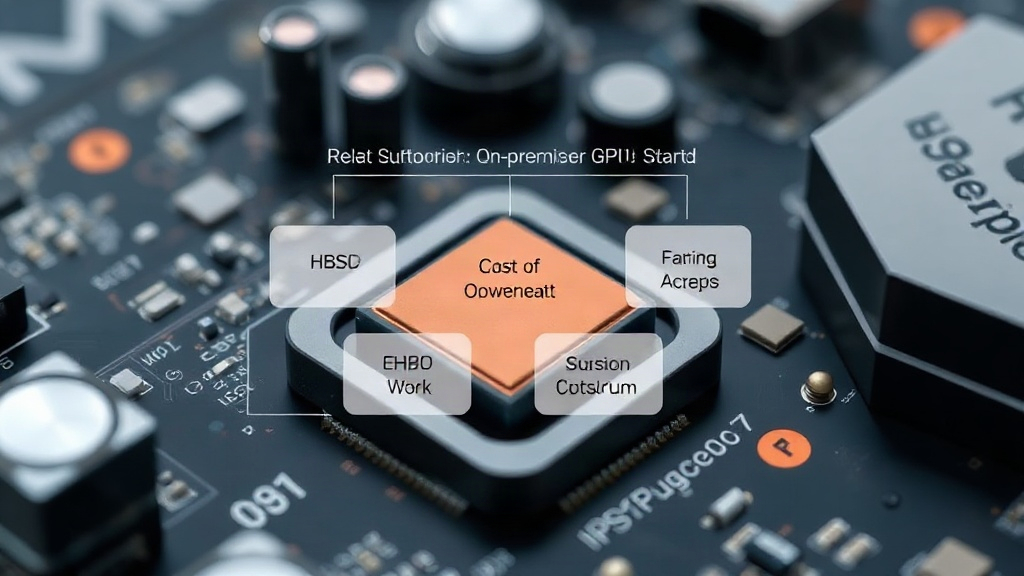
Purchasing enterprise-grade accelerators like the H100 or B200 is only the first step; the silicon represents a fraction of the total operational budget. To accurately calculate the genuine Total Cost of Ownership (TCO) over a typical 36-month operational lifecycle, four distinct categories of physical facility expenses must be incorporated. These are not optional add-ons but fundamental requirements for operating such high-performance hardware.
1. High-Density Electrical Upgrades
Modern AI accelerators, especially the H100 and B200, consume vast amounts of power. An NVIDIA H100 SXM5 module, for instance, can draw up to 700W, and a full server populated with multiple such GPUs can easily exceed 5kW. Datacenters not specifically designed for high-density compute may not have the existing power infrastructure to support these loads. This necessitates significant upgrades, including higher-capacity power distribution units (PDUs), redundant power feeds, and potentially new electrical substations or transformers. The cost of these upgrades can run into hundreds of thousands or even millions of dollars, depending on the scale of the deployment and the existing facility’s capabilities.
2. Thermal Dissipation Systems
The power consumed by GPUs is largely converted into heat. Managing this heat is critical to prevent hardware failure and maintain optimal performance. High-density compute racks generate an enormous thermal load. Standard HVAC systems are often insufficient. Datacenters housing these clusters require advanced cooling solutions, such as in-row cooling units, liquid cooling (direct-to-chip or immersion), or sophisticated hot-aisle/cold-aisle containment strategies. The capital expenditure for these systems, along with the ongoing operational cost of running them (which itself consumes significant electricity), must be factored into the TCO.
3. Physical Rack Footprint and Density
High-performance GPUs are often housed in specialized server chassis designed for maximum compute density and efficient cooling. These servers are typically larger and heavier than standard rack-mount servers. Furthermore, achieving the necessary power and cooling density often means that fewer servers can be housed per rack than in a traditional datacenter. This translates to a larger physical footprint requirement for the same amount of compute, increasing datacenter space costs, which are already substantial in desirable locations. The cost of real estate, construction, or leasing of datacenter space is a significant line item that is often underestimated by startups focused solely on hardware acquisition.
4. Interconnect Fabric and Networking
Training large AI models requires massive communication between GPUs, both within a single server and across multiple servers. Technologies like NVIDIA's NVLink and NVSwitch provide high-bandwidth, low-latency interconnects that are essential for efficient distributed training. Building out this high-speed fabric involves not only the specialized switches and cabling but also the network engineering expertise to design, implement, and maintain it. The cost of this high-performance networking infrastructure, including the switches, optical transceivers, and fiber optic cabling, can be substantial. Furthermore, ensuring sufficient bandwidth to the broader internet for data ingress/egress and remote access adds another layer of networking cost.
The Cloud Alternative: Simplicity and Scalability
Cloud providers like AWS, Azure, and Google Cloud have already made these massive infrastructure investments. They offer access to H100 and, soon, B200 GPUs on a pay-as-you-go or reserved instance basis. For AI startups, particularly those in their early stages or with highly variable workloads, the cloud offers compelling advantages:
- Reduced Upfront Capital Expenditure: Startups can access cutting-edge hardware without the multi-million dollar initial investment required for an on-premise cluster. This preserves precious capital for R&D, talent acquisition, and go-to-market strategies.
- Scalability and Flexibility: Cloud platforms allow startups to scale their compute resources up or down rapidly in response to changing project needs. This is invaluable for experimentation, burst training runs, or accommodating unpredictable demand.
- Managed Infrastructure: The cloud provider handles all the complexities of power, cooling, networking, and hardware maintenance. This frees up engineering teams to focus on model development and deployment rather than datacenter operations.
- Access to Latest Hardware: Cloud providers are typically among the first to receive large shipments of new, high-end GPUs. This ensures that startups can access the most powerful hardware without waiting for on-premise supply chains to stabilize.
However, the cloud is not without its drawbacks. For very large, consistent, and long-term workloads, the cumulative monthly costs can eventually exceed the TCO of an owned on-premise cluster. The pricing models can also be complex, and egress charges for data can add up. Furthermore, startups are beholden to the cloud provider’s roadmap and pricing changes.
When Does On-Premise Make Sense?
The decision to go on-premise hinges on several factors:
- Scale of Workload: Very large, sustained training runs (e.g., training foundation models with trillions of parameters) may eventually justify the capital expenditure.
- Predictability of Demand: If compute needs are consistent and predictable over years, the long-term cost savings of ownership can outweigh the upfront investment and operational overhead.
- Data Sovereignty and Security: For organizations with extremely stringent data sovereignty requirements or unique security protocols, maintaining a physically isolated on-premise environment might be necessary.
- Customization and Control: On-premise deployments offer complete control over hardware, networking, and software stack, which can be crucial for highly specialized research or performance tuning.
For most AI startups, especially those in their growth phases, the agility, lower upfront cost, and managed nature of cloud GPU rentals for H100s and B200s present a more practical and financially sound option. The complex realities of building and operating an on-premise datacenter are a significant undertaking that can distract from the core mission of developing and deploying AI solutions.