
Global Unicorn Surge: H1 2026 Outpaces 2025 Totals

The first half of 2026 has witnessed an unprecedented surge in new unicorn creations, with 195 companies achieving a valuation of $1 billion or more. This figure not only surpasses the total number of new unicorns minted throughout all of 2025 (193 companies) but also marks the highest count seen since the latter half of 2022. The data, compiled by Crunchbase, indicates a significant acceleration in venture capital activity and a robust appetite for high-growth potential startups. This dramatic uptick suggests a fundamental shift in the venture landscape. After a period of recalibration in 2023 and 2024, where funding rounds became more scrutinised and valuations were adjusted, investors appear to be regaining confidence. The sheer volume of new unicorns points to a renewed willingness to back ambitious ventures, particularly those operating in sectors that have captured significant investor attention.
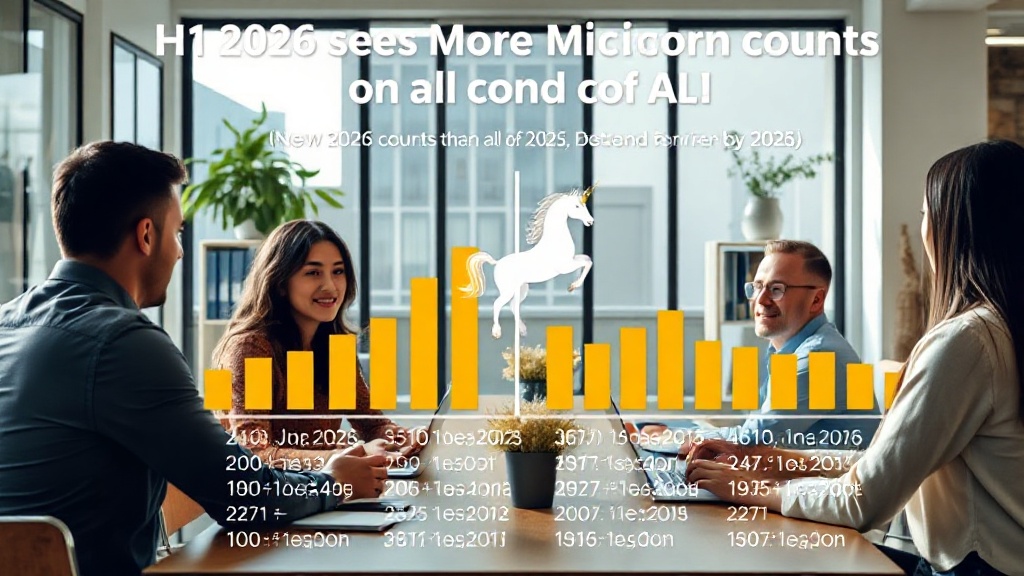
Infographic showing the stark contrast in new unicorn counts between H1 2026 and all of 2025

Key Sectors Driving the Growth

While the overall numbers are impressive, a closer examination reveals that specific technology sectors are disproportionately represented among the new unicorns. Artificial intelligence (AI), robotics, and semiconductor (chips) companies are leading this charge. These industries are at the forefront of technological innovation, addressing critical challenges and opening up new market opportunities. The AI sector, in particular, continues to be a hotbed of investment. Advances in large language models, generative AI, and specialized AI applications have created a fertile ground for startups. Investors are betting on the transformative potential of AI across various industries, from healthcare and finance to creative arts and manufacturing. Companies developing novel AI algorithms, specialized hardware for AI computation, and end-to-end AI solutions are finding it easier to attract significant capital. Robotics is another sector experiencing a renaissance. Driven by advancements in automation, machine learning, and sensor technology, robotics startups are developing solutions for logistics, manufacturing, healthcare, and even consumer applications. The demand for automated systems to improve efficiency, reduce labor costs, and perform tasks in hazardous environments is fueling this growth. Similarly, the semiconductor industry is seeing a resurgence, partly fueled by the insatiable demand for chips required to power AI and advanced computing. Startups focused on developing next-generation chip architectures, specialized AI accelerators, and advanced materials for chip manufacturing are attracting substantial investment. Geopolitical considerations and the drive for supply chain resilience are also contributing to increased investment in domestic and allied chip production capabilities.

Investor Sentiment and Market Dynamics

The surge in unicorn creation reflects a broader shift in investor sentiment. After a period characterized by higher interest rates and a more cautious approach to venture funding, there is a palpable return of risk appetite. This shift can be attributed to several factors: * **Maturing Technologies:** Key technologies like AI and advanced robotics have moved beyond theoretical concepts to demonstrate tangible real-world applications and clear paths to monetization. * **Market Demand:** The ongoing digital transformation across industries necessitates advanced technological solutions, creating a strong market pull for innovative startups. * **Strategic Investments:** Many of these new unicorns are attracting investment not just for their growth potential but also for their strategic importance in key technological domains. This includes a focus on national security implications and supply chain diversification. The valuation environment also appears to be stabilizing, with investors willing to offer more favorable terms to companies with strong fundamentals and clear market leadership. However, the sheer pace of unicorn creation also raises questions about the sustainability of these valuations and the potential for future market corrections. The focus now shifts to execution and profitability, as these newly minted unicorns will be under pressure to deliver on their ambitious growth trajectories.

What This Means for the Future

The first half of 2026 has set a new benchmark for startup creation and venture capital deployment. The dominance of AI, robotics, and chip companies suggests these sectors will continue to be the primary engines of innovation and economic growth in the coming years. For founders in these fields, the current environment presents a unique window of opportunity to secure significant funding and scale their operations rapidly. For investors, the challenge lies in identifying the truly disruptive companies amidst a crowded field and managing the inherent risks associated with high-growth, early-stage ventures. The rapid increase in unicorn counts also implies a greater supply of potential acquisition targets and IPO candidates in the medium term, which could invigorate public markets and M&A activity. This trend underscores a global focus on technological advancement as a key driver of economic competitiveness. Governments and corporations worldwide are recognizing the strategic importance of AI, advanced manufacturing, and next-generation computing, creating a supportive ecosystem for innovation. The coming months will reveal whether this H1 2026 momentum can be sustained and how these new unicorns will navigate the path to long-term success.