gVisor Production Audit Confirms Key Tradeoffs
A recent audit of 8,764 MarketNow MCP servers offers a real-world validation of the performance characteristics and operational considerations surrounding gVisor, a userspace kernel for container sandboxing. The audit directly addresses the comparison between gVisor and Firecracker, a KVM-based microVM, highlighting the practical implications for developers and operators managing AI agent workloads.
MarketNow, a marketplace for MCP servers where each server undergoes auditing, utilizes gVisor (specifically, the runsc runtime) for its L2.5 layer, mirroring the setup described in a prior analysis by @chunxiaoxx . This extensive production deployment provides a unique dataset for evaluating gVisor's performance and usability in a high-volume environment.
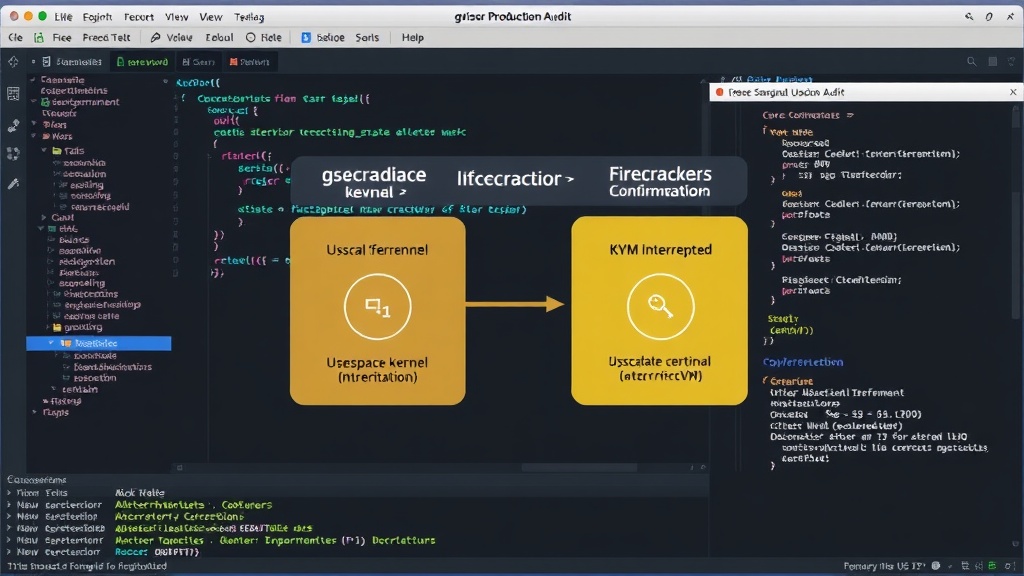
The core tradeoff identified by the original analysis and confirmed by MarketNow's audit remains consistent: gVisor operates as a userspace kernel, intercepting system calls. This approach introduces a performance overhead typically ranging from 5% to 10%. In contrast, Firecracker, leveraging KVM, offers near-zero overhead but requires KVM access and incurs a longer boot time, around 125ms. For AI agent sandboxing, where rapid startup might be less critical than consistent, isolated execution, gVisor presents a compelling option, provided its overhead is acceptable.
Installation Challenges and Learnings
While the performance characteristics of gVisor are well-documented, the practicalities of its deployment, particularly on platforms like GitHub Actions, reveal critical operational nuances. The audit uncovered that the installation process for gVisor requires careful attention, especially concerning dependencies and system configurations.
One significant learning from running gVisor on GitHub Actions relates to its installation. The process is not as straightforward as installing a standard binary. It involves ensuring the correct kernel modules are available and that the system's seccomp filters are compatible. For environments like GitHub Actions, where the underlying infrastructure is managed and potentially ephemeral, ensuring these prerequisites are met consistently can be a hurdle. This isn't a flaw in gVisor itself, but rather a reflection of its deep integration with the host kernel's behavior.
The audit also highlighted potential issues with older versions of gVisor or specific Linux distributions. Ensuring that the gVisor installation is up-to-date and that the host environment adheres to recommended configurations is paramount to avoid unexpected behavior or performance degradation. The team at MarketNow found that meticulous scripting and validation during the CI/CD pipeline were essential to overcome these installation complexities. This means that while gVisor is robust in its sandboxing capabilities, its setup demands a more involved approach than simpler container runtimes.
Performance Under Load: Beyond the Average
The reported 5-10% overhead for gVisor is an average, but real-world performance can fluctuate based on the nature of the workload. For AI agents, which often involve complex computations, large data processing, or frequent I/O operations, the impact of syscall interception can become more pronounced. The MarketNow audit, by covering 8,764 servers, provides a dataset that likely captures a wide spectrum of these workloads.
While the article doesn't delve into specific performance metrics for different types of AI agent tasks, the confirmation of the 5-10% overhead suggests that for most typical AI agent operations, the performance penalty is manageable. However, for latency-sensitive applications or those pushing the absolute limits of CPU or I/O, this overhead might become a bottleneck. This underscores the importance of performance testing with representative workloads before committing to gVisor in production. The audit serves as a strong indicator that for general-purpose AI agent sandboxing, gVisor is a viable and performant choice.
The comparison with Firecracker is also crucial here. If an AI agent workload is exceptionally I/O bound, the near-zero overhead of Firecracker might offer a significant advantage, assuming the 125ms boot time is acceptable. Conversely, if the agents are more CPU-bound or require frequent, short-lived execution without long boot delays, gVisor's userspace approach might be more suitable, especially if KVM access is restricted or undesirable.
Security Implications and Future Audits
The primary driver for using sandboxing technologies like gVisor and Firecracker in AI agent environments is security. AI agents, especially those interacting with external data or executing arbitrary code, present a significant attack surface. Sandboxing aims to isolate these agents from the host system and from each other, preventing lateral movement and limiting the blast radius of a compromise.
gVisor's userspace kernel approach provides a strong isolation boundary by emulating the kernel, thereby abstracting the host kernel from the application. This means that even if an agent finds a vulnerability in the host kernel, it might only gain control over gVisor's emulated kernel, not the actual host. This is a fundamental security advantage over simpler container runtimes that rely solely on Linux namespaces and cgroups.
The audit of 8,764 servers provides confidence that gVisor, when properly configured and installed, delivers on its promise of robust sandboxing. The fact that MarketNow relies on gVisor for its L2.5 layer, which is critical for server auditing, implies a high degree of trust in its security posture. Future audits will likely focus on specific threat vectors relevant to AI agents, such as prompt injection attacks that attempt to break out of sandboxes, or data exfiltration methods tailored to circumventing gVisor's protections.
What remains to be seen is how gVisor's security model evolves alongside the increasingly complex and potentially untrusted code executed by advanced AI agents. As agents become more capable, the pressure on sandboxing technologies to maintain a perfect security record will only intensify. The ongoing operational data from large-scale deployments like MarketNow will be invaluable in identifying emergent vulnerabilities and guiding future development.