Understanding Service-to-Service Communication
Choosing the right communication protocol for services is critical in modern microservice architectures. Two dominant paradigms, REST (Representational State Transfer) and gRPC (gRPC Remote Procedure Calls), offer distinct approaches, each with trade-offs in performance, readability, and complexity. REST, the de facto standard for web APIs, leverages HTTP/1.1 and JSON for its human-readable format. gRPC, a high-performance framework developed by Google, utilizes HTTP/2 and Protocol Buffers (Protobuf) for a significantly faster, more efficient binary serialization.
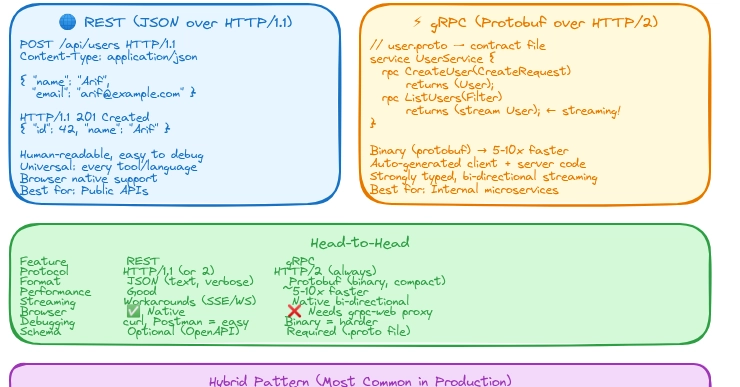
The fundamental difference lies in their underlying protocols and data formats. REST typically relies on HTTP methods (GET, POST, PUT, DELETE) to operate on resources, with data exchanged in JSON. This makes REST APIs easy to understand, debug, and consume, as JSON is human-readable and widely supported across programming languages and tools. However, HTTP/1.1's overhead, particularly in connection management and header size, can lead to performance bottlenecks in high-throughput scenarios. Text-based JSON serialization also consumes more bandwidth and CPU cycles compared to binary formats.
REST: The Web's Universal Language
REST has become ubiquitous due to its simplicity and broad compatibility. Its principles promote statelessness, cacheability, and a uniform interface, making distributed systems easier to scale and maintain. Developers are highly familiar with RESTful concepts, and tools like Postman make testing and interacting with REST APIs straightforward. The use of standard HTTP status codes provides clear feedback on request outcomes.
However, REST's strengths can also be its weaknesses. The flexibility of JSON means that schemas are often implicit or documented separately, potentially leading to integration challenges. For internal service-to-service communication where human readability is less critical than raw performance, REST can be suboptimal. The chattiness of HTTP/1.1, with its per-request overhead, becomes a significant factor when dealing with thousands or millions of requests per second between microservices. Each request involves establishing a connection (or reusing one with keep-alive), sending headers, and then the payload. The verbose nature of JSON, while human-friendly, adds to the data size being transmitted.
gRPC: High-Performance, Protocol Buffer-Driven
gRPC fundamentally changes the approach to communication. It's an RPC framework that treats a service as a collection of methods that can be directly called remotely. Instead of defining resources and their operations, you define the services and their methods in a `.proto` file. This contract-first approach, using Protocol Buffers, ensures strict type checking and efficient serialization. Protobuf serializes structured data into a compact binary format, which is significantly smaller and faster to parse than JSON.
gRPC leverages HTTP/2, which offers several advantages over HTTP/1.1, including multiplexing (allowing multiple requests and responses over a single TCP connection), server push, and header compression. These features drastically reduce latency and improve throughput, making gRPC ideal for high-performance, low-latency communication scenarios, such as between microservices within a data center or for mobile clients connecting to backend services.
The strict schema definition in Protobuf files acts as a built-in contract, ensuring that both client and server agree on the data structures and methods. This reduces integration errors and simplifies code generation for clients and servers in various languages. The performance gains are substantial; sources suggest gRPC can be 5-10 times faster than REST, with reduced bandwidth consumption. This efficiency is particularly important for internal APIs where latency directly impacts the overall response time of user-facing requests.
When to Choose Which
The decision between gRPC and REST hinges on the specific use case and the consumers of the service. For public-facing APIs, where ease of use, broad compatibility, and human readability are paramount, REST remains the dominant choice. Browsers, third-party developers, and external integrations benefit greatly from REST's familiar structure and standard HTTP semantics. The wealth of tooling and documentation available for REST further solidifies its position for external interfaces.
However, for internal communication between microservices, or for performance-critical applications like real-time data streaming or mobile-to-backend communication, gRPC often proves superior. If your primary concern is maximizing throughput, minimizing latency, and reducing network traffic, gRPC's efficiency with Protobuf and HTTP/2 is hard to beat. The development experience with gRPC is also streamlined for internal systems, as code generation from `.proto` files automates client and server stub creation, reducing boilerplate and potential errors. Think of it like this: REST is a universally understood spoken language excellent for public speeches, while gRPC is a highly efficient, specialized Morse code perfect for rapid, secure communication between trusted parties.
Challenges and Considerations
While gRPC offers significant performance advantages, it introduces some complexity. Debugging gRPC services can be more challenging than REST APIs due to the binary nature of the data and the reliance on HTTP/2. Tools for inspecting gRPC traffic are less common and less user-friendly than those for REST. Furthermore, browser support for gRPC is not native; it requires a proxy like gRPC-Web. For organizations already heavily invested in RESTful practices and tooling, adopting gRPC for internal services requires a shift in mindset and potentially new training for development teams.
Conversely, the ease of use of REST can mask performance issues in high-volume scenarios. Relying solely on REST for all inter-service communication can lead to an architecture that, while easy to start with, becomes a performance bottleneck as the system scales. The lack of a strict contract in many REST implementations can also lead to runtime errors and integration problems that a contract-first approach like gRPC's Protobuf definitions would prevent.
Conclusion
Ultimately, the choice between gRPC and REST is not about one being definitively superior to the other, but about selecting the right tool for the job. REST excels in its simplicity, readability, and broad compatibility, making it the go-to for public APIs and scenarios where ease of integration is key. gRPC shines in high-performance, low-latency environments, particularly for internal microservice communication, where its efficiency, strict contracts, and HTTP/2 underpinnings offer significant advantages. Understanding the specific needs of your services and their consumers will guide you to the most effective communication strategy.