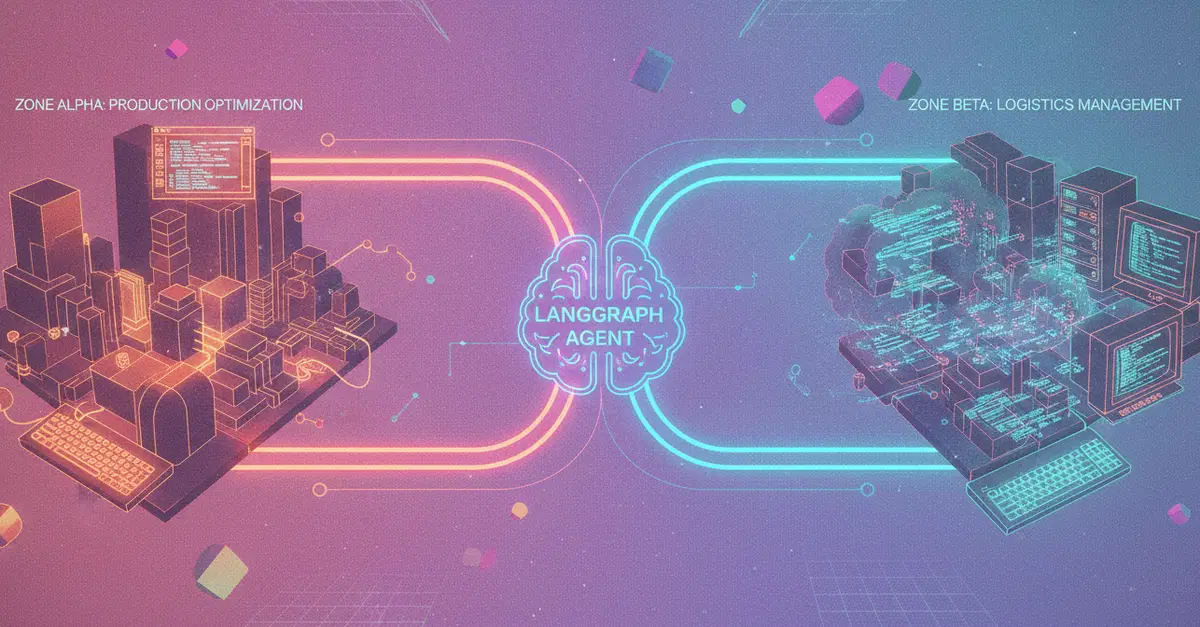
Inter-Zone Coordination: The Missing Piece
The previous installments of this LangGraph series meticulously built a ride-share zone-balancing agent, module by module. Part 1 established a rule-based foundation for a single zone. Part 2 integrated an LLM to interpret unstructured operational notes, enhancing the agent's understanding of real-world events. Part 3 introduced memory mechanisms, allowing the agent to track its actions and decisions over multiple cycles. Part 4 added a crucial human oversight layer, enabling conditional pauses for review before executing potentially costly interventions like surge pricing or driver bonuses. Each step, however, operated under a critical assumption: each zone was evaluated and balanced in isolation.
This isolationist approach masked a fundamental inconsistency. Incentives like driver_bonus and surge_pricing are designed to attract drivers, implicitly assuming an external, almost infinite pool of available drivers. In reality, the driver pool within a metropolitan area is finite and shared across adjacent zones. When two zones simultaneously implement aggressive incentive programs, they are effectively competing for the same limited resource. This competitive dynamic means that a decision made for one zone, based solely on its internal metrics, can negatively impact its neighbor by siphoning off drivers. Part 5 directly confronts this limitation by enabling the agent to consider two zones concurrently, recognizing their interconnectedness.
From Isolation to Interdependence
The core innovation in this final part is the shift from single-zone evaluation to a paired-zone assessment. Instead of processing Zone A and then Zone B independently, the agent now evaluates them together. This new approach acknowledges that the driver pool is a shared, limited resource. When Zone A decides to offer a significant driver bonus, it directly impacts the availability of drivers for Zone B. Conversely, if Zone B implements surge pricing, it draws drivers away from Zone A. The agent must now account for these cross-zone effects to make optimal decisions.
The architecture has been adapted to handle this dual-zone coordination. Each zone still maintains its local operational context and state. However, the decision-making process now involves a more holistic view. When considering interventions, the agent must weigh not only the immediate impact within a single zone but also the ripple effects on its neighboring zone. This is particularly important for balancing supply and demand. A severe deficit in one zone might be exacerbated if the balancing action in a neighboring zone pulls away the very drivers needed to rectify the situation.
For instance, if Zone A experiences a sudden surge in demand due to an unexpected event, and Zone B is also experiencing moderate demand, the agent might be tempted to apply a high surge multiplier in Zone A. However, if Zone B also has a smaller, but still significant, demand that could escalate, applying a high surge in Zone A might deplete drivers from Zone B, potentially causing it to also fall into deficit. The agent must now make a more nuanced calculation, potentially moderating the surge in Zone A to ensure Zone B remains adequately supplied, or perhaps finding a solution that benefits both zones simultaneously.
Addressing the Shared Driver Pool
The practical implementation involves modifying the agent's state and transition functions. Instead of a single `ZoneState` object, the agent now manages a collection of states, effectively representing multiple zones. The decision nodes are reconfigured to accept inputs and produce outputs that consider the interplay between these zones. The agent's objective function, implicitly or explicitly, is updated to optimize for system-wide efficiency rather than just localized balance.
This means that when the agent identifies a need for intervention, it doesn't just look at its own zone's driver-to-rider ratio. It looks at the ratios across the two zones it's currently evaluating. If Zone A has a severe driver shortage and Zone B has a surplus, the agent can now directly implement strategies to move drivers from Zone B to Zone A. This could involve targeted bonuses for drivers in Zone B to relocate, or a more sophisticated dynamic pricing model that makes Zone A significantly more attractive. The previous approach, where incentives were assumed to draw from an external pool, is no longer sufficient.
The agent's reasoning process is now more complex. It must simulate the potential outcomes of its decisions across both zones. This is akin to a chess player considering not just their next move, but also the opponent's likely response and the resulting board state. The LLM component, already trained to understand operational nuances, can now be leveraged to interpret potentially conflicting signals from two zones and suggest a coordinated response.
The Limits of Two-Zone Coordination
While coordinating two zones is a significant step forward, the series acknowledges this is a specific implementation choice, not a general solution for N zones. The complexity of managing interdependencies grows exponentially with each additional zone. Evaluating three zones simultaneously would require a more intricate state representation and a more computationally intensive decision-making process. Four zones would be even more challenging, and so on.
The decision to limit coordination to two zones at a time is a pragmatic one, balancing effectiveness with computational feasibility. For many urban environments, adjacent zones are the most directly competitive for drivers. Expanding this to a larger, interconnected network would likely require hierarchical coordination or more advanced graph-based approaches where zones are nodes and their interdependencies are edges. However, for the scope of this series, the two-zone model provides a clear demonstration of how to break free from the isolationist assumption and build more realistic, interconnected balancing agents.
This final part of the series effectively closes the loop on the initial problem statement: supply and demand failing to line up. By enabling agents to understand and act upon the shared nature of resources like drivers, LangGraph provides a powerful framework for building sophisticated, context-aware operational systems. The journey from a simple rule-based agent to one that can coordinate complex, interdependent systems highlights the evolution of AI agents and their potential in dynamic, real-world applications.
What’s Next?
While this series concludes, the underlying principles of building stateful, interactive, and context-aware agents with LangGraph are broadly applicable. Developers can extend this work by exploring multi-zone coordination, integrating more sophisticated prediction models for demand and supply, or further refining the human-in-the-loop mechanisms for high-stakes decisions. The modular nature of LangGraph makes it an ideal toolkit for iterating on these complex operational challenges.