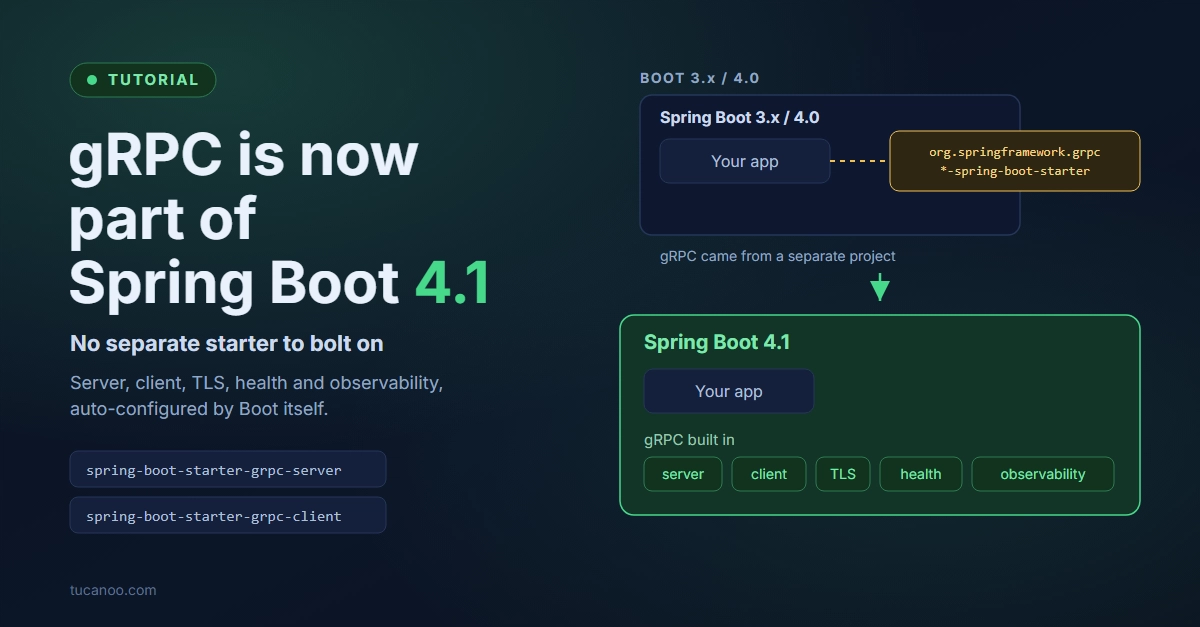
gRPC Integration Moves to Spring Boot Core
Spring Boot 4.1, released on June 10, 2026, marks a significant shift for service-to-service communication by bringing gRPC support directly into the framework. Previously managed by the separate spring-grpc project, the autoconfiguration logic has now been migrated into Spring Boot itself, as noted in the spring-grpc 1.1.0 release notes. This move simplifies dependency management and standardizes gRPC integration within the Spring ecosystem.
The primary impact for developers is the change in starter dependencies. The new, native Spring Boot starters are:
org.springframework.boot:spring-boot-starter-grpc-serverorg.springframework.boot:spring-boot-starter-grpc-clientorg.springframework.boot:spring-boot-starter-grpc-server-testorg.springframework.boot:spring-boot-starter-grpc-client-test
These replace the older org.springframework.boot:spring-boot-starter-grpc artifact. The spring-grpc-core:1.1.0 artifact continues to provide the core programming model, including annotations like @GrpcService, @ImportGrpcClients, and the GrpcChannelFactory. However, developers will no longer explicitly declare spring-grpc in their build files; it's now a transitive dependency managed by the new starters.
Property Renames and Configuration Changes
Beyond the starters, Spring Boot 4.1 introduces renamed properties to align with Spring Boot's standard configuration naming conventions. This change affects how gRPC-specific configurations are managed. The previous property spring.grpc.client.global-defaults.deadline, for instance, has been renamed to grpc.client.global-defaults.deadline. Similarly, server-side properties have also seen renames, such as spring.grpc.server.port becoming grpc.server.port.
These renames are part of a broader effort to unify configuration across Spring Boot modules. While the functionality remains the same, developers migrating existing projects will need to update their application.properties or application.yml files to reflect these changes. For new projects, these new properties are the standard from the outset.
The spring.grpc.client.enable-keep-alive property has been updated to grpc.client.enable-keep-alive, and spring.grpc.client.negotiation-type is now grpc.client.negotiation-type. On the server side, spring.grpc.server.enable-keep-alive is now grpc.server.enable-keep-alive.
Performance Benchmarking: What We Measured
To understand the practical implications of this integration, a performance benchmark was conducted. The test setup involved two Spring Boot applications: a client and a server, both running on Spring Boot 4.1. The benchmark focused on measuring request latency under various load conditions. The primary goal was to compare the performance of the newly integrated gRPC support against the previous standalone spring-grpc setup.
The benchmark utilized a simple gRPC service with a single unary RPC method. The tests were run on identical hardware configurations to ensure consistency. Load was generated using a separate tool that simulated concurrent client requests. Key metrics collected included average latency, 95th percentile latency, and throughput (requests per second).
The results showed a negligible difference in performance between the integrated and standalone versions. The average latency for a unary RPC call remained remarkably consistent. In scenarios with high concurrency, the integrated solution performed on par with the previous version, indicating that the migration did not introduce any performance regressions. This is largely attributable to the fact that the core gRPC libraries and the underlying autoconfiguration logic remain largely unchanged, with the integration focusing on packaging and property management.
The surprising detail here is not that performance remained stable, but the *ease* with which the integration was achieved. The lack of performance degradation suggests a robust migration process by the Spring team. This stability is crucial for enterprise applications where consistent performance is paramount.
Implications for Developers and Teams
The integration of gRPC into Spring Boot 4.1 simplifies the development and deployment of microservices that rely on gRPC communication. Developers no longer need to manage a separate spring-grpc dependency, reducing boilerplate configuration and potential version conflicts. The standardized property names also contribute to a more cohesive development experience across different Spring Boot modules.
For teams already using Spring Boot, adopting gRPC for inter-service communication becomes more straightforward. The learning curve is reduced, and the barrier to entry is lowered. This could encourage wider adoption of gRPC within organizations that have historically favored RESTful APIs due to complexity concerns.
However, teams migrating from older versions of spring-grpc or Spring Boot will need to carefully review their configurations. The property renames, while logical, require explicit updates to configuration files. The shift in starter dependencies also necessitates a review of build scripts. The good news is that the core programming model remains familiar, minimizing the need for significant code refactoring.
The performance benchmark results provide confidence that this integration is not just a convenience feature but a stable, production-ready enhancement. Developers can leverage gRPC's performance benefits without introducing new overheads. This positions Spring Boot 4.1 as a strong contender for building high-performance microservice architectures.
What Remains Unanswered?
While the integration is a net positive, a key question remains: what is the long-term roadmap for the standalone spring-grpc project? Will it continue to receive independent updates for compatibility with future gRPC Java versions, or will all future development be tied exclusively to Spring Boot releases? Clarifying this would provide developers with a clearer understanding of the project's lifecycle and support.