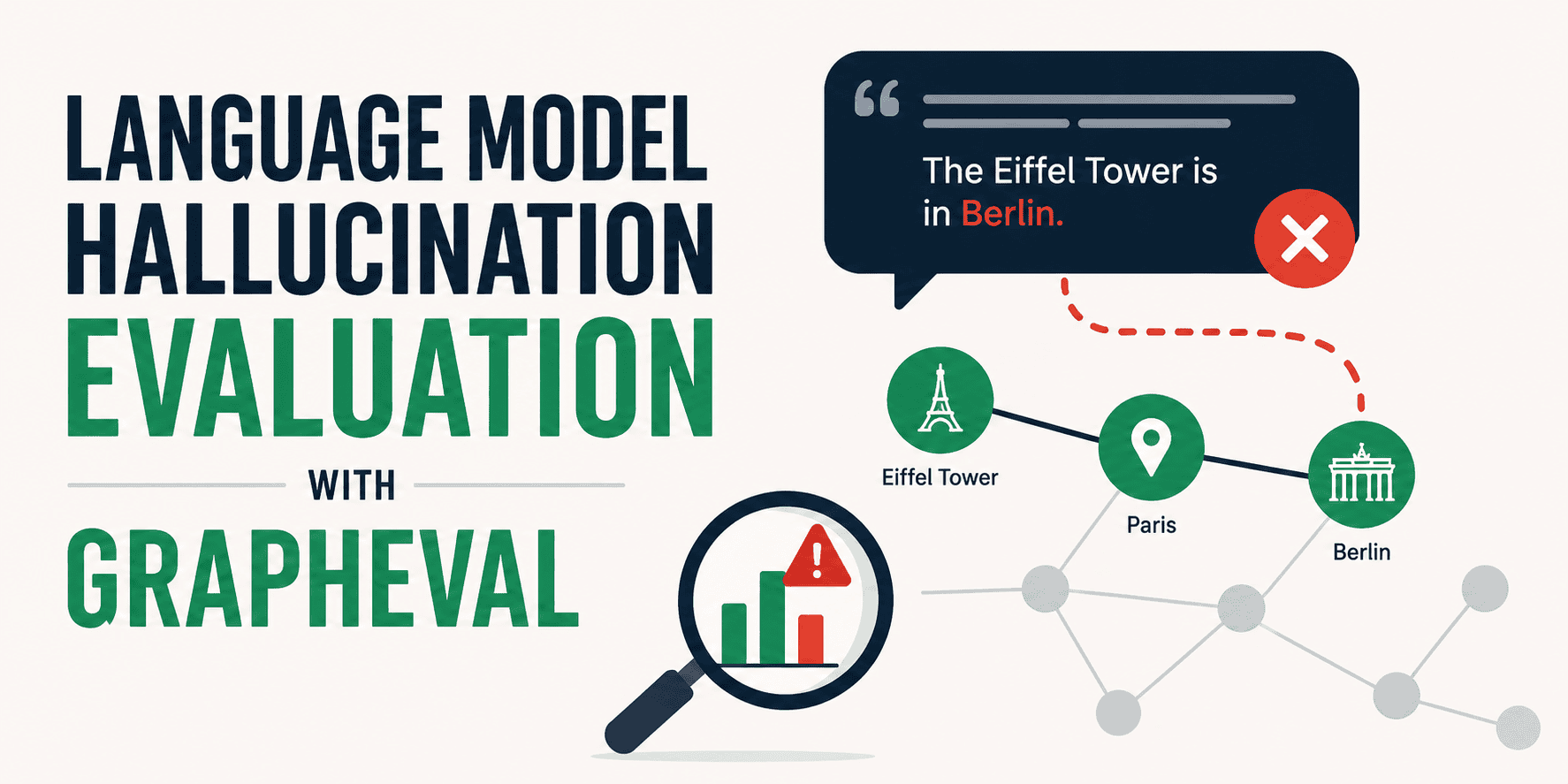
The Pervasive Problem of LLM Hallucinations
Large Language Models (LLMs) have demonstrated remarkable capabilities in generating human-like text, answering complex questions, and even writing code. However, a persistent and significant drawback is their tendency to 'hallucinate' – to confidently present factually incorrect or nonsensical information as truth. This phenomenon poses a critical risk, especially as LLMs are increasingly integrated into applications where accuracy is paramount, such as medical diagnosis, legal research, and financial analysis. Current evaluation methods often fall short, relying on simple metrics that can miss subtle factual errors or be easily gamed. The challenge is not just identifying that a model has erred, but understanding the nature and scope of its factual inaccuracies.
The quest for reliable LLM evaluation has led to the development of sophisticated new tools and methodologies. One such advancement is GraphEval, a novel framework designed to provide a more robust and nuanced assessment of language model hallucinations. Unlike traditional evaluation techniques that might focus on surface-level fluency or keyword matching, GraphEval leverages the power of graph theory to analyze the factual consistency of generated text.
Understanding GraphEval's Methodology
GraphEval approaches the problem by transforming the evaluation process into a structured, graph-based analysis. The core idea is to represent factual information as nodes and relationships in a graph. When an LLM generates text, GraphEval attempts to map this generated content onto a pre-existing knowledge graph or to construct a graph from the generated text itself. This allows for a systematic check of factual claims against a structured representation of knowledge.
The methodology can be broken down into several key stages. First, a knowledge graph is established. This can be a general-purpose knowledge graph like Wikidata or a domain-specific one tailored to the application area. Alternatively, for open-ended generation, a graph can be constructed directly from the LLM's output, capturing entities and their asserted relationships. Second, the LLM's generated text is parsed to extract entities and the claims made about them. This involves Named Entity Recognition (NER) and Relation Extraction (RE) techniques. Third, these extracted entities and relations are queried against the knowledge graph. Discrepancies, contradictions, or missing links indicate potential hallucinations.
The surprising detail here is not the complexity of graph theory, but how its inherent structure for representing interconnected data directly maps to the way factual knowledge is organized and, crucially, how LLMs often fail to maintain that structure. Think of it less like a simple fact-checker and more like a detective meticulously mapping out a crime scene, where each clue (entity) and its connection to others (relations) must logically fit together. GraphEval essentially builds this map for the LLM's output and checks for inconsistencies.

Key Implications and Practical Applications
The implications of GraphEval are far-reaching for both LLM developers and users. For developers, it offers a more precise diagnostic tool. Instead of a binary pass/fail on factual accuracy, GraphEval can pinpoint specific areas where a model is prone to hallucination, such as factual recall, logical consistency, or adherence to specific domain knowledge. This granular feedback enables targeted fine-tuning and improvement of LLM architectures and training data. For instance, if a model consistently hallucinates relationships between specific types of medical entities, developers can focus on augmenting training data with more accurate examples of those relationships.
For end-users and organizations deploying LLMs, GraphEval provides a higher degree of confidence in the reliability of AI-generated content. By employing GraphEval as part of a validation pipeline, businesses can implement stricter quality control, ensuring that critical applications do not disseminate misinformation. This is particularly vital in regulated industries where factual accuracy is not just desirable but legally mandated. The framework also opens doors for more sophisticated prompt engineering, allowing users to craft prompts that are more likely to elicit factually grounded responses, knowing that a robust evaluation method is in place to catch deviations.
Addressing the Limitations and Future Directions
While GraphEval presents a significant leap forward, it is not without its limitations. The effectiveness of the framework is heavily dependent on the quality and comprehensiveness of the underlying knowledge graph. Building and maintaining accurate, up-to-date knowledge graphs is a substantial undertaking, especially for rapidly evolving domains. Furthermore, the computational cost of constructing and querying large knowledge graphs can be significant, potentially posing a scalability challenge for real-time evaluation of extremely large-scale LLM outputs.
What nobody has addressed yet is the inherent subjectivity in defining what constitutes a 'hallucination' in nuanced creative or speculative writing. While GraphEval excels at factual recall and relational consistency, its application to more abstract or opinion-based LLM outputs remains an open question. Future research will likely focus on refining graph construction techniques, exploring hybrid evaluation methods that combine graph-based analysis with other metrics, and developing more efficient algorithms to reduce computational overhead. The goal is to make robust, graph-informed evaluation accessible and practical for a wide range of LLM applications.
In essence, GraphEval moves beyond simply asking 'Is this text true?' to asking 'Does this text align with a structured understanding of truth?' This shift in perspective is crucial for building truly trustworthy AI systems. By providing a more rigorous, graph-centric approach to evaluating LLM outputs, GraphEval offers a promising path toward mitigating the risks associated with AI-generated misinformation and unlocking the full potential of these powerful technologies.