
The Cold Start Problem in Serverless GPUs
Serverless GPU providers promise cost-effective, on-demand access to powerful hardware for machine learning inference and training. However, a significant bottleneck plagues these services: the cold start latency. When a GPU instance is provisioned after a period of inactivity, it can take an unacceptably long time to become ready for a request. For a 17 GB AI model benchmarked by developer Mirek Zicar, this latency ranged from a reasonable 6-8 seconds to an abysmal 90-122 seconds on the primary provider used. This variability, particularly the extreme tail latency, renders many serverless GPU deployments impractical for latency-sensitive applications.
Simply switching to a different serverless GPU provider does not solve the issue. Zicar's benchmarking revealed that each provider exhibits its own unique tail latency characteristics. This means that while one provider might offer faster average times, it could still suffer from occasional, lengthy cold starts. The problem is not isolated to a single vendor; it's an inherent challenge in managing ephemeral, on-demand GPU resources.
The core issue lies in the nature of cold starts. When a serverless function or GPU instance is invoked after a period of idleness, the underlying infrastructure must provision the hardware, load the operating system, download necessary dependencies, and finally load the model into GPU memory. Each of these steps adds to the total initialization time. For large AI models, which require significant memory and complex loading processes, this initialization can easily stretch into minutes.
GPUHedge: A Speculative Execution Approach
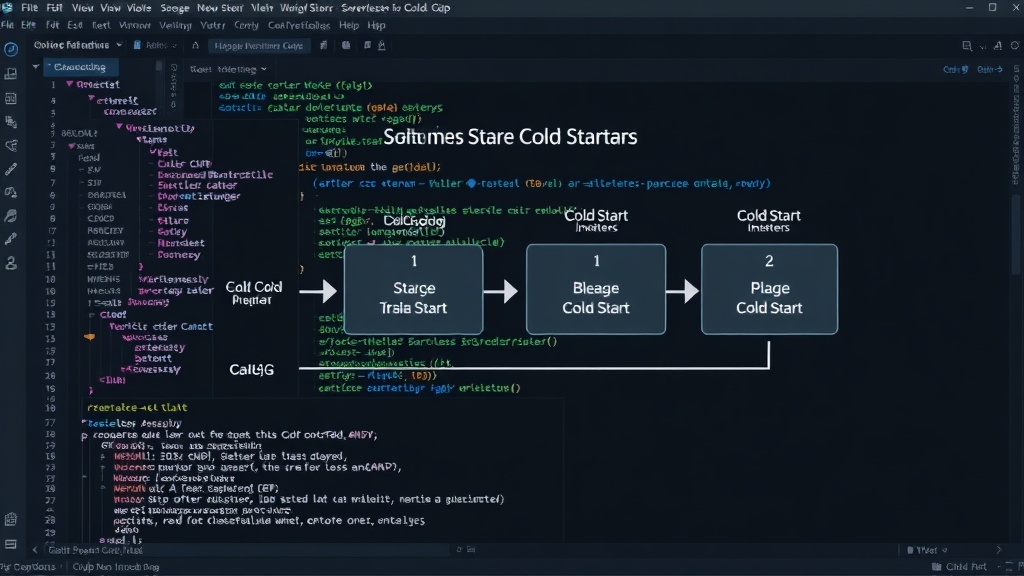
To combat this, Zicar developed GPUHedge, an open-source tool designed to treat the problem as one of speculative execution. The fundamental idea is not to eliminate cold starts, but to mitigate their impact on the end-user by hedging bets across providers and executing requests speculatively. GPUHedge operates by initiating a request on a primary, preferred GPU provider. While this primary request is in progress, GPUHedge monitors its lifecycle state. If the job’s state indicates it might be heading towards a long cold start, GPUHedge conditionally launches the same request on a secondary, backup provider.
The system is designed to yield the first result that passes a predefined validation check. This validator ensures the response is correct and meets basic criteria. Once a valid result is received from any provider, it is returned to the user. Crucially, the losing job, which was launched speculatively on the backup provider or the primary provider if it was slow, is immediately cancelled using the provider’s native API. This cancellation minimizes unnecessary resource consumption and associated costs.
This speculative execution model is akin to a chef starting to prepare a dish on their primary stove, but as soon as they notice it might take too long, they immediately start a duplicate on a second stove. The first dish that is ready and tastes good gets served, and the other is discarded. In the context of serverless GPUs, this means actively managing multiple potential outcomes simultaneously to ensure a fast response, even if one of the initial attempts encounters a significant delay.
How GPUHedge Works Under the Hood
GPUHedge’s architecture involves several key components. At its core is a policy engine that dictates the hedging strategy. This engine decides when to launch a backup job and which provider to use. The system interacts with various serverless GPU providers through their respective APIs. For each request, GPUHedge first sends it to the designated primary provider. It then monitors the job’s status, looking for indicators of impending long latency. These indicators could include specific state transitions or simply a timer exceeding a predefined threshold. If such an indicator is detected, GPUHedge triggers the launch of the same request on a backup provider.
The use of native APIs for cancellation is critical. It ensures that resources are released promptly, preventing orphaned jobs from incurring costs or consuming capacity needed by other users. The validation step is equally important. It ensures that the returned result is not only fast but also accurate, maintaining the integrity of the inference or training process. The current alpha release is Apache-2.0 licensed and available on GitHub, allowing developers to experiment with the policy engines without needing to set up provider accounts or incur costs, facilitating early adoption and feedback.
The benefit is a dramatic reduction in tail latency. Zicar’s benchmarks show a reduction in p95 latency from 117 seconds to just 30 seconds. This makes serverless GPUs a much more viable option for applications where responsiveness is paramount, such as real-time AI services, interactive applications, or critical batch processing tasks that cannot tolerate multi-minute delays.
Implications and Future Directions
The GPUHedge project addresses a critical pain point for developers and organizations relying on serverless GPU infrastructure. By abstracting away the complexities of multi-provider management and speculative execution, it lowers the barrier to entry for using these powerful resources effectively. For developers, this means being able to build and deploy applications with more predictable performance, without being solely at the mercy of a single provider’s cold start characteristics.
The open-source nature of GPUHedge is also a significant factor. It allows the community to contribute, improve the policy engines, and add support for more providers. As serverless GPU offerings continue to evolve, tools like GPUHedge will become increasingly important for optimizing performance and cost. The current alpha status suggests that while promising, further development and testing are needed before widespread production adoption. However, the core concept of hedging against provider variability through speculative execution is a powerful strategy that could fundamentally change how developers approach serverless GPU deployments.
What remains to be seen is how effectively GPUHedge scales with a very large number of concurrent requests and how its cost-effectiveness holds up under sustained high load, especially if multiple backup jobs are frequently triggered. Optimizing the cancellation logic and the validation process across diverse model types will also be key areas for future development.