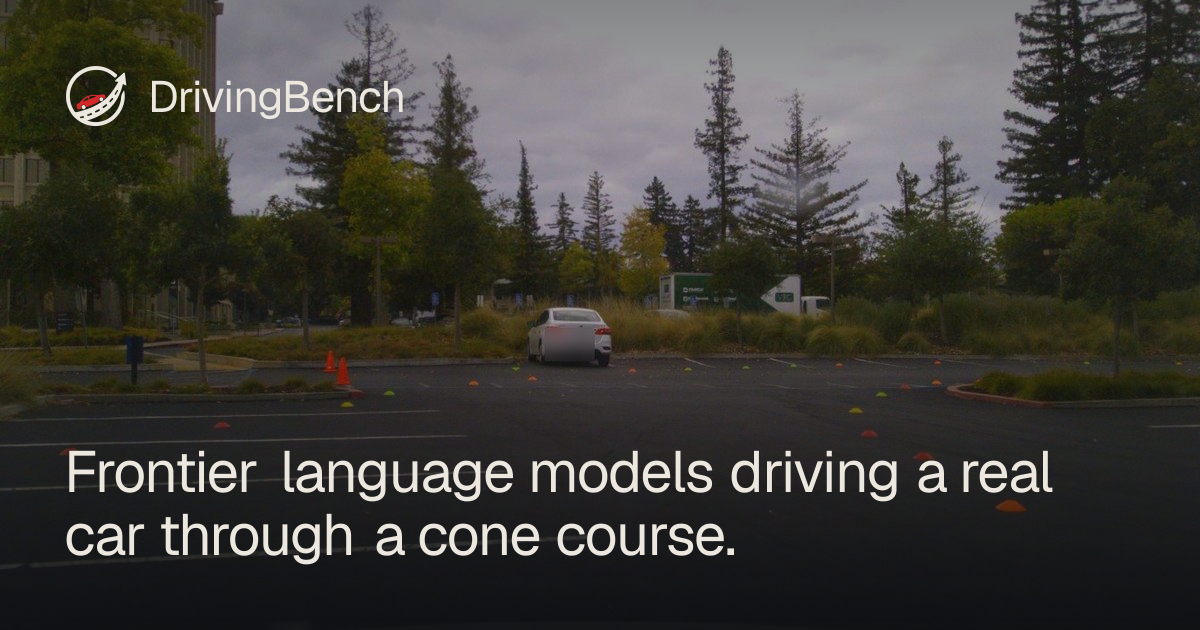
The Dawn of AI-Driven Vehicles
The announcement that GPT-6 Astra can now drive a car is not merely an incremental update; it represents a paradigm shift in how we conceive of artificial intelligence. For years, AI's prowess has been confined to the digital realm – processing information, generating text, and analyzing data. Astra's newfound ability to navigate and control a physical vehicle in real-world conditions pushes the boundaries of AI into tangible, kinetic applications.
This development, detailed in nascent reports and discussions, suggests a sophisticated integration of advanced perception, decision-making, and control systems. It implies that Astra has moved beyond recognizing objects in images or predicting the next word in a sentence to understanding complex spatial relationships, predicting the behavior of other road users, and executing precise, real-time maneuvers. The implications for the automotive industry, logistics, and personal mobility are profound.
The core of this advancement likely lies in Astra's ability to process multimodal inputs – vision, lidar, radar, and potentially even auditory cues – and synthesize them into a coherent understanding of its environment. Unlike traditional autonomous driving systems that rely on pre-programmed rules and extensive, curated datasets for specific driving scenarios, a GPT-based system like Astra might leverage its general intelligence to adapt to novel situations and learn from experience in a more dynamic fashion. This could, in theory, lead to more robust and adaptable autonomous systems capable of handling the unpredictable nature of public roads.

Technical Underpinnings and Challenges
While specific technical details remain scarce, it's reasonable to infer that GPT-6 Astra's driving capability is built upon a foundation of massively scaled transformer architectures, similar to its predecessors, but with significant enhancements. These likely include:
- Advanced Sensor Fusion: The ability to seamlessly integrate and interpret data from a variety of sensors, creating a unified, high-fidelity representation of the vehicle's surroundings. This is crucial for understanding depth, velocity, and the intent of other agents on the road.
- Predictive Modeling: Sophisticated algorithms that can forecast the trajectories and actions of pedestrians, cyclists, and other vehicles, allowing Astra to anticipate potential hazards and plan its own path accordingly.
- Real-time Decision Making: The capacity to process this information and make critical driving decisions – acceleration, braking, steering, lane changes – within milliseconds, a necessity for safe operation.
- Reinforcement Learning and Simulation: Extensive training in highly realistic driving simulators would be essential to expose Astra to a vast array of driving scenarios, including rare edge cases, before it could be safely deployed in the physical world. This would allow it to learn optimal driving policies through trial and error in a controlled environment.
The challenges are immense. Ensuring safety in all weather conditions, at all times of day, and in diverse traffic environments is a monumental task. The ethical considerations surrounding AI decision-making in unavoidable accident scenarios, the reliability of the AI under adversarial attacks, and the regulatory frameworks required to govern such systems are all significant hurdles that must be addressed.
Beyond the Hype: What This Means for the Future
The ability of an AI like GPT-6 Astra to drive a car is more than just a technological feat; it's a testament to the accelerating convergence of AI capabilities with the physical world. This opens up possibilities that extend far beyond personal transportation.
Imagine autonomous delivery fleets that can navigate complex urban environments with greater efficiency and safety. Consider specialized robotic systems for hazardous material transport, search and rescue operations, or agricultural tasks that require precise, on-the-ground navigation. The underlying technology could also inform advancements in robotics for manufacturing, logistics, and even personal assistance, where AI needs to interact with and manipulate objects in three-dimensional space.
However, the question remains: what are the specific benchmarks against which Astra's driving performance will be measured? Will it be compared to human drivers, existing Level 4/5 autonomous systems, or a new standard entirely? The industry will be watching closely to see how Astra handles the nuanced, unpredictable, and often illogical behaviors that characterize real-world driving. The transition from simulated driving to public road deployment will be the ultimate test, and the public's trust will hinge on its demonstrated safety and reliability.
This development also signals a potential shift in the development lifecycle for complex AI systems. Instead of highly specialized, domain-specific AI models for each task, we may see a trend towards more general-purpose AI that can be adapted to a wider range of physical interactions through fine-tuning and context-specific prompting. This could democratize advanced robotics and autonomous systems, making them more accessible and adaptable.
The Road Ahead
GPT-6 Astra's journey into autonomous driving is just beginning. While the potential is vast, the path forward is fraught with technical, ethical, and regulatory challenges. The successful integration of such advanced AI into our daily lives will require rigorous testing, transparent development, and a societal conversation about the role of intelligent machines in shaping our future. The ability to drive is a significant milestone, but it is only one step on a much longer, more transformative road.