
The BABEL Codec: Unlocking GPT-2's Internal World
For years, large language models like OpenAI's GPT-2 have operated as sophisticated black boxes. Their internal workings, the intricate dance of weights and activations that transform input text into coherent output, have remained largely opaque. This opacity has presented a significant barrier to understanding, debugging, and ultimately, trusting these powerful AI systems. Now, a project named BABEL claims to have achieved the first complete, certified decode of a production language model's internal state: GPT-2 small. This breakthrough allows for the interpretation of the model's internal state into human-readable English and, crucially, the translation of English back into a format the model can process internally.
The BABEL codec, developed by researchers and made available on GitHub, reports a remarkable 94.7% reconstruction of GPT-2's behavior. This isn't a localized success; the reconstruction holds true across every layer of the model and across various text regimes tested. This suggests a comprehensive understanding of the model's decision-making processes, not just isolated phenomena. The project makes its entire methodology and findings open-source, including the full lexicon, grammar tables, decoder/encoder weights, and reproduction scripts. A live demo allows users to input any sentence and observe the model's internal 'thoughts' as interpreted by BABEL.
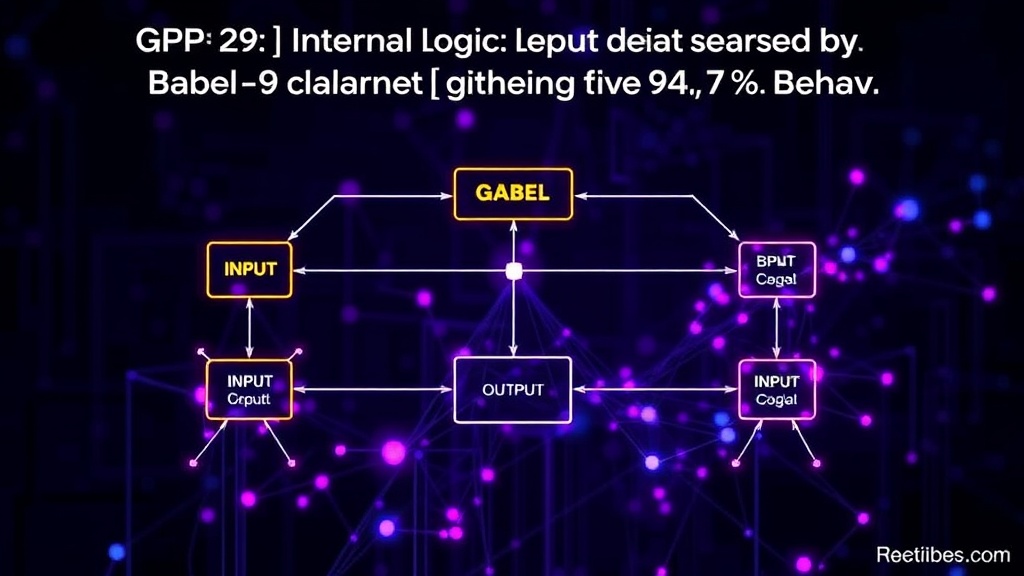
How BABEL Decodes Language Model Internals
The core innovation of BABEL lies in its ability to bridge the gap between the high-dimensional, abstract representations within the neural network and human language. Traditional methods for understanding LLMs often involve probing specific neurons or layers to see how they react to certain inputs, a process that can be time-consuming and may not reveal the holistic logic. BABEL, conversely, aims to create a direct, certified mapping.
The codec functions bidirectionally. First, it reads the model's internal state – the activation patterns across its layers – and translates these patterns into English. This allows researchers and users to see what the model is 'thinking' at any given point in its processing. Imagine typing a sentence and seeing a step-by-step breakdown of how the model is interpreting grammar, semantics, and context, all rendered in plain English. This is akin to having a debugger for a neural network, but instead of code, it's a language explaining the model's internal logic.
Second, and perhaps more challenging, BABEL can write English back into the model's internal state. This means that by understanding the internal representations, one can construct specific internal states that correspond to desired outputs or behaviors. This bidirectional capability is key to achieving the reported high fidelity in behavior reconstruction. It suggests that BABEL isn't just observing; it's learning to speak the model's internal language fluently enough to influence its processing.
Implications for AI Understanding and Development
The implications of BABEL's success are far-reaching. For developers and researchers working with LLMs, a fully decoded model offers unprecedented opportunities for debugging and fine-tuning. Identifying precisely why a model generates a particular output, or fails to generate a desired one, becomes significantly easier when its internal reasoning is laid bare. This could accelerate the development of more reliable, less biased, and more controllable AI systems.
For the broader AI community, BABEL represents a significant step towards demystifying artificial intelligence. The ability to 'read the mind' of a language model, even a relatively small one like GPT-2 small, fosters greater transparency and trust. It moves us closer to understanding the emergent properties of these complex systems and the principles that govern their behavior. This level of interpretability is crucial as AI systems become more integrated into critical applications, from healthcare to finance.
The project's commitment to open-sourcing all components – paper, lexicon, grammar tables, weights, and scripts – is also noteworthy. This allows for independent verification and further research, fostering a collaborative approach to AI interpretability. The demo, in particular, serves as a powerful educational tool, enabling anyone to interact with a decoded LLM and gain a deeper appreciation for its internal mechanics.
The Future of Black Box AI
While GPT-2 small is a foundational model, the principles behind BABEL could potentially be extended to larger, more complex models. The challenge scales significantly with model size and architecture. However, the reported 94.7% reconstruction rate on GPT-2 suggests that a systematic approach to decoding internal states is feasible. This raises the question: what happens when we can fully decode models like GPT-3, GPT-4, or even future architectures? Will this lead to a new era of transparent AI, or will it reveal complexities that are even harder to manage?
The BABEL project, by opening the black box of GPT-2, not only provides a powerful tool for understanding a specific model but also sets a precedent for how we can approach AI interpretability moving forward. It underscores the human effort behind AI development, showcasing how dedicated researchers can unravel complex systems and share that knowledge openly.