
A New Quicksort for Modern Hardware
Sorting is a fundamental operation in computer science. Quicksort, invented by Tony Hoare in 1959, remains a dominant algorithm due to its average-case O(n log n) time complexity and in-place nature. However, traditional Quicksort implementations often fail to fully exploit the capabilities of modern processors, particularly their vector instruction sets (like AVX, SSE, ARM NEON). These instruction sets allow a single instruction to operate on multiple data elements simultaneously, offering substantial performance gains. Google's recent work introduces a vectorized and performance-portable Quicksort that aims to bridge this gap.
The core challenge in vectorizing Quicksort lies in its inherently recursive and data-dependent nature. Standard Quicksort picks a pivot, partitions the array around it, and then recursively sorts the two sub-arrays. This branching logic and unpredictable data access patterns make it difficult to feed data into vector units efficiently and consistently. Traditional vectorization strategies often struggle with the irregular memory access and conditional branches inherent in Quicksort's partitioning step.
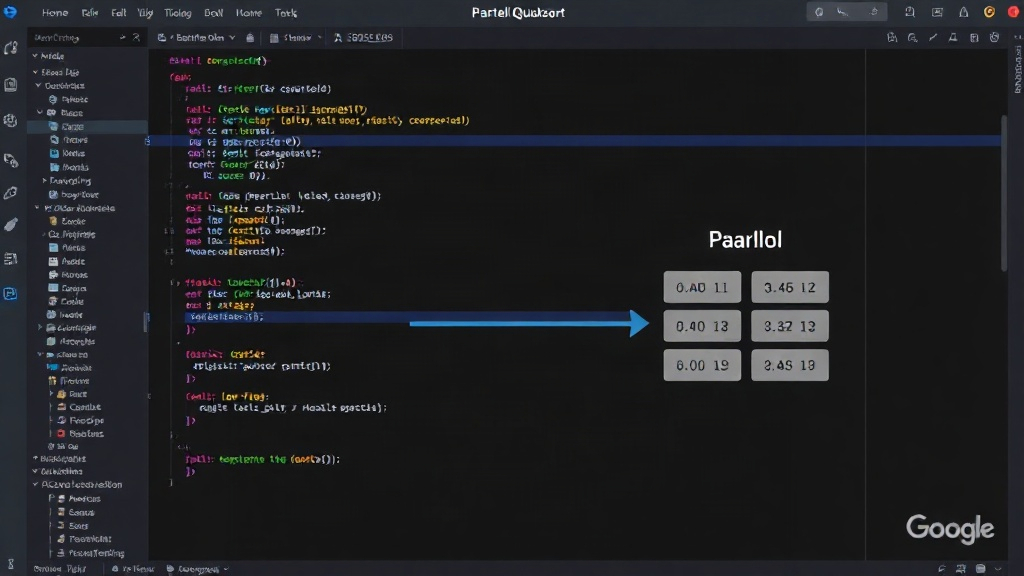
This new implementation tackles this by performing multiple comparisons and swaps in parallel within the partitioning step. Instead of comparing and swapping elements one by one, it uses vector instructions to compare multiple elements against the pivot simultaneously. This allows for faster identification of elements smaller than the pivot and elements larger than the pivot. The algorithm is designed to be 'performance-portable,' meaning it can adapt and achieve good performance across a wide range of CPU architectures without requiring manual tuning for each specific instruction set.
Breaking Down the Partitioning Problem
The key innovation lies in how the partitioning step is vectorized. Traditional Quicksort partitioning, like Hoare's or Lomuto's, typically involves a single pass through the array, comparing elements to a pivot and swapping them to their correct sides. This sequential process is a bottleneck for vectorization.
The vectorized approach, as described, likely employs techniques to process chunks of data using vector registers. For instance, it might load multiple elements into a vector register, perform a vectorized comparison with the pivot, and then use the resulting mask to determine which elements need to be moved. This parallel comparison and movement of data significantly reduces the number of cycles required for partitioning. The algorithm likely includes logic to handle cases where the vector width is not an exact multiple of the data chunk size, or when the remaining elements are fewer than a full vector width, ensuring efficiency even at the boundaries.
Furthermore, achieving 'performance portability' means the algorithm is not hardcoded for a specific instruction set (e.g., AVX2). Instead, it likely uses a higher-level abstraction or runtime detection mechanism to select the most appropriate vector instructions available on the target CPU. This could involve using compiler intrinsics that map to different instruction sets or employing a library that abstracts these differences. The goal is to gain speedups from vectorization on any modern CPU that supports such instructions, without requiring developers to rewrite the code for each architecture.
Performance and Portability Gains
The benefits of this approach are twofold: raw speed and adaptability. By leveraging vector instructions, the algorithm can achieve significantly faster sorting times compared to scalar implementations, especially for large arrays. This is crucial for applications where sorting performance is a critical factor, such as database systems, data analytics pipelines, and machine learning frameworks.
The portability aspect ensures that these performance gains are not limited to a niche set of processors. Developers can integrate this Quicksort implementation into their projects, confident that it will perform well across a diverse hardware landscape, from servers with high-end AVX-512 instructions to mobile devices with ARM NEON. This reduces the engineering effort required to optimize for different platforms.
What remains to be seen is how this vectorized Quicksort performs on smaller arrays where the overhead of vectorization might outweigh the benefits, and how it compares to other highly optimized sorting algorithms like introsort or radix sort in specific use cases. The implementation details regarding pivot selection and handling of highly repetitive data will also be critical for its practical effectiveness.
Implications for Software Development
This development signals a trend towards algorithms that are more aware of underlying hardware capabilities. As CPUs become more complex with wider vector units and specialized cores, algorithms that can dynamically adapt and exploit these features will become increasingly important. For developers, this means that off-the-shelf sorting functions might soon offer substantial performance improvements without requiring manual intervention.
Projects that rely heavily on sorting will benefit most directly. This could include in-memory databases, search engines, scientific computing applications, and any system that processes large datasets. The ability to sort data faster directly translates to quicker query responses, faster data processing, and more responsive applications. This work from Google pushes the boundaries of what's possible with fundamental algorithms on modern silicon.