The Challenge of Interference-Free Software in Automotive
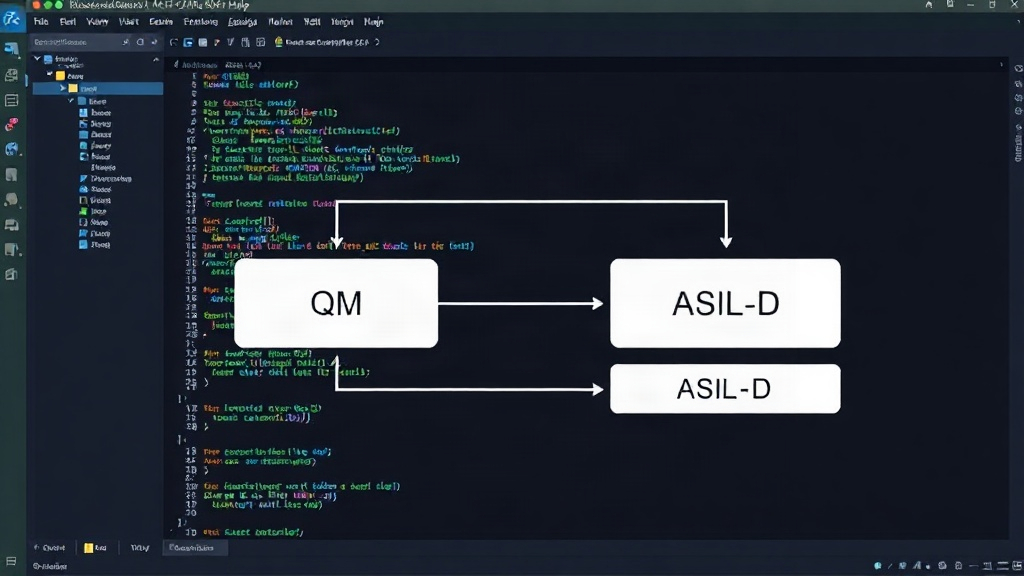
Integrated electronics engineers in the automotive sector face a persistent challenge: how to rigorously prove the absence of interference between software components operating at different safety integrity levels (SILs), specifically the non-critical QM (Quality Managed) and the safety-critical ASIL-D (Automotive Safety Integrity Level D) bands. This proof becomes particularly complex when these components share a common memory system, and especially when memory allocation is fixed, leaving no dynamic memory for common pitfalls like heap fragmentation or allocation failures.
Traditional explanations often remain theoretical, dwelling on AUTOSAR system architectures. However, in real-world application, a single bug in QM software – perhaps a buffer overflow or an unexpected halt writing to a shared memory buffer intended for ASIL-D critical data, like the torque vectoring packet – can cascade into a system-wide crash. This is not a theoretical risk; it’s a practical failure mode that can compromise vehicle safety. The core problem lies in ensuring that a failure in a lower-integrity component does not propagate to, or corrupt the operation of, a higher-integrity component. This is known as Freedom From Interference (FFI).
A Zero-Heap Approach to FFI Verification
The solution presented here tackles FFI head-on by adopting a zero-heap memory architecture for the real-time operating system (RTOS). This approach, tested on the electric platform v2.4 (ECM: HV-CTRL-01) using Hardware-in-the-Loop (HIL) simulation and validated with telemetry data from real instruments, fundamentally alters the risk landscape. By eliminating dynamic memory allocation (the heap), the RTOS removes an entire class of potential interference vectors.
In a zero-heap system, all memory is statically allocated at compile time. This means there is no memory pool from which the system can request or release blocks during runtime. This design choice directly prevents common issues such as:
- Heap Fragmentation: Dynamic allocation and deallocation can lead to memory being split into small, unusable chunks, eventually causing allocation failures even when sufficient total memory exists.
- Memory Leaks: If allocated memory is not properly deallocated, it becomes permanently unavailable, leading to gradual memory exhaustion and potential system instability.
- Race Conditions in Allocation: Concurrent access to the heap by multiple tasks can lead to corruption if not properly synchronized, a complex bug to debug.
- Denial-of-Service Attacks: Malicious or buggy QM software could intentionally exhaust the heap, starving ASIL-D components of necessary memory.
By enforcing a static memory model, the RTOS guarantees that memory regions assigned to ASIL-D functions will never be encroached upon by QM functions due to memory allocation failures. This creates a hard boundary, ensuring FFI at the memory management level.
Achieving Low CAN-FD Latency for ASIL-D Tasks
Beyond memory management, the RTOS design prioritizes deterministic and low-latency communication, a critical requirement for ASIL-D functions. The specific implementation targets CAN-FD (Controller Area Network Flexible Data-rate), a high-throughput communication protocol essential for modern vehicle control systems. The system reports a remarkably low latency of 8.7 microseconds (µs) for CAN-FD message transmission and reception within the ASIL-D band.
This low latency is achieved through several key architectural decisions:
- Optimized Interrupt Handling: The RTOS features highly efficient interrupt service routines (ISRs) for the CAN-FD controller. These ISRs are designed for minimal execution time, ensuring that the system can respond to incoming messages or prepare outgoing ones with minimal delay.
- Direct Memory Access (DMA): Leveraging DMA controllers allows data transfers between the CAN-FD controller and system memory to occur in parallel with CPU operations. This offloads the CPU, freeing it to perform other critical ASIL-D computations rather than managing data movement.
- Memory Protection Unit (MPU): The use of an MPU is crucial. It acts as a hardware gatekeeper, defining access permissions for different memory regions. In this zero-heap context, the MPU is configured to strictly enforce that ASIL-D tasks can only access their designated memory partitions, and QM tasks cannot access ASIL-D memory at all. This hardware-level enforcement is key to the FFI proof.
- Fixed-Priority Preemptive Scheduling: The RTOS employs a scheduling algorithm where ASIL-D tasks are assigned higher priorities than QM tasks. When an ASIL-D task becomes ready to run (e.g., upon receiving a CAN-FD message), it can preempt any lower-priority QM task that is currently executing. This ensures that critical operations are not delayed by non-critical ones.
The combination of a static memory model, optimized communication drivers, and hardware-enforced memory protection allows the RTOS to provide the deterministic performance required for ASIL-D functions while simultaneously proving the absence of interference from QM code. The 8.7µs latency figure is not just a benchmark; it represents the system's ability to react rapidly to safety-critical events communicated over CAN-FD.
HIL Simulation and Real-World Validation
The practical validation of this approach was conducted using a Hardware-in-the-Loop (HIL) simulation environment. HIL testing is vital in automotive development as it allows engineers to test embedded systems in a controlled environment that mimics the real vehicle's sensors, actuators, and communication buses. This setup included the electric platform v2.4 (ECM: HV-CTRL-01), simulating its operational context.
Telemetry data was collected using real instruments, providing empirical evidence of the system's behavior under simulated driving conditions. The data captured included the safety band (ASIL-D operations) and the isolated band (QM operations), visually demonstrating their separation. Screenshots of this telemetry data, reportedly showing performance on a simulated