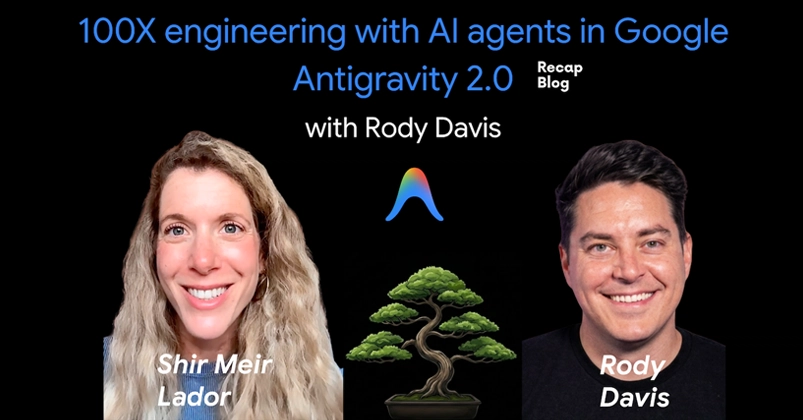
Antigravity 2.0: The Agent-First Platform Evolution
Google's Antigravity initiative has matured significantly, evolving from a specialized agentic IDE into a comprehensive agent-first platform. The latest iteration, Antigravity 2.0, unbundles its capabilities into four core pillars: a standalone desktop Agent Manager for orchestrating complex workflows, a robust CLI designed for server-side operations and automation, an SDK enabling custom Python-based agent development, and a dedicated IDE for focused development tasks. This modular approach signifies a fundamental shift in how developers will interact with AI, moving away from traditional Integrated Development Environments (IDEs) towards environments where AI agents are the primary interface and orchestrator.
Rody Davis, a leading agentic engineer at Google, highlights this transition as a massive paradigm shift. The vision is to empower engineers to achieve '100X' productivity by leveraging AI agents to handle repetitive tasks, complex code generation, and even code reviews. This is not about replacing developers, but augmenting their capabilities to focus on higher-level problem-solving and innovation.
The Reality of Scaling AI Agents
While building a functional AI agent demo can now be achieved rapidly, often within a day with existing frameworks, the real challenge lies in scaling these agents for production environments. This sentiment is echoed across the AI development community. The initial excitement of a working agent is quickly tempered by the complexities of robust software engineering practices. Issues such as versioning, reliable deployment strategies, environment management across different stages, comprehensive monitoring, effective rollback mechanisms, and stringent access control become paramount.
The experience shared is that a successful pilot project often exposes these scaling deficiencies. Without a plan for what comes after the initial success, teams find themselves scrambling to implement essential infrastructure. This suggests that the focus needs to shift from merely agent creation to agent *engineering*—applying disciplined software development principles to AI agent systems.
Code Reviews in an AI-Driven World
The prospect of AI agents participating in code reviews presents both opportunities and challenges. If agents can achieve 100X productivity, their ability to assist in or even conduct code reviews could dramatically accelerate development cycles. However, this raises significant questions about quality assurance and the nature of code ownership. How do we ensure that AI-generated code meets quality standards? What is the role of human oversight when an agent performs a review? The current paradigm of human-centric code reviews must adapt.
Davis suggests that agents can be equipped with specific 'skills' to perform these tasks. These skills are essentially specialized functions or capabilities that an agent can call upon. For code reviews, these skills might include static analysis, adherence to style guides, identification of common bugs, and even performance optimization suggestions. The goal is to augment human reviewers, flagging potential issues and allowing human engineers to focus on architectural soundness, logic, and business requirements.
Leveraging 'Skills' for 100X Performance
The concept of 'skills' is central to unlocking the 100X potential of AI agents within platforms like Antigravity 2.0. These are not just abstract capabilities but concrete, callable functions that agents can utilize to perform specific tasks. Think of them as a highly specialized toolkit for the AI agent. For instance, an agent tasked with developing a new feature might use a 'code generation' skill, a 'testing' skill, a 'documentation' skill, and a 'code review' skill.
The development of these skills is crucial. The Antigravity 2.0 SDK, built on Python, allows developers to create and integrate their own custom skills, effectively extending the agent's capabilities. This creates an ecosystem where agents can be tailored to specific domains or project needs. The ability to orchestrate these skills through the Agent Manager or CLI allows for the creation of complex, multi-step automated workflows that were previously impossible or prohibitively time-consuming for human teams.
The Unbundling of the Agent-First Platform
Antigravity 2.0's unbundled architecture is a strategic move. By separating the Agent Manager, CLI, SDK, and IDE, Google provides flexibility. Developers can choose the components that best suit their workflow. A backend engineer might rely heavily on the CLI for automated deployments, while a data scientist could use the SDK to build custom agents for data analysis pipelines. The Agent Manager acts as the central nervous system, coordinating these disparate components and enabling complex agentic workflows.
This modularity is key to addressing the scaling challenges. It allows for independent development and deployment of agent capabilities. It also provides clear points for integration and monitoring. The platform aims to provide the necessary infrastructure to move beyond the 'demo in a day' phase and into sustained, scalable AI agent operations. The question for many in the field remains: what specific infrastructure investments are most critical to make *before* the first pilot project succeeds?
Looking Ahead: The Future of Agentic Engineering
The shift to an agent-first paradigm, exemplified by Antigravity 2.0, signals a future where AI agents are integral to the software development lifecycle. The focus on skills and the unbundled platform architecture are designed to tackle the inherent complexities of scaling AI agents. While the promise of 100X engineering is enticing, the practical implementation requires a deep understanding of both AI capabilities and robust software engineering principles. The journey from a single agent demo to a production-ready, scalable system is where the true engineering challenge lies, and platforms like Antigravity 2.0 aim to provide the tools and framework to navigate it.