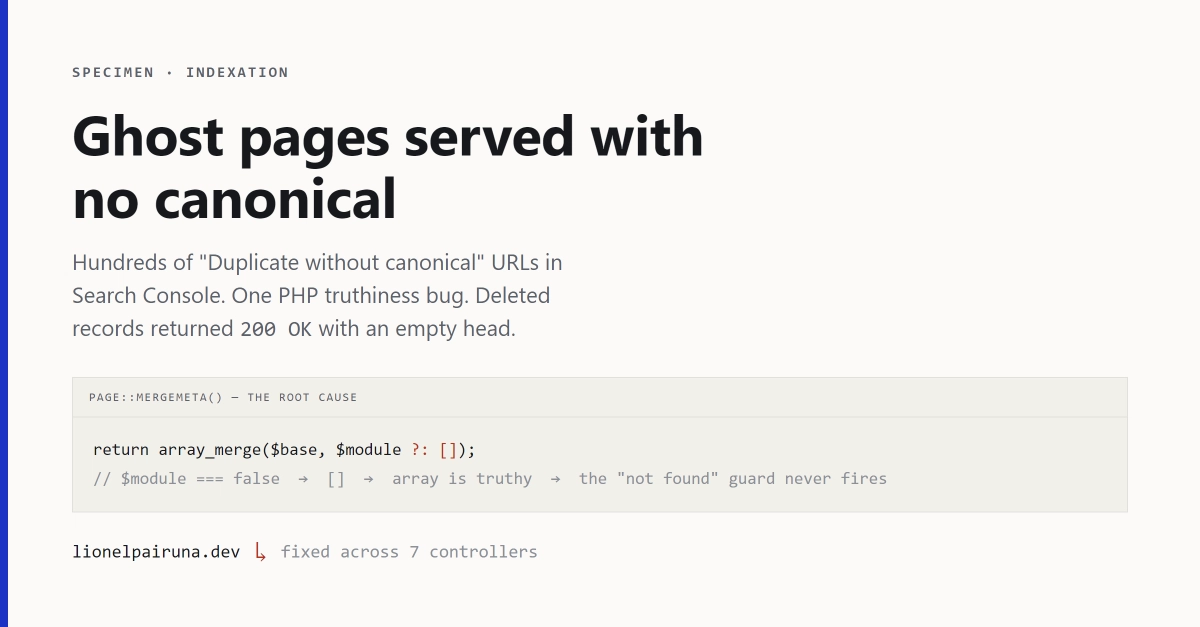
The Unseen Problem: Google's Indexing Deluge
Weeks after a routine release, the Google Search Console began to fill with alarming warnings. Not site errors, not broken links in the traditional sense, but a growing tide of problematic indexing: Duplicate without user-selected canonical (68 URLs), Crawled – currently not indexed (245), and Discovered – not indexed (62). This wasn't a site-wide outage; the website itself functioned perfectly. Yet, Google was relentlessly crawling and attempting to index a rapidly expanding set of URLs that should have been invisible. The only place this anomaly surfaced was within the coverage reports, a silent alarm for the unwary.
Reproduction: The Deleted Record Dilemma
The common thread among these problematic URLs was stark: they all pointed to database records that had been deleted or marked as inactive. A portfolio item switched off, a user profile removed, a product listing deactivated. These were not pages that should exist, let alone be indexed. Logically, any request for such a URL should have resulted in a redirect, typically a 302 Found, to a relevant listing page or a 404 Not Found. Instead, a critical failure in the application's routing logic meant these requests were being mishandled.
The investigation revealed that when a user accessed a URL corresponding to a deleted or inactive record, the backend application did not issue the expected redirect. Instead, it continued to serve content, albeit often incomplete or placeholder content, associated with that specific, now-invalid, database entry. This behavior was subtle enough to bypass standard error logging and health checks, yet it provided Googlebot with a valid-looking (to the crawler) URL that pointed to non-existent data.
The implications were significant. A site that appeared to be functioning normally was, from Google's perspective, serving a growing number of pages with stale or deleted information. This dilutes the perceived quality of the site and can negatively impact its overall search rankings. The core issue stemmed from a faulty conditional statement in the application's routing middleware. The intended logic was to check for the existence and active status of a database record before rendering a page. If the record was not found or was inactive, a redirect should have been triggered. However, the code was structured such that the redirect condition was effectively never met for these specific cases.

The Root Cause: A Flawed Conditional
The debugging process pinpointed the exact line of code responsible. The application was intended to check if a meta-tag object, associated with the requested resource, existed and was active. The condition was written as if (!$meta_tags). The intention was to redirect if the $meta_tags variable was null or empty. However, due to a subtle oversight, the application logic that fetched or generated the $meta_tags object would sometimes return an empty, but not null, object (e.g., an empty array or an object with no properties) when a record was deleted or inactive. In PHP, an empty array or an object without properties evaluates to false in a boolean context. Therefore, !$meta_tags would evaluate to true, triggering the intended redirect. The problem arose when the fetching mechanism returned a non-empty, but invalid, object that PHP still evaluated as true in this specific boolean check, bypassing the redirect and serving the stale content.
This is analogous to a bouncer at a club checking IDs. The rule is: if the ID is missing (null), don't let them in (redirect). But the bouncer was also letting in people with expired IDs because they still *had* an ID, even if it was invalid for entry. The code wasn't robust enough to differentiate between a truly absent ID and a technically present but unusable one. This oversight allowed Googlebot, which diligently follows links and attempts to index content, to discover and crawl these defunct pages. Without a proper 404 or 301/302 response, Googlebot assumed the content was legitimate and attempted to index it, leading to the flood of coverage errors.
The Googlebot Perspective
Googlebot operates by discovering URLs, fetching their content, and analyzing it for indexing. When it encounters a URL that returns a 200 OK status code, it assumes the page is valid and worthy of indexing. Even if the content on the page is sparse, nonsensical, or clearly indicates a deleted item, a 200 OK signals to the crawler that the page exists. The application's failure to return a proper HTTP status code (like 404 for not found, or a 301/302 redirect for moved/deleted content) was the critical flaw. Google's systems are designed to penalize or de-prioritize sites that consistently serve duplicate or low-quality content, or pages that lead to a poor user experience. By indexing URLs pointing to deleted records, the site was inadvertently signaling these issues to Google, leading to the coverage errors and potential ranking degradation.
The sheer volume of these URLs meant that Googlebot spent significant crawl budget on pages that provided no value and actively harmed the site's SEO. This is a classic example of how subtle backend logic errors can have significant downstream effects on external systems like search engine crawlers. The developer's realization that Google noticed the problem before they did highlights the importance of monitoring search console reports not just for explicit errors, but for patterns that indicate underlying content or routing issues.
Mitigation and Prevention
The fix involved refining the conditional logic to accurately detect deleted or inactive records. Instead of relying solely on the presence of the $meta_tags variable, the code was updated to perform a more thorough check. This included verifying the actual status of the associated database record and ensuring that the fetched meta-tag object was not just present but also contained valid, active data. The corrected logic now ensures that a 302 Found redirect is issued to a relevant listing page when a record is deleted or inactive, or a 404 Not Found is returned if no appropriate listing exists.
To prevent recurrence, several measures were implemented:
- Enhanced Unit Testing: New test cases were added specifically to cover scenarios involving deleted or inactive records, ensuring that the routing logic behaves as expected.
- Stricter HTTP Status Codes: The application was configured to consistently return appropriate HTTP status codes for all requests, particularly for content that no longer exists or is inaccessible.
- Proactive Monitoring: Regular review of Google Search Console coverage reports and other SEO analytics tools was integrated into the development workflow.
This incident serves as a potent reminder that even seemingly robust applications can harbor subtle bugs that have significant SEO implications. The key takeaway is that a 200 OK status code is a promise of valid content; failing to uphold that promise, even inadvertently, can lead to unexpected and detrimental consequences in search engine indexing.