A Hypothetical Declaration Drafted with AI
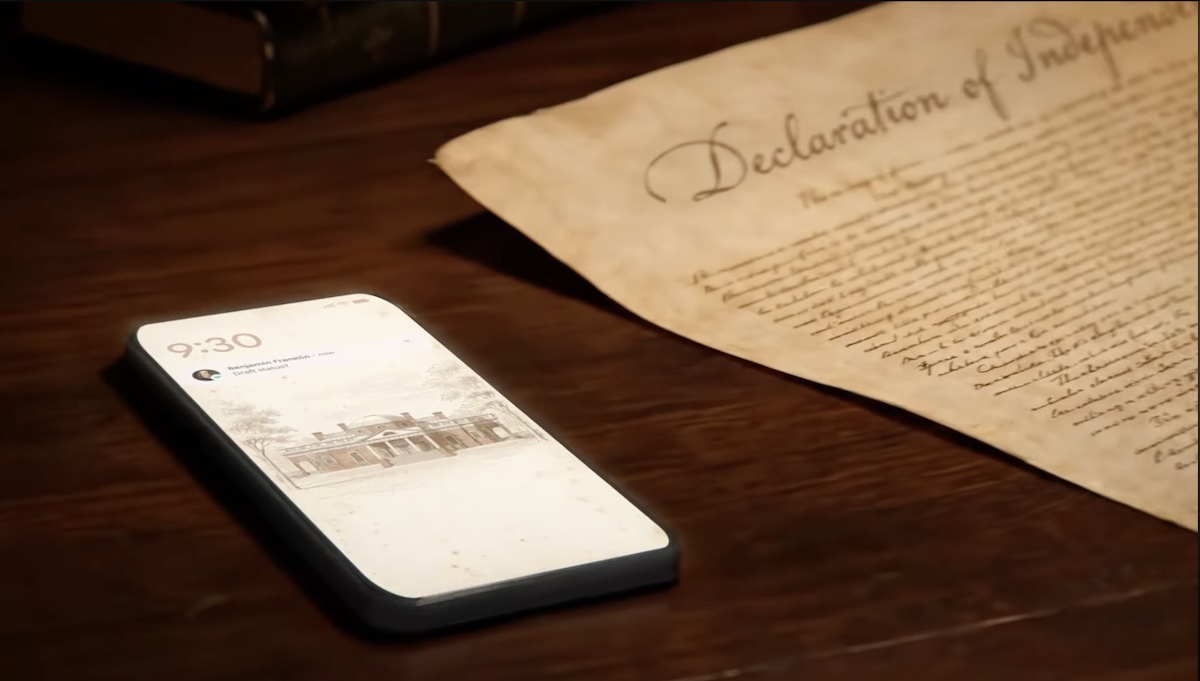
Google's latest commercial, released around the 250th anniversary of the signing of the Declaration of Independence, presents a thought-provoking scenario: What if the Founding Fathers had access to modern AI tools, specifically those found within Google Workspace? The ad envisions a world where Thomas Jefferson, Benjamin Franklin, and other key figures leverage AI to refine their arguments, research historical precedents, and craft the seminal document of American liberty.
The commercial opens with a familiar scene – quill pens scratching on parchment. However, the context quickly shifts. Instead of isolated contemplation, the Founding Fathers are depicted interacting with AI-powered interfaces, asking questions like, "What are the most compelling arguments for natural rights based on Enlightenment philosophers?" and "Summarize the key grievances against King George III, citing specific parliamentary acts." The AI, presented as an intelligent assistant, provides concise summaries, relevant data points, and even suggests alternative phrasings to strengthen their impassioned prose.
This imaginative take highlights Google's vision for how AI can augment human creativity and productivity. The ad doesn't suggest AI would write the Declaration on its own. Instead, it positions AI as a powerful collaborator – a tool that can accelerate research, enhance clarity, and help articulate complex ideas more effectively. The Founding Fathers are still the architects of the document, but AI acts as their sophisticated research assistant and editorial advisor.
AI as a Collaborative Tool for Critical Documents
The commercial cleverly sidesteps the potential pitfalls of AI-generated content by focusing on its supportive role. Imagine Jefferson, struggling with a particular turn of phrase to capture the essence of self-evident truths. An AI could offer variations, drawing from vast linguistic databases and historical texts, allowing Jefferson to select the most resonant option or be inspired to craft an even better one. Similarly, when enumerating grievances, AI could meticulously cross-reference historical records, ensuring accuracy and completeness, much like a modern-day researcher using advanced search algorithms.
This portrayal is more than just a marketing stunt; it's a commentary on the evolving nature of work and creation. In 1776, the tools were quills, ink, and libraries. Today, they are keyboards, cloud-based suites, and AI assistants. Google's message is clear: these advanced tools can help us tackle monumental tasks, whether drafting a nation's founding document or building the next generation of technology. The ad implicitly argues that AI, when used thoughtfully, can amplify human intellect and drive innovation, much like the intellectual fervor of the Enlightenment fueled the creation of a new republic.
The visual metaphor of the Founding Fathers using AI is particularly striking. It juxtaposes the historical weight of the Declaration with the cutting-edge nature of artificial intelligence. This contrast serves to demonstrate that AI is not a futuristic concept detached from our past but a tool that can be integrated into the very fabric of human endeavor, from historical moments of profound significance to the everyday tasks of professionals today.
Implications for Modern Workflows
The commercial implicitly asks users to consider how AI within Google Workspace could transform their own workflows. For developers, AI might assist in debugging code or generating documentation. For writers, it could help overcome writer's block or suggest stylistic improvements. For researchers, it could accelerate literature reviews and data analysis. The core idea is that AI doesn't replace human expertise but enhances it, freeing up cognitive resources for higher-level thinking, strategy, and creativity.
This vision is particularly relevant as AI becomes more integrated into productivity suites. Tools like Google's Duet AI aim to provide contextual assistance across various applications, from drafting emails to summarizing documents and generating presentations. The commercial serves as a high-level, albeit fictionalized, demonstration of this potential. It frames AI not as a threat to human ingenuity but as a powerful ally in the pursuit of ambitious goals.
The surprising detail here is not that Google is promoting its AI capabilities, but the choice of historical context. By linking AI assistance to the creation of the Declaration of Independence, Google elevates its tools beyond mere productivity enhancers. It positions them as instruments that can aid in the articulation of fundamental human values and the pursuit of liberty – a bold claim for a software suite.
What remains to be seen is how effectively these AI tools can truly replicate the nuanced, persuasive, and ethically grounded arguments that characterized the Declaration. While AI can process information and generate text, the spark of revolutionary conviction and the deep understanding of human rights that fueled the Founding Fathers remain uniquely human. The commercial offers a glimpse into a potential future of AI-assisted creation, but the human element at its core is irreplaceable.