The Limits of AI Agents
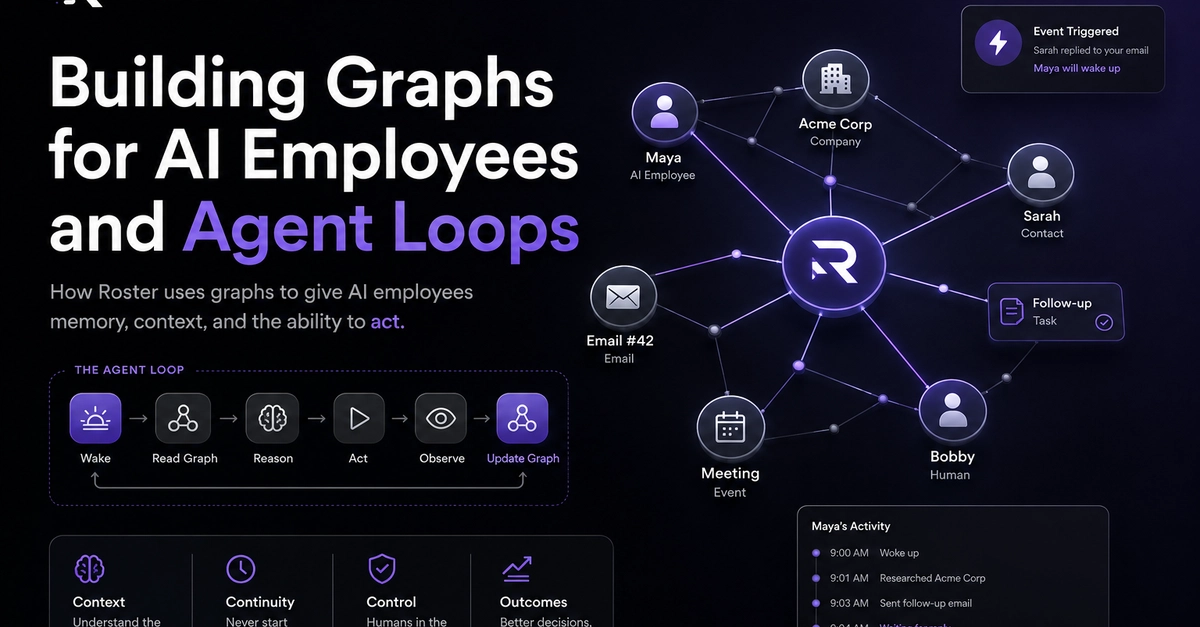
Traditional AI agents operate on a simple loop: Think → Act → Observe → Repeat. This model is effective for discrete, short-lived tasks. However, it falls short when the goal is to create an AI that functions more like a human employee – one that can manage complex, ongoing responsibilities that span hours, days, or even weeks. An agent executing a single tool call or answering a solitary query is fundamentally different from a system that can maintain context, track progress, and ensure follow-through.
The core limitation lies in state management and long-term memory. A simple agent forgets its past actions, the context surrounding them, and the implications for future steps. It lacks the persistent understanding of its operational environment that is crucial for any sophisticated work. This is where the concept of an AI employee, powered by knowledge graphs, emerges as a more robust paradigm.
Introducing the AI Employee: Memory, Ownership, and State
An AI employee requires a deeper level of cognitive capability. It must not only perform actions but also understand the ramifications of those actions and the overall workflow. This means the AI needs to remember:
- What tasks have been completed.
- Who is responsible for which parts of a project.
- What work is currently pending or blocked.
- What has changed in the environment or data since the last interaction.
- What the next logical steps should be.
- When it should resume activity or wake up for a specific event.
- When human oversight or approval is necessary.
This extended memory and contextual awareness transform an AI from a mere tool into a persistent entity capable of owning and managing work. It's the difference between a calculator that gives you an answer and an accountant who manages your finances over time.
The Power of Graph Engineering for AI Employees
Graph engineering is the key to unlocking this more sophisticated AI capability. Unlike linear databases or simple memory structures, knowledge graphs excel at representing complex relationships between entities. In the context of an AI employee, a knowledge graph can serve as the central nervous system, storing and organizing all the critical information needed for long-term operation.
Consider how events trigger human action: a new email, a calendar reminder, or an alert. A knowledge graph can act as this sophisticated event manager. When an event occurs, the graph can identify the relevant AI employee or component, provide it with the necessary context derived from its stored knowledge, and direct its subsequent actions. The graph holds the state of the work, who owns it, and its history, allowing the AI to pick up where it left off or to intelligently decide what needs to happen next.
This architecture is the foundation for systems like Roster, which aims to build AI that can truly 'own' work. Instead of just firing off a single tool call, Roster's approach allows AI to maintain an ongoing relationship with tasks and projects, much like a human employee would. The graph allows the AI to understand its operational environment dynamically, adapting to changes and making informed decisions based on a rich, interconnected web of information.
Distinguishing AI Employees from Agents
The fundamental distinction lies in persistence and context. An AI agent is stateless between actions; it's a series of isolated decisions. An AI employee, by contrast, is stateful. It maintains a continuous understanding of its tasks, the environment, and its own progress. This statefulness is enabled by the knowledge graph, which acts as a persistent memory and reasoning substrate.
For developers building AI applications, this means a shift in architectural thinking. Instead of focusing solely on prompt engineering for single turns, the emphasis moves towards designing data models and graph structures that can represent the long-term state of work. This involves defining entities like 'tasks,' 'projects,' 'owners,' 'dependencies,' 'deadlines,' and 'approvals,' and modeling the relationships between them.
The 'Observe' step in the agent loop becomes far more complex for an AI employee. It's not just about observing the immediate output of a tool; it's about observing changes in the broader system, the status of related tasks, or external events that might impact the ongoing work. The knowledge graph facilitates this by providing a structured way to ingest and interpret these diverse inputs.
Building the Future of AI Work Management
The development of AI employees powered by knowledge graphs represents a significant step forward in artificial intelligence applications. It moves beyond the realm of single-shot task execution towards AI that can manage complex, multi-stage processes, collaborate with humans effectively, and exhibit a form of operational continuity. This paradigm shift is crucial for building AI systems that can truly augment human capabilities in the workplace, handling responsibilities that require memory, context, and sustained effort.
For teams looking to integrate AI more deeply into their workflows, the question is no longer just about what tools AI can use, but about what responsibilities AI can truly own. The answer, increasingly, lies in architectures that provide persistent memory and relational understanding – precisely what knowledge graphs offer.