The AI Imperative for Marketing Teams
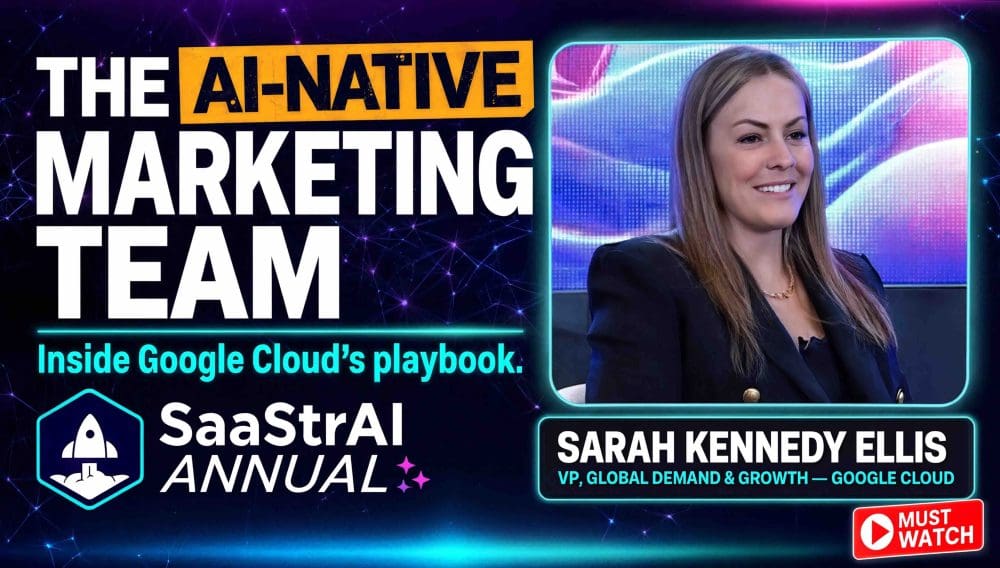
The marketing landscape is undergoing a seismic shift, driven by the relentless advance of artificial intelligence. Sarah Kennedy Ellis, Google Cloud ’s VP of Global Demand & Growth, articulated this transformation at SaaStr AI 2026. Having navigated significant platform shifts in her previous roles at Marketo and Adobe, Ellis brings a unique perspective on how marketing teams must evolve to remain effective. Her core thesis is that AI is not merely an incremental tool; it necessitates a fundamental reimagining of marketing operations, strategy, and team structure. This isn't about adding AI to existing workflows; it's about building workflows *around* AI.
Ellis's experience is invaluable. She managed marketing at Marketo before its $4.75 billion acquisition by Adobe and subsequently led marketing for Adobe ’s enterprise software division. This dual perspective, from a successful MarTech vendor to a software giant, positions her to speak authoritatively on how companies of all sizes must adapt. The message from SaaStr AI 2026 is clear: the era of AI-native marketing is here, and teams that fail to embrace it will be left behind.
Eight Pillars of an AI-Native Marketing Team
Ellis distilled her insights into eight actionable takeaways for building and operating an AI-native marketing function. These are not isolated tactics but interconnected principles designed to foster agility, efficiency, and intelligence across the entire marketing funnel.
1. Embrace AI as a Co-Pilot, Not a Replacement
The most immediate concern for many marketers is job displacement. Ellis reframes this by emphasizing AI's role as a powerful co-pilot. AI can automate repetitive tasks, analyze vast datasets for insights, and personalize customer interactions at scale. This frees human marketers to focus on higher-level strategic thinking, creative ideation, and complex problem-solving. Think of it less like a robot taking over the factory floor, and more like an incredibly skilled assistant who handles all the data crunching and initial drafts, allowing the human expert to refine and strategize.
2. Foster a Culture of Experimentation and Learning
The AI landscape is evolving at breakneck speed. What works today might be obsolete tomorrow. Therefore, an AI-native marketing team must cultivate a culture that embraces rapid experimentation, continuous learning, and data-driven iteration. This means encouraging teams to test new AI tools, analyze their performance rigorously, and quickly adapt strategies based on what the data reveals. Failure is not a setback but a learning opportunity, essential for staying ahead.
3. Integrate AI Across the Entire Marketing Funnel
AI's impact should not be confined to a single department or task. Ellis stresses the importance of integrating AI across all stages of the customer journey, from initial awareness and lead generation to customer nurturing and retention. This includes using AI for predictive analytics in demand generation, personalizing content at scale, optimizing ad spend, and even automating customer support interactions. A holistic integration ensures a consistent and intelligent customer experience.
4. Develop AI Literacy and Skills Within the Team
Simply adopting AI tools is insufficient. Marketers need to understand how these tools work, their underlying principles, and their limitations. This requires investing in training and development to build AI literacy across the team. This doesn't mean every marketer needs to be a data scientist, but they should be comfortable interpreting AI outputs, understanding prompt engineering basics, and identifying opportunities to leverage AI more effectively in their daily tasks.
5. Prioritize Data Quality and Governance
AI models are only as good as the data they are trained on. Ellis highlights the critical need for robust data quality and governance practices. This involves ensuring data accuracy, consistency, and ethical sourcing. Clean, well-organized data is the bedrock upon which effective AI-driven marketing campaigns are built. Without it, AI tools can generate flawed insights and lead to misguided strategies.