The Central Question: Why Did the Agent Do That?
The most challenging incidents involving AI agents, whether in development or live production, often stem from a single, frustrating question: "Why did the agent do that?" This isn't just about what happened, but the underlying causation. Why did it choose a specific tool? Why did it decide to retry an operation? Why was a notification skipped, or why did it trust outdated information? Even when every API call appears successful, an action might still be blocked. Traditional logging, which typically records a sequence like agent started, model called, tool called, tool completed, response sent, provides a basic timeline. However, this linear view loses the critical context of decision-making. AI agents are sophisticated workflows involving routing, model inferences, tool executions, validation steps, memory retrieval, user approval checks, retry mechanisms, suppressions, and user feedback. Reconstructing this entire decision path in a production environment without turning telemetry into a repository of sensitive prompts is the core challenge.
Building an Execution Tree for Traceability
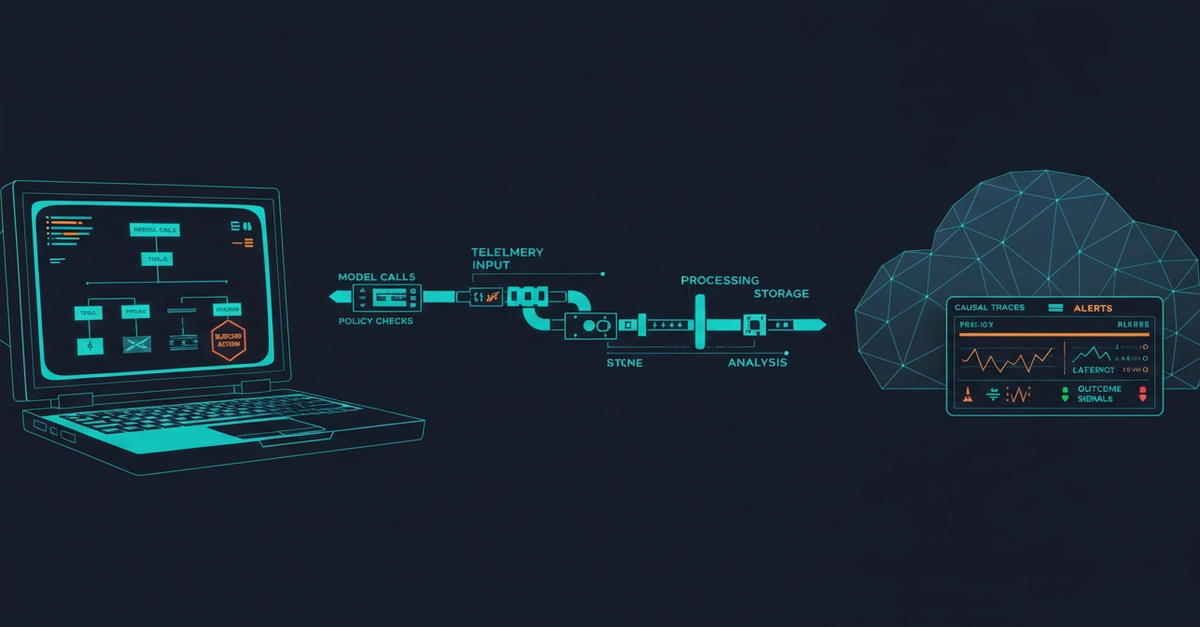
To address this, the fundamental approach is to visualize the agent's execution as a tree. This structure moves beyond a simple log of events to map the relationships between different stages of the agent's decision process. Each node in the tree represents a specific action or decision point, such as a model call, a tool invocation, or a validation step. The branches illustrate the flow of control and the dependencies between these nodes. This allows engineers to trace the agent's logic step-by-step, understanding not just what happened, but *why* it happened. For example, if an agent failed to call a tool, the execution tree would show which preceding decision or input led to that outcome, rather than just noting the absence of the tool call in a flat log.
The Role of Structured Telemetry
Effective observability for AI agents hinges on structured telemetry. Instead of relying on unstructured text logs, agents should emit data in a consistent, machine-readable format. This data should capture not only the event itself but also its context: the inputs, outputs, parameters, and any relevant metadata. For model calls, this includes the prompt, temperature settings, and the model's response. For tool calls, it means recording the tool name, arguments, and the result. This structured data forms the basis for reconstructing the execution tree. Think of it less like reading a diary and more like analyzing a meticulously organized spreadsheet where every entry has a purpose and a timestamp. This structured approach is vital for debugging complex, multi-step processes where a single error can cascade through the system.
Distinguishing Between Traces and Logs
It's crucial to differentiate between traditional logging and distributed tracing in the context of AI agents. Logs are typically sequential records of events, useful for understanding discrete occurrences. Tracing, on the other hand, captures the end-to-end journey of a request or operation as it moves through various components of the agent system. For an AI agent, a trace would encompass the entire lifecycle of a user query, from initial input parsing, through model invocations, tool executions, memory lookups, and final response generation. Each step in this journey becomes a 'span' in the trace, with parent-child relationships clearly defined. This allows for the visualization of the entire decision flow, highlighting latency at each stage and identifying the exact point where an error or unexpected behavior originated. This is akin to following a single detective through a crime scene, noting every clue they pick up and put down, rather than just having a list of all items found at the scene.
Key Data Points for Observability
To achieve robust production observability, several key data points must be captured for each agent interaction:
- Event Type: The nature of the action (e.g.,
MODEL_CALL,TOOL_EXECUTION,MEMORY_RETRIEVAL,VALIDATION_STEP). - Timestamps: Precise start and end times for each event to calculate duration and identify bottlenecks.
- Inputs and Outputs: What went into a specific step (e.g., prompt, tool arguments) and what came out (e.g., model response, tool result). Care must be taken to avoid logging sensitive PII or proprietary information.
- Causal Links: Explicit references to parent events, establishing the execution hierarchy. This is critical for reconstructing the decision tree.
- Status/Result: Whether the event succeeded, failed, was retried, or was suppressed.
- Metadata: Any additional context, such as agent version, tool version, or specific configuration parameters used.
This comprehensive data collection allows for the reconstruction of the agent's reasoning process, even in complex, asynchronous environments. Without these structured data points, diagnosing production issues becomes a manual, time-consuming process of sifting through disparate logs.
Challenges in Production Telemetry
Producing useful telemetry for AI agents in production is not without its challenges. The sheer volume of data generated by complex agents can be overwhelming, leading to high costs and performance overhead. Furthermore, balancing the need for detailed observability with the requirement to protect sensitive user data and proprietary model information is paramount. Prompts can contain PII, and tool outputs might reveal internal system details. Implementing effective redaction, anonymization, or selective logging strategies is therefore essential. The goal is to capture enough information to understand the agent's behavior without compromising privacy or security. This requires careful design of the telemetry pipeline, ensuring that only relevant, non-sensitive data is retained and analyzed.
The Future of Agent Observability
As AI agents become more integral to business operations, robust observability will transition from a 'nice-to-have' to a fundamental requirement. The ability to reliably debug, monitor, and optimize these systems in real-time is critical for maintaining trust and performance. Future advancements will likely focus on more sophisticated anomaly detection, predictive alerting based on trace data, and automated root cause analysis. The development of standardized observability frameworks for AI agents will also accelerate, making it easier for developers to instrument their applications and gain deep insights into agent behavior. Ultimately, moving from local traces to production observability means treating AI agents not as black boxes, but as systems whose internal workings can be understood and managed effectively.