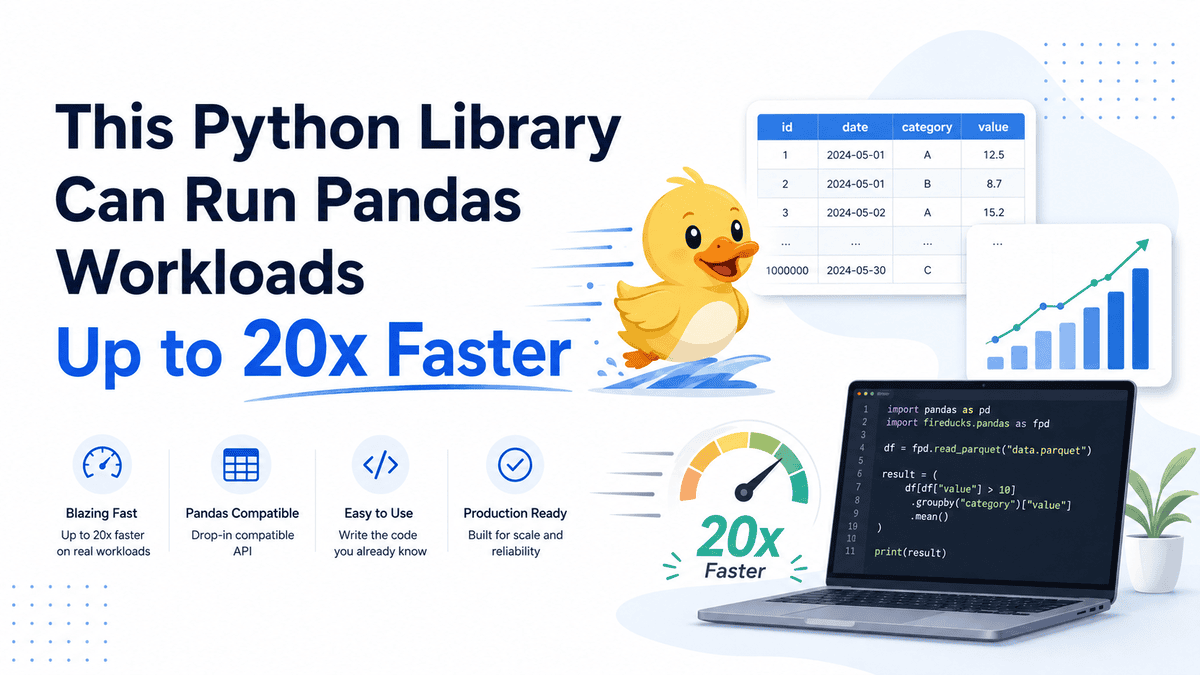
FireDucks: A New Paradigm for Pandas Performance
Data scientists and analysts often hit a performance ceiling when working with large datasets in Python. The ubiquitous Pandas library, while powerful and flexible, can become a bottleneck for computationally intensive tasks. Enter FireDucks, a novel Python library designed to tackle this challenge head-on. FireDucks promises to accelerate Pandas workloads by up to 20 times, a significant leap that could redefine workflows for many in the data science community. This performance boost is achieved through a combination of sophisticated techniques including lazy execution, compiler optimization, and multithreaded processing.
The core problem with traditional Pandas execution is its eager nature. When you perform an operation on a Pandas DataFrame, the computation happens immediately. For complex sequences of operations, this means intermediate results are constantly being computed, stored, and then used in the next step. This can lead to excessive memory usage and wasted CPU cycles, especially when the final result only requires a subset of these intermediate computations. FireDucks sidesteps this by employing lazy execution. Instead of running operations immediately, FireDucks builds a computation graph. Operations are only executed when the final result is explicitly requested, and crucially, only the necessary parts of the graph are computed. This is akin to planning a complex road trip before leaving the house, mapping out the most efficient route and only driving the segments needed to reach the destination, rather than driving every possible detour along the way.

Leveraging Compiler Optimization
Beyond lazy evaluation, FireDucks incorporates advanced compiler optimization techniques. Modern compilers can analyze code and transform it into a more efficient form, often at the machine code level. FireDucks integrates with Python's compilation pipeline to optimize the execution of DataFrame operations. This means that the operations, when finally executed, are not just running as standard Python code but as highly optimized instructions tailored for the specific hardware. This step is crucial for extracting maximum performance from the underlying CPU. It allows for techniques like loop unrolling, instruction-level parallelism, and efficient memory access patterns that are typically beyond the reach of standard Python interpreters.
The library's architecture is designed to be a drop-in replacement for many common Pandas operations. Developers can often switch from Pandas to FireDucks with minimal code changes, making the adoption process smoother. The goal is to allow users to benefit from the speed improvements without a steep learning curve or a complete rewrite of their existing data analysis pipelines. This approach recognizes the deep integration of Pandas into the Python data science ecosystem and aims to augment, rather than replace, its established utility.
Multithreaded Processing for Parallelism
Another key component of FireDucks' performance strategy is its adept use of multithreaded processing. Modern processors have multiple cores, and efficiently utilizing them is paramount for speed. FireDucks is engineered to distribute computations across these cores. When a complex workload is executed, the library can break down the task into smaller pieces and assign them to different threads. These threads can then work in parallel, significantly reducing the overall execution time. This is particularly effective for operations that are inherently parallelizable, such as applying a function to many rows or columns independently.
The benchmark results reported by KDnuggets highlight the effectiveness of this multi-pronged approach. The library demonstrated up to 20x faster performance on certain DataFrame operations compared to standard Pandas. While the exact speedup will vary depending on the specific workload, dataset size, and hardware, these figures indicate a substantial improvement that can have a tangible impact on productivity. For tasks that previously took hours, FireDucks might bring them down to minutes, enabling more iterative analysis and faster model development.
Implications for the Data Science Workflow
The implications of a library like FireDucks are far-reaching. For data scientists working with large datasets, this means faster experimentation. Instead of waiting for long-running queries or data transformations, they can iterate more rapidly, test more hypotheses, and arrive at conclusions sooner. This acceleration can also enable the use of larger datasets that were previously intractable due to performance limitations. For organizations, this translates to increased efficiency and potentially lower infrastructure costs, as data processing tasks can be completed more quickly.
The development of FireDucks also signals a broader trend in the Python data science landscape: the ongoing effort to push performance boundaries. Libraries like NumPy, Dask, and Polars have already made significant strides in this area. FireDucks appears to carve out its niche by focusing on optimizing Pandas workloads specifically, offering a path for existing Pandas users to gain performance without necessarily migrating to entirely new frameworks. The question remains how FireDucks will integrate with other performance-oriented libraries and what its long-term maintenance and community support will look like as it gains traction.