
The Distributed Landscape for High-Volume E-commerce
Scaling an e-commerce platform beyond 10,000 orders per day, especially with multiple SKUs and dynamic warehouse management, exposes the limitations of naive architectures. Simple hardware scaling hits a wall when faced with the complexities of distributed transactions, race conditions, and the need for eventual consistency. This isn't just about handling more traffic; it's about fundamentally re-architecting the system to manage inherent distributed system challenges.
The transition from a monolithic e-commerce system to a distributed ecosystem of 21+ microservices demands a rigorous approach. Without clearly defined bounded contexts, microservices can easily devolve into a performance bottleneck – a "distributed monolith" that offers the complexity of distributed systems without their benefits. This deep dive explores the practical application of Domain-Driven Design (DDD) and Golang to build a robust, scalable e-commerce backend.
The core challenge lies in decomposing the business domain into independent, cohesive services. Each service must own its data and logic, communicating with others through well-defined APIs. This decomposition is the bedrock of DDD, ensuring that the software design mirrors the business domain accurately. For a high-volume e-commerce platform, this means services for product catalog, inventory management, order processing, customer accounts, payments, shipping, and more, each operating with a degree of autonomy.
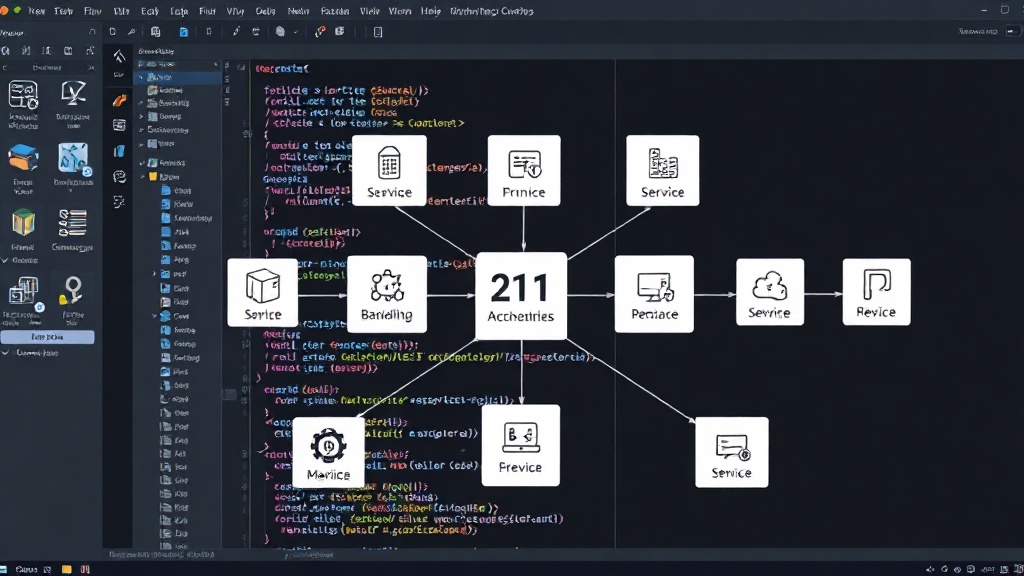
Golang and Kratos: The Technical Foundation
Golang emerges as a strong candidate for building such a distributed system due to its built-in concurrency primitives, efficient compilation, and strong standard library support for networking. Its performance characteristics are well-suited for high-throughput, low-latency microservices. The article specifically mentions the use of the Kratos architecture, a Golang framework that likely provides a structured way to build these services, potentially offering features for service discovery, inter-service communication, and configuration management.
Kratos, in this context, is not just a library but an architectural pattern. It guides the development of individual services, ensuring consistency across the 21-service ecosystem. Think of Kratos as the blueprint and toolkit for each of the 21 builders, ensuring they all speak the same foundational language and follow similar construction principles, even though their specific functions differ vastly. This standardization is crucial for managing a large microservice deployment effectively. It simplifies onboarding new developers, debugging, and maintaining the overall system health.
Implementing Distributed Transactions with Saga Patterns
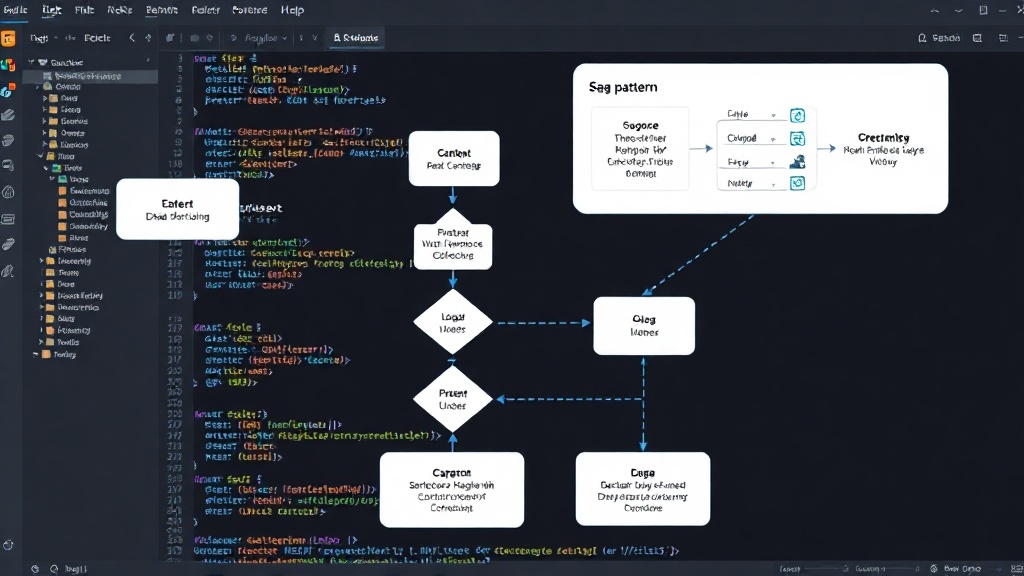
One of the most significant hurdles in distributed systems is managing transactions that span multiple services. Traditional ACID transactions are often impractical or impossible in a microservices environment. The Saga pattern offers a viable alternative for ensuring data consistency across services. It sequences local transactions within each service, and if a local transaction fails, it executes compensating transactions to undo the preceding operations.
For an e-commerce checkout process, this is critical. A typical checkout involves multiple steps: creating an order, processing payment, updating inventory, and initiating shipping. If payment fails after inventory is deducted, the Saga pattern ensures that the inventory deduction is reversed. This orchestration can be managed in two primary ways: choreography, where each service publishes events that trigger subsequent services, or orchestration, where a central orchestrator service manages the entire workflow. The article hints at an orchestration approach for distributed checkout, providing a more centralized control point for complex workflows.
Consider the checkout flow: a customer places an order. Service A (Order Service) creates the order. Service B (Payment Service) attempts to charge the customer. If successful, Service C (Inventory Service) deducts stock. If Service B fails, Service A must be notified to cancel the order, and Service C must not proceed. If Service C fails after Service B succeeds, a compensating transaction must be triggered to refund the customer via Service B. This chain of events, with built-in rollbacks, is the essence of the Saga pattern in action.
Handling Race Conditions Under Load
High-volume e-commerce platforms are prime targets for race conditions. These occur when two or more operations access shared resources concurrently, and the outcome depends on the unpredictable timing of their execution. A classic example is inventory management: two customers attempting to purchase the last item in stock simultaneously. Without proper synchronization, both might see the item as available, leading to overselling.
Mitigating race conditions in a distributed system requires careful design. Techniques include using optimistic locking, pessimistic locking, or leveraging the inherent properties of the chosen architecture and programming language. For Golang services, mutexes and atomic operations can manage concurrency within a single service instance. However, in a distributed context, solutions often involve distributed locks, versioning of resources, or designing services to be idempotent and using mechanisms like message queues with careful consumer management. Eventual consistency, while challenging, often becomes a necessary trade-off, where the system eventually reaches a consistent state rather than enforcing immediate transactional integrity across all services.
The article's focus on severe load implies that simple locking mechanisms might not suffice. Advanced strategies, potentially involving distributed consensus protocols or carefully designed event sourcing mechanisms, might be employed to ensure that critical operations like inventory updates are handled reliably even under extreme concurrency. The surprising detail here is not the complexity of the architecture itself, but the explicit acknowledgement of severe load as a primary driver for adopting such intricate patterns, suggesting that standard microservice patterns alone were insufficient.
The Broader E-commerce Context: Custom vs. Off-the-Shelf
While this article dives deep into building a custom, highly distributed e-commerce backend, it's essential to frame this within the larger industry landscape. For many businesses, particularly smaller ones or those just starting, platforms like Shopify offer a compelling alternative. Shopify provides a battle-tested, feature-rich platform that handles payments, tax, shipping, and checkout optimization out-of-the-box.
Shopify's strength lies in its mature ecosystem and continuous optimization by a large team. Features like Shop Pay, numerous payment methods, address validation, and abandoned-cart recovery are difficult and expensive to replicate. Choosing between a custom build and an off-the-shelf solution like Shopify is a strategic decision. Premature engineering – building complex, distributed systems before they are truly needed – can be as costly as platform lock-in that stifles future growth. The decision hinges on whether a business's unique requirements and scale have truly outgrown the capabilities of platforms like Shopify, necessitating the significant investment in a custom, microservices-based architecture like the one described.
The architecture detailed here represents the upper echelon of e-commerce platform development, suitable for businesses that have demonstrably outgrown the capabilities of SaaS solutions and require fine-grained control over every aspect of their operation to handle extreme scale and complexity. It's a path paved with sophisticated patterns like DDD and Saga, powered by Golang, and executed with meticulous attention to distributed system nuances.