The Python Latency Problem
Four small services, each acting as a Model Context Protocol adapter for an AI agent, were experiencing crippling latency. These services, written in Python, handled tasks like image generation via Replicate, social posting to Nostr, Git-based research assistance, and web search using Tavily. They ran on Knative within a modest Kubernetes cluster. While functional, their performance was a consistent drag on the AI agent's capabilities.
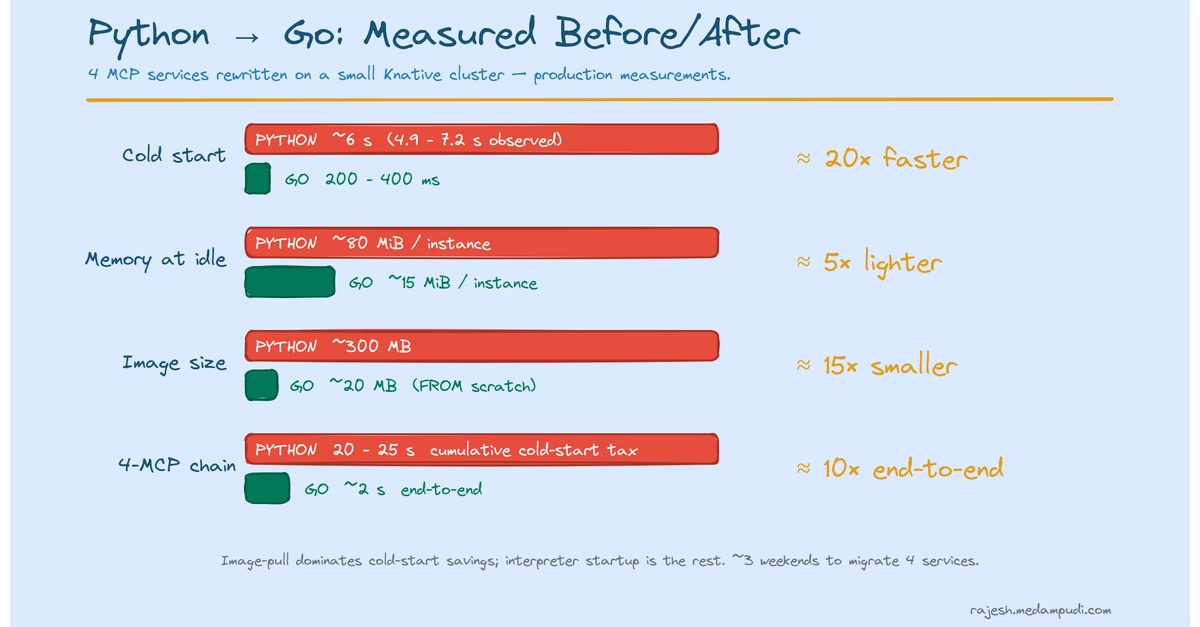
The core issue was a six-second cold start time. This delay, while seemingly short in some contexts, proved fatal for an AI agent relying on these tools. For the agent, there was no distinction between a cold start and inherent sluggishness; the tool was simply slow. Users, unaware of the underlying technical cause, perceived the agent as broken or unresponsive. On a bad day, these waits stretched even longer, making the AI agent practically unusable for real-time interaction.
The author found this six-second window to be particularly frustrating. It was long enough to be noticeable and detrimental to user experience, yet short enough that optimizing it felt like a worthwhile endeavor. The user's perception was key: the AI agent's effectiveness was directly tied to the perceived speed of its underlying tools. This consistent lag was not just an inconvenience; it was a fundamental barrier to the agent's utility.
The Go Solution: Performance and Simplicity
The decision to rewrite these services in Go was driven by a need for significantly improved performance, particularly around startup time and overall execution speed. Go's compiled nature and efficient concurrency model offered a compelling alternative to Python's interpreted execution and GIL limitations, especially in a microservices environment where rapid scaling and low latency are paramount.
The rewrite focused on maintaining the core functionality of each adapter while leveraging Go's strengths. This meant re-implementing the API clients and business logic in Go. The development process itself revealed further advantages. Go's strong typing and straightforward error handling simplified debugging and reduced the likelihood of runtime errors that could plague the Python versions. The compiled binaries were also significantly smaller and faster to deploy than Python environments, contributing to quicker rollouts and easier management.
The results were immediate and dramatic. Cold start times plummeted from six seconds to mere milliseconds. This near-elimination of latency meant the AI agent could access its tools almost instantaneously. The user experience transformed from one of frustration and perceived failure to one of seamless, responsive interaction. The agent felt faster, more capable, and less prone to errors, simply because its underlying components could now keep pace.
Cost and Considerations of the Rewrite
While the performance gains were substantial, the rewrite was not without its costs. The primary investment was developer time. Rewriting four services, even small ones, required significant effort. This involved understanding the existing Python code, designing the Go equivalents, implementing them, testing thoroughly, and deploying the new versions. The author estimates this took approximately two weeks of focused work.
Beyond the time investment, there were also considerations around the learning curve. While Go is known for its simplicity, adopting it for the first time involves learning its idioms, standard library, and best practices. For developers accustomed to Python's dynamic typing and extensive third-party ecosystem, the transition requires a shift in mindset. However, the author found Go's explicitness and strong tooling to be beneficial in the long run, leading to more maintainable code.
The choice of Go also meant a shift in dependency management and deployment. Instead of relying on Python's package managers and virtual environments, Go uses its own module system. The compiled binaries could be deployed as standalone executables, simplifying containerization and reducing the attack surface compared to running Python applications within an interpreter and its dependencies. This architectural simplification was an unexpected but welcome benefit.
The critical trade-off was developer time versus improved system performance and user experience. For these specific AI agent tools, where responsiveness was a direct measure of utility, the investment proved to be highly valuable. The author highlights that this decision would depend on the specific requirements of any given service; not all services benefit equally from a Go rewrite.
Broader Implications for AI Agents and Microservices
This case study underscores a critical aspect of building effective AI agents: the performance of their tool-use capabilities. An AI agent's intelligence is only as good as its ability to access and utilize external information and functions quickly. When tool calls are slow, the agent's decision-making process is hampered, leading to a degraded user experience and reduced effectiveness.
The choice of programming language and runtime environment for microservices that support AI agents is therefore paramount. While Python is often favored for its ease of use and rich libraries, its performance characteristics, particularly regarding cold starts in serverless or containerized environments, can be a significant bottleneck. Go, with its compiled nature, efficient concurrency, and fast startup times, emerges as a strong contender for these performance-sensitive components.
This rewrite also serves as a reminder that the decision to adopt a new technology should be driven by clear, measurable problems. The author did not rewrite services simply because Go was popular; they did it because Python's performance was actively harming the user experience. The success of the Go rewrite validates the approach of optimizing critical path components for speed, even if it requires a significant engineering effort.
What remains to be seen is how broadly this pattern will be adopted. As AI agents become more sophisticated and integrated into daily workflows, the demand for near-instantaneous tool execution will only grow. Developers building such systems will increasingly face the trade-offs between development speed and runtime performance, and languages like Go may become the default choice for the performance-critical edges of AI applications.