The Default Choice: AWS Savings Plans
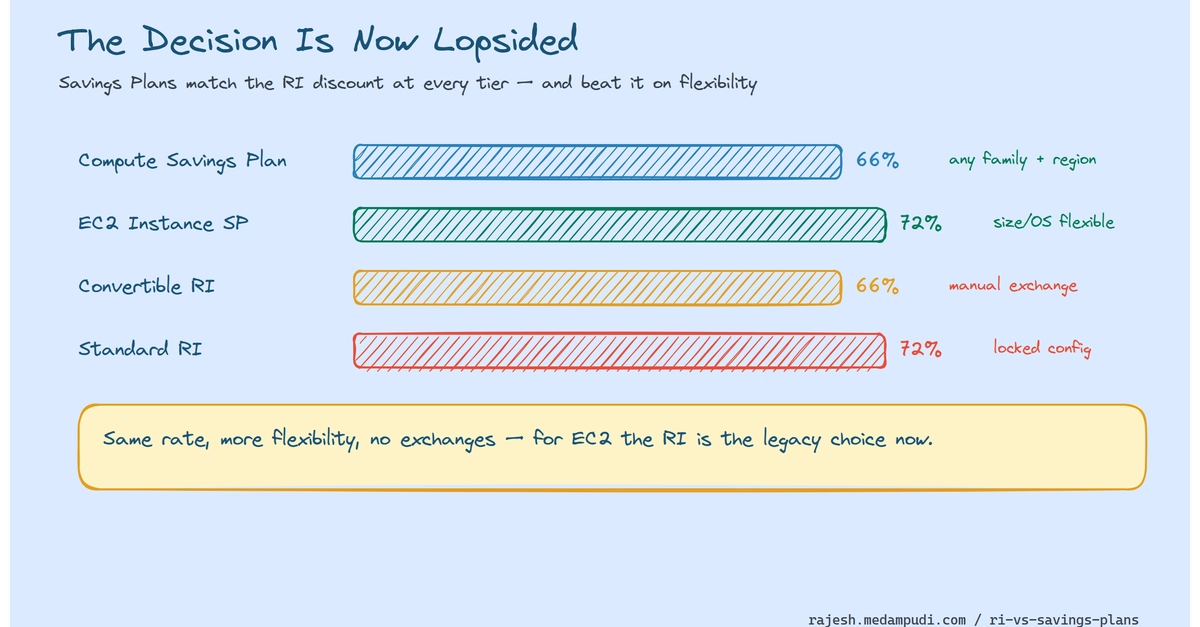
For the vast majority of AWS users, the decision between Savings Plans and Reserved Instances (RIs) is straightforward: choose Savings Plans. This recommendation stems from their superior flexibility and simplified management, making them a more practical option for dynamic cloud environments. Compute Savings Plans, in particular, offer the same discount levels as Convertible RIs but with significantly less administrative overhead. They automatically adapt to your workload, following instances across different instance families, regions, and even to serverless options like AWS Fargate and Lambda. This inherent adaptability is a critical advantage for teams whose resource needs fluctuate or evolve.
The primary benefit of Savings Plans lies in their ability to abstract away the complexities of instance type and region selection that plague RIs. While RIs tie you to specific instance families and geographic locations, Compute Savings Plans provide a commitment to a certain amount of spend per hour, which AWS then applies to eligible usage wherever it occurs. This means you don't need to predict future instance families or regional needs as precisely. The discount is applied automatically, reducing the manual effort required to optimize cloud spend.
The introduction of Database Savings Plans further narrows the scope for RIs. While specific database services like OpenSearch, Redshift, and certain RDS instances still require the older Reserved Instance model (until December 2025 for databases), the availability of dedicated Savings Plans for these workloads simplifies the cost optimization process for a significant portion of cloud spend.

When Reserved Instances Still Make Sense
Despite the broad applicability of Savings Plans, there are specific scenarios where Reserved Instances remain the superior choice. These exceptions are becoming increasingly rare, but understanding them is crucial for fine-tuning cost optimization strategies.
The most significant exception involves certain AWS services that have not yet transitioned to a Savings Plan model. As of now, this primarily includes services like Amazon OpenSearch Service and Amazon Redshift. For these specific services, purchasing RIs is the only way to secure discounted pricing. Additionally, many database services, including Amazon RDS, ElastiCache, and DynamoDB, will continue to rely on the RIs model until December 2025. After this date, dedicated Database Savings Plans are expected to cover these services, further diminishing the need for RIs.
Beyond service-specific limitations, RIs can also be advantageous for organizations with extremely stable and predictable workloads. If your infrastructure deployment is static, with no anticipated changes in instance families, regions, or compute platforms (e.g., moving from EC2 to Fargate), then a Standard Reserved Instance might offer a slightly deeper discount than a comparable Savings Plan. Standard RIs offer a commitment to a specific instance family in a specific region, providing the highest possible discount for that exact configuration. However, this rigidity comes at the cost of flexibility. If your workload shifts even slightly, you may not fully utilize the RI, negating the potential savings.
Convertible Reserved Instances offered a middle ground, allowing some flexibility to change instance families and operating systems. However, Compute Savings Plans now largely supersede Convertible RIs by offering broader flexibility across instance families, regions, Fargate, and Lambda, often with comparable or better discount structures and significantly less management overhead.
Understanding the Mechanics: Commitment vs. Instance
The fundamental difference between Savings Plans and Reserved Instances lies in how they represent your commitment to AWS. Reserved Instances are instance-specific commitments. When you purchase an RI, you are committing to a particular instance family (e.g., m5.large), operating system, tenancy, and region for a 1-year or 3-year term. Your discount is applied only when you run an instance that exactly matches these specifications. This requires meticulous planning and ongoing management to ensure you are maximizing the utilization of your RIs. Missing a match means paying on-demand rates for that instance, even if you have unused RI capacity.
Savings Plans, on the other hand, are commitment-based. You commit to spending a certain amount of money per hour on compute usage (e.g., $10/hour). AWS then applies this commitment to eligible usage across various services and regions. For Compute Savings Plans, this includes EC2 instances (regardless of family, OS, tenancy, or region), Fargate, and Lambda. This model is inherently more forgiving and adaptable. If your workload shifts from an m5.large in us-east-1 to a c6g.xlarge in eu-west-2, the Savings Plan commitment continues to apply, ensuring you receive the discount without manual intervention.
The billing mechanics are also distinct. With RIs, the discount is applied to matching instances. If you have an RI for an m5.large and run two m5.large instances, one will be covered by the RI discount, and the second will be at on-demand rates. With Savings Plans, the commitment is deducted from your total eligible hourly spend. If your commitment is $10/hour and your eligible usage totals $12/hour, the first $10 is covered by the Savings Plan, and only the remaining $2 is billed at the on-demand rate. This ensures that as your usage scales, your Savings Plan continues to provide value up to your committed amount.
The Management Overhead Factor
One of the most compelling reasons to favor Savings Plans is the drastic reduction in management overhead. Managing RIs effectively requires continuous monitoring and forecasting. Teams need to track their instance usage, predict future needs across different instance families and regions, and adjust their RI portfolio accordingly. This often involves complex spreadsheets or specialized third-party tools. The risk of over-provisioning RIs (buying more than you use) or under-provisioning (leaving potential discounts on the table) is significant and requires dedicated resources to mitigate.
Savings Plans automate much of this process. The Compute Savings Plan, in particular, acts like a universal discount applied across your compute footprint. AWS handles the allocation of the discount, meaning your team can focus on building and deploying applications rather than meticulously managing a portfolio of instance-specific commitments. This operational efficiency is invaluable, especially for fast-growing companies or those with rapidly evolving technology stacks. The time saved on RI management can be reinvested into innovation and core business functions.
When to Re-evaluate
While Savings Plans are the default, it's essential to periodically re-evaluate your cost optimization strategy. The AWS ecosystem is constantly evolving. New Savings Plan types may be introduced, and existing service support can change. For instance, the upcoming shift for databases from RIs to Database Savings Plans in December 2025 will require a review of existing database cost management strategies.
Furthermore, if your organization operates in a highly specialized niche with extremely predictable, long-term infrastructure needs that will not change for years, a deep dive into Standard RIs for specific services might still yield marginal additional savings. However, for most, the ease of use, automatic application of discounts, and broad coverage of Compute Savings Plans make them the clear winner. The decision boils down to balancing potential marginal gains in discount for extreme predictability against the significant benefits of flexibility and reduced management burden offered by Savings Plans.