
The Pain of Multi-Repo Releases
The chore of cutting releases across multiple independent repositories became a significant bottleneck. Imagine spending over an hour just to push out a single update for a set of Go microservices. This wasn't an abstract problem; it was a reality. The process involved manually tagging each service, waiting for Continuous Integration (CI) pipelines to complete, updating dependencies in other services' go.mod files to point to the new commit SHAs, pushing those changes, and then waiting for their CI to finish. This cycle was repeated for each service, often leading to forgotten dependency bumps and broken builds, sometimes discovered late at night.
This experience was the catalyst for change. The last manual release, fraught with errors and time sinks, marked the end of that approach.
Automating the Multi-Repo Workflow
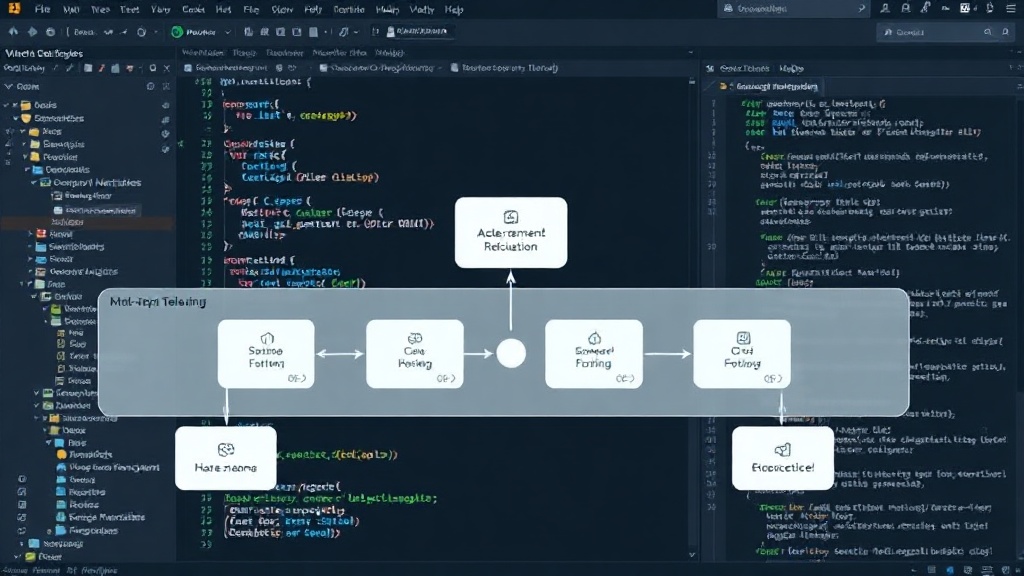
The first step was to automate the existing multi-repo release process. This involved orchestrating Jenkins, Python scripts, and GitLab. The goal was to remove the manual dependency management and CI triggering, creating a more robust and less error-prone system. Jenkins was configured to manage the overall release pipeline. Python scripts were developed to handle tasks such as:
- Detecting new commits in the target repositories.
- Incrementing version numbers (e.g., semantic versioning).
- Tagging new releases in GitLab.
- Updating
go.modfiles in dependent repositories to reference the newly tagged commits. - Triggering CI pipelines for each affected service.
This automation significantly reduced the cognitive load and the potential for human error. However, even with automation, the inherent complexities of managing dependencies across six distinct repositories remained a fundamental issue. The time spent coordinating these independent pipelines, even if automated, was still substantial.
The Monorepo Revelation
The realization dawned that the multi-repo architecture itself was the primary impediment to truly efficient releases. Managing inter-repository dependencies, even with tooling, introduces overhead. Each repository has its own lifecycle, its own CI/CD configuration, and its own dependency graph. When one service updates a shared library, every other service that depends on it must be updated, tested, and released. This creates a cascading effect that is difficult to manage at scale.
The solution proposed was to collapse these six microservices into a single Go monorepo. A monorepo consolidates multiple distinct projects, often related, into one version control repository. This approach offers several advantages, particularly for managing shared code and dependencies:
- Atomic Commits: Changes across multiple services that are interdependent can be committed and versioned together. This ensures consistency.
- Simplified Dependency Management: All dependencies are managed within a single
go.modfile (or a similar mechanism for other languages). Version conflicts are easier to detect and resolve. - Streamlined CI/CD: A single CI/CD pipeline can be configured to build, test, and deploy only the services that have changed, often leveraging tooling that understands the dependency graph.
- Code Sharing: Shared libraries and common code can be placed in a central location, easily accessible by all services within the monorepo.
The transition to a monorepo was not merely about consolidating code; it was a strategic move to simplify the entire release and development workflow.
Achieving 15x Speed Improvement
The impact of moving to a monorepo was dramatic. The time required to cut a release plummeted. Instead of an hour or more, releases could be performed in mere minutes. This represents a speed improvement of approximately 15x. The key to this acceleration lies in how the monorepo streamlines the release process:
- Intelligent CI: With a monorepo, CI systems can be configured to only run tests and build steps for the specific services that were modified. Tools like Bazel or custom scripts can analyze the commit diff and the dependency graph to determine the minimal set of actions required.
- Direct Dependency Updates: When a shared library within the monorepo is updated, the other services can immediately pick up the change without needing to commit and push a new version of the library and then update another repo. The change is effectively atomic within the monorepo's context.
- Reduced Coordination Overhead: The need to coordinate releases across separate repositories is eliminated. A single release command can trigger the necessary updates and deployments for all affected services simultaneously.
The entire setup, including the monorepo structure and the release automation tooling, is designed to run locally on a developer's laptop. This makes it accessible for others to fork, experiment with, and adopt. The focus is on empowering developers with efficient tools that don't rely on complex, external infrastructure for everyday tasks.
The Future of Microservice Releases
This transition from a complex multi-repo setup to a streamlined monorepo demonstrates a significant shift in how microservice releases can be managed. The success hinges on leveraging automation not just to speed up existing processes but to fundamentally rethink the architecture when it becomes a bottleneck. The ability to perform releases 15x faster frees up valuable developer time, allowing teams to focus on building features and improving the product rather than managing release logistics. It begs the question: how many other organizations are wrestling with similar multi-repo release pains, unaware that a strategic architectural shift could yield such dramatic improvements?