
Go's Core Strengths for AI Tooling
The landscape of software development is rapidly evolving, with Artificial Intelligence increasingly playing a role in assisting developers. From code generation to bug detection and automated testing, AI is becoming an indispensable partner. For developers building these sophisticated AI-assisted tools, the choice of programming language is critical. Google's Go language, often referred to as Golang, is emerging as a particularly strong contender, offering a unique blend of features that make it ideal for this specialized domain.
Go's design philosophy prioritizes simplicity, efficiency, and concurrency. These aren't just abstract ideals; they translate directly into tangible benefits when developing complex AI systems. The language's straightforward syntax reduces cognitive load, allowing developers to focus on the intricate logic of AI models and their integration into development workflows. This simplicity is crucial when dealing with the inherent complexity of AI, ensuring that the tooling itself doesn't become an insurmountable hurdle.
Furthermore, Go's exceptional performance is a significant advantage. AI workloads, especially those involving large models or real-time analysis, demand efficient execution. Go's compiled nature and efficient garbage collection contribute to low latency and high throughput, making it suitable for performance-sensitive applications. This is especially important for tools that need to provide rapid feedback to developers, such as AI-powered code completion or immediate error suggestions.
Concurrency is perhaps Go's most celebrated feature, and it's a game-changer for AI-assisted development. Modern development environments are inherently concurrent, with multiple processes running simultaneously – compilers, linters, testing frameworks, and now AI analysis tools. Go's built-in support for goroutines and channels simplifies the creation of highly concurrent applications. This means developers can build AI tools that seamlessly integrate into existing multi-threaded development environments without the typical complexities and pitfalls associated with traditional threading models. Imagine an AI code assistant that can analyze your code in the background without interrupting your typing, or a debugging tool that can monitor multiple threads concurrently. This is the power that Go's concurrency model unlocks.
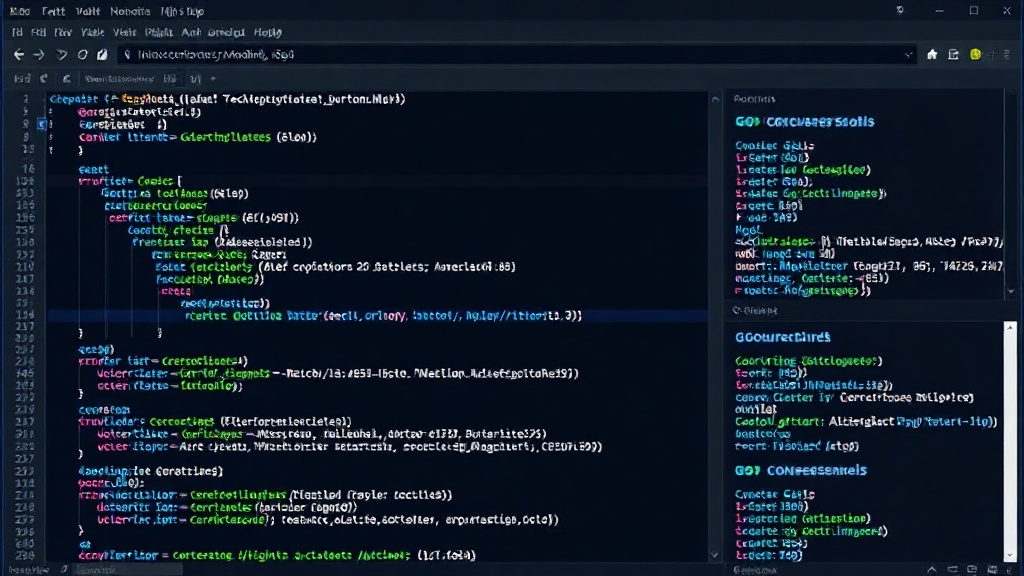
Building and Deploying AI Tools with Go
The ecosystem surrounding Go is also a key factor in its suitability for AI-assisted software engineering. While Go may not have the extensive AI-specific libraries found in Python, its strengths lie in its ability to build robust, scalable infrastructure and tooling. For AI-assisted development, this means Go is excellent for creating the backend services, APIs, and command-line interfaces that power AI features. Think of it less like a language for training massive neural networks and more like the ideal language for building the sophisticated machinery that delivers those trained models to developers efficiently and reliably.
The ease of deployment is another significant win for Go. Go compiles to a single static binary with no external dependencies, making it incredibly simple to distribute and run applications across different environments. This is invaluable for AI tools that need to be integrated into diverse developer setups, from local machines to cloud-based IDEs. Developers can simply download and run a Go binary, eliminating complex installation procedures or dependency conflicts that can plague other language ecosystems. This 'batteries-included' approach to deployment significantly lowers the barrier to entry for adopting AI-powered development tools.
Moreover, Go's strong standard library provides essential building blocks for network services, file manipulation, and data processing, which are common requirements for AI tooling. Developers can leverage these robust, well-tested components to quickly assemble the infrastructure needed to serve AI models, manage data pipelines, or orchestrate complex development tasks. This reduces the reliance on external libraries for fundamental functionalities, leading to more stable and maintainable applications.
The Future of AI and Go in Development
As AI continues to permeate software engineering, the demand for sophisticated, efficient, and easily deployable development tools will only grow. Go is well-positioned to be a foundational language for building this next generation of developer productivity tools. Its strengths in concurrency, performance, and deployment make it a natural fit for creating the intelligent agents and automated systems that will augment human developers.
The surprising detail here is not that Google is promoting its own language, but rather how Go’s pragmatic design choices, originally focused on improving Google's internal infrastructure, are proving to be so well-suited for the cutting edge of AI tooling. These are not features designed with AI in mind from day one, but rather fundamental language characteristics that happen to align perfectly with the demands of distributed systems, real-time processing, and efficient resource utilization – all core to modern AI applications.
What nobody has addressed yet is the potential long-term impact on developer education. As Go becomes more prevalent in building AI development tools, will we see a corresponding shift in how developers are trained to think about concurrency and distributed systems? The current focus in many curricula is on single-threaded execution and manual thread management. Go's model, while simpler, requires a different mental model, one that could significantly influence how future generations of engineers approach complex software design.
For developers looking to build or contribute to the AI-assisted software engineering ecosystem, learning Go is a strategic move. It equips them with the tools to create high-performance, concurrent, and easily deployable applications that can power the intelligent development environments of tomorrow. The simplicity of the language, coupled with its robust performance and concurrency features, makes it an unparalleled choice for this rapidly expanding field.