The Beginner's Dilemma: Why Two Seemingly Identical Structures?
Go beginners often encounter a common stumbling block: the distinction between arrays and slices. At first glance, they appear remarkably similar. Both store collections of values, use square brackets for syntax, and allow element access via an index. This superficial resemblance leads to a natural question: why does Go offer two data structures that seem to perform the same function? Many explanations state that arrays have a fixed size while slices are dynamic. While technically correct, this definition often fails to provide the crucial conceptual understanding needed to grasp the 'why' behind their existence.
The core of the confusion stems from a misunderstanding of how each type is represented in memory and how Go treats them. It's not just about size; it's about the underlying mechanism and the flexibility each offers.
Arrays: Fixed-Size, Value-Based Containers
An array in Go is a sequence of elements of a specific, unchanging type and length. When you declare an array, its size is part of its type. For example, [5]int is a different type from [10]int. This means an array of 5 integers cannot be assigned to a variable expecting an array of 10 integers, nor can it be passed to a function expecting an array of 10 integers. Arrays are value types. When you pass an array to a function or assign it to another variable, the entire array is copied. This can be inefficient for large arrays, as it involves duplicating all elements.
Consider this declaration: var numbers [3]int = [3]int{1, 2, 3}. Here, numbers is an array of 3 integers. Its length is fixed at 3. You cannot add a fourth element to it. If you need to store more than 3 integers, you must declare a new, larger array.
The memory for an array is allocated directly on the stack (for local variables) or within the struct it belongs to. There is no indirection. When you access an element, like numbers[0], the compiler knows exactly where in memory that element resides based on the array's base address and the element's offset.
Slices: Dynamic, Reference-Based Views
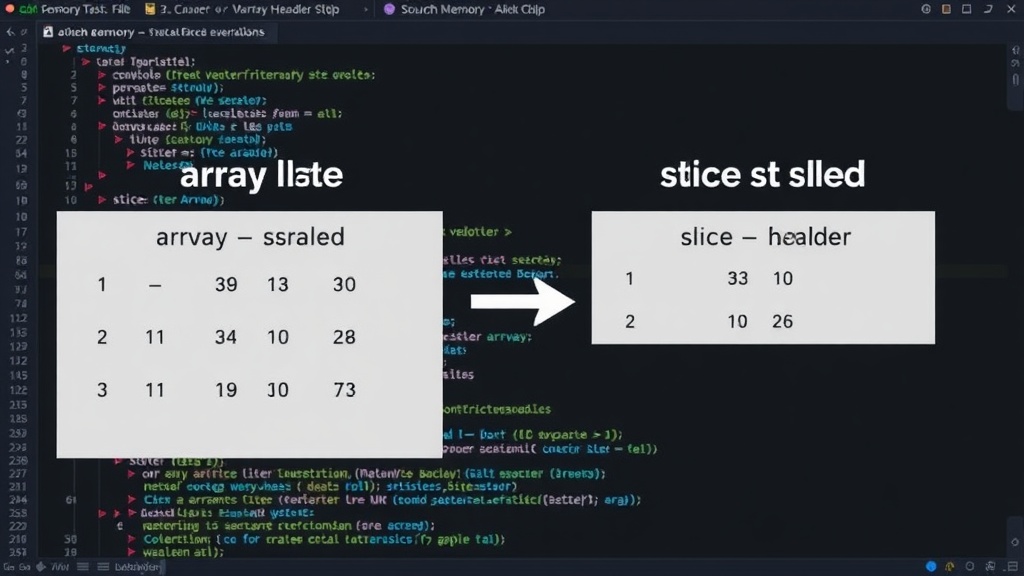
Slices, on the other hand, are far more flexible. A slice is not a data structure in itself but rather a lightweight descriptor (or header) that points to an underlying array. This descriptor contains three key pieces of information:
- A pointer to the first element of the underlying array that is accessible through the slice.
- The length of the slice (the number of elements currently in the slice).
- The capacity of the slice (the maximum number of elements the slice can hold without reallocation, starting from the pointer).
When you declare a slice, you are creating this descriptor, not the data itself. For example, var numbersSlice []int declares a nil slice. To create a slice with elements, you might use numbersSlice := []int{1, 2, 3}. This syntax creates an underlying array and a slice header pointing to it. The length and capacity are both 3.
The magic of slices lies in their ability to dynamically grow and shrink. You can append elements to a slice using the append() function. If the underlying array has enough capacity, append() simply increases the slice's length and returns a new slice header pointing to the same underlying array. However, if the underlying array is full, append() allocates a new, larger underlying array, copies the existing elements, adds the new element, and returns a slice header pointing to this new array. This is how slices achieve dynamism.
Crucially, slices are reference types. When you pass a slice to a function or assign it to another variable, only the slice header (the pointer, length, and capacity) is copied. The underlying array is not copied. This makes passing slices much more efficient than passing arrays, especially for large collections.
This reference-like behavior means that if you modify an element through one slice, other slices that share the same underlying array will see that change. For instance:
func modifySlice(s []int) {
    s[0] = 99
}

func main() {
    mySlice := []int{1, 2, 3}
    modifySlice(mySlice)
    fmt.Println(mySlice) // Output: [99 2 3]
}
This is a fundamental difference from arrays, where modifying a copy would not affect the original.
The "Why": Practical Implications and Use Cases
Understanding the underlying mechanics explains why Go has both. Arrays are useful when you need a fixed-size collection and want the compiler to enforce that size. They can sometimes offer performance benefits due to their predictable memory layout and stack allocation, though this is often negligible compared to the flexibility slices provide.
Slices are the workhorse of Go programming for handling collections. Their dynamic nature makes them ideal for situations where the number of elements is not known at compile time or can change during execution. This includes reading data from files, processing user input, managing lists of items, and virtually any scenario where you need a resizable collection.
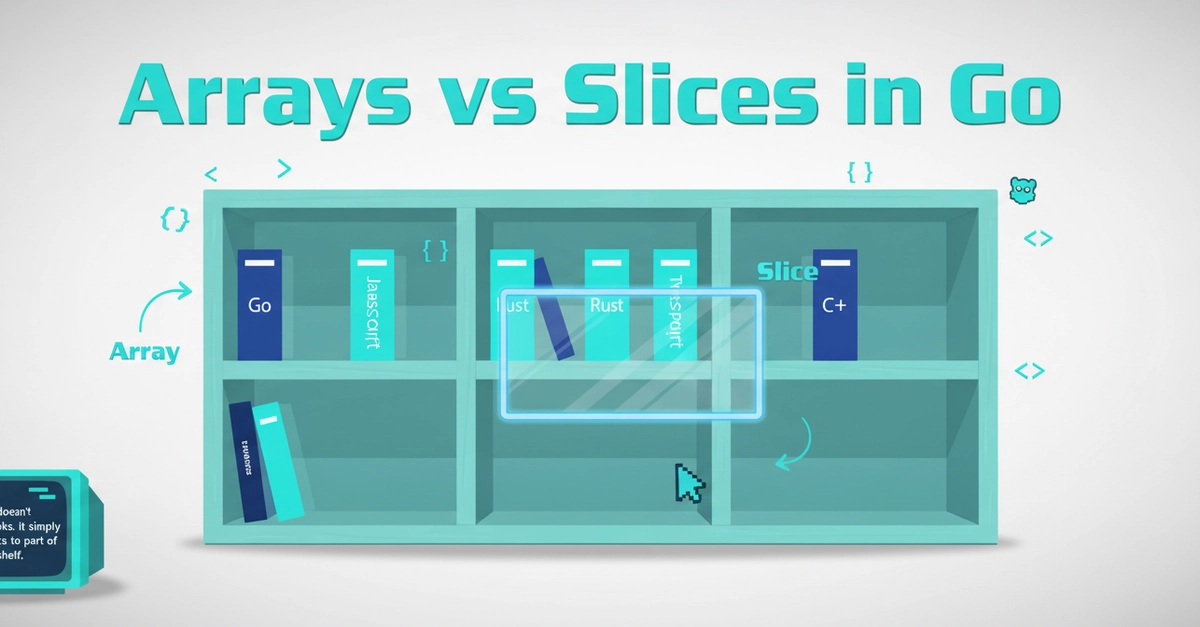
Think of an array like a pre-defined parking lot with a fixed number of spots. Once it's built, you can't add more spots. A slice, however, is like a parking attendant who knows where the available spots are in a larger, potentially expandable parking structure. They can tell you how many cars are currently parked (length) and how many more can fit before needing to build more levels (capacity).
The critical takeaway is that slices provide a view into an underlying array. You can create multiple slices that refer to the same underlying array, each with a different length and capacity, or even pointing to different segments of it. This capability is powerful for manipulating data efficiently without unnecessary copying.
When to Use Which?
Use Arrays when:
- You need a fixed-size collection and the size is known at compile time.
- You require the collection to be a value type, meaning you want copies to be independent.
- Performance is absolutely critical, and you've profiled that array's stack allocation is a benefit (rare).
Use Slices when:
- The size of the collection is dynamic or unknown at compile time.
- You need to efficiently pass collections to functions without copying the entire data.
- You want to leverage built-in functions like
append()for easy modification. - You are working with data that might need to grow or shrink.
In practice, slices are used far more frequently in Go development than arrays. They offer a balance of performance and flexibility that makes them suitable for most collection-handling tasks. While understanding arrays is important for grasping the foundations, becoming proficient with slices is key to writing idiomatic and efficient Go code.