
The Latency Imperative for Real-Time APIs
For applications like SpeakFlow, a real-time speech translation service, latency is not merely a performance metric; it defines the product's viability. A delay of 300 milliseconds in processing an audio chunk can transform a natural conversation into a disjointed experience. This critical constraint drove the design of a multi-cluster, multi-region Kubernetes setup spanning 10 Google Kubernetes Engine (GKE) regions across Google Cloud Platform (GCP). This article details the comprehensive architecture, the rationale behind each design choice, and the potential pitfalls that demand careful consideration.
The Problem: Why Multi-Region is Non-Negotiable
SpeakFlow operates on a tight loop for real-time audio processing: speech-to-text, translation, and text-to-speech. Each step must adhere to strict latency budgets. Routing a user in Tokyo to a cluster located in us-central1, for instance, introduces approximately 150 milliseconds of network latency before any computation even begins. This overhead is unacceptable for a seamless user experience.
The core challenge is to minimize the network round-trip time for audio processing. This requires co-locating compute resources as close as possible to the end-user. A single-region deployment would inevitably lead to high latency for a globally distributed user base. Conversely, a naive multi-region deployment often leads to significant operational complexity, particularly around managing Kubernetes manifests.
Architectural Decisions for Global Reach and Low Latency
To address these challenges, SpeakFlow adopted a multi-cluster, multi-region GKE architecture. The key principle is to deploy independent Kubernetes clusters in each target region, with each cluster serving users geographically proximate to it. This ensures that the initial network hop is minimized.
Global Load Balancing and Traffic Routing
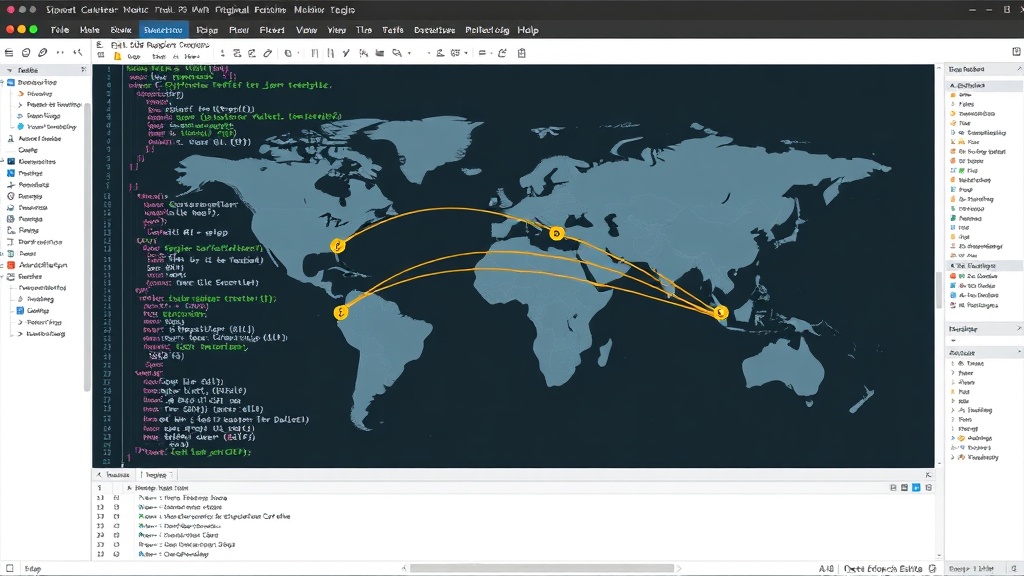
A global load balancing solution is essential to direct incoming user traffic to the nearest available regional cluster. Google Cloud's Global External HTTP(S) Load Balancing is a natural fit. It provides a single global IP address that distributes traffic across multiple regional backends (in this case, GKE clusters). Health checks are configured to ensure that traffic is only routed to healthy clusters and healthy pods within those clusters.
The challenge with this approach is ensuring that the load balancer points to the correct regional endpoint. While Global External HTTP(S) Load Balancing can target network endpoint groups (NEGs) that point to GKE services, managing these across many regions requires careful automation. Furthermore, for real-time applications, session affinity or sticky sessions are often undesirable, as they can lead to uneven load distribution. SpeakFlow relies on the load balancer's ability to distribute requests based on proximity and health, ensuring users hit the closest healthy instance.
State Management and Data Synchronization
Managing state across distributed clusters introduces complexity. For a real-time API, the state might include user sessions, real-time translation models, or cached data. Duplicating state across all 10 regions is often infeasible due to cost, consistency issues, and synchronization overhead.
SpeakFlow’s strategy involves centralizing certain types of state and distributing others. For instance, core user authentication and account data might reside in a central, highly available database (e.g., Cloud Spanner or a managed PostgreSQL instance with multi-region replication). However, rapidly changing or highly localized data might be cached within each region or even within the pods themselves.
The challenge lies in ensuring data consistency and availability. For elements that must be globally consistent, a database like Cloud Spanner, with its globally distributed, strongly consistent capabilities, is invaluable. For data that can tolerate eventual consistency or is specific to a region, regional databases or distributed caches (like Memorystore for Redis) can be employed. The key is to categorize data by its consistency requirements and tailor the storage solution accordingly.
The Manifest Duplication Problem and Its Solution
The most significant operational hurdle in multi-cluster Kubernetes deployments is manifest management. Deploying the same set of Kubernetes resources (Deployments, Services, ConfigMaps, etc.) to 10 different clusters typically means maintaining 10 identical sets of YAML files, or worse, a single large set that needs to be templated and applied with region-specific overrides. This leads to:
- Increased Error Surface: Small changes require updating multiple files, increasing the chance of human error and drift.
- Difficulties in Upgrades: Rolling out updates becomes a complex, error-prone orchestration task.
- Codebase Bloat: The repository managing manifests can become unwieldy.
SpeakFlow tackled this by adopting a declarative, GitOps-based approach combined with a powerful templating and overlay system. Instead of duplicating manifests, they maintain a single source of truth for the application's desired state.
Helm and Kustomize for Templating and Overlays
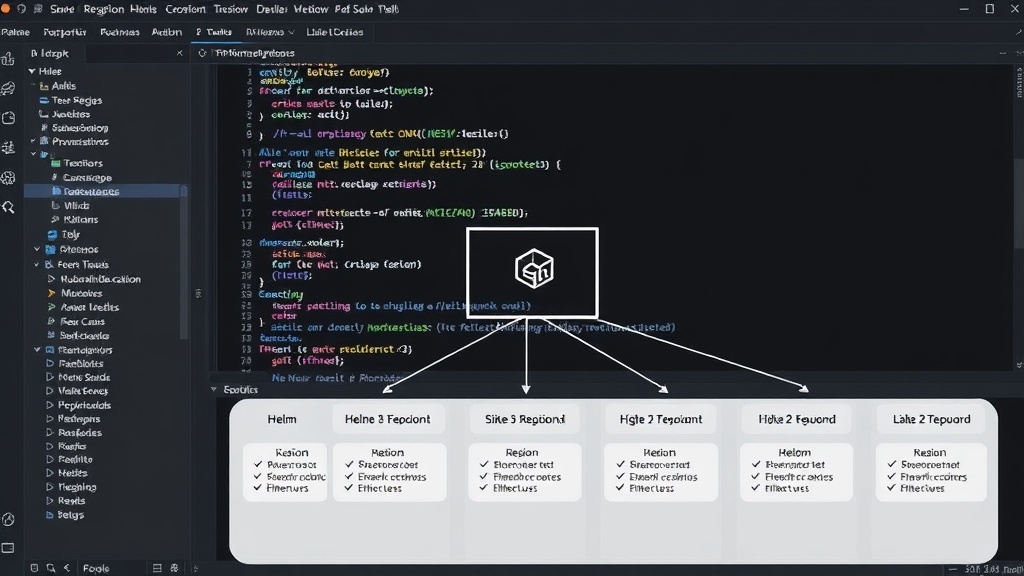
Helm charts and Kustomize are key tools for managing Kubernetes configurations efficiently across multiple environments. SpeakFlow uses Helm to define the base application structure (Deployments, Services, etc.). Each regional cluster then uses a Kustomize overlay. Kustomize allows you to take a base set of YAML and apply patches or modifications to customize it for a specific environment without duplicating the entire base configuration.
For example, a base Helm chart might define a Deployment. For each region, a Kustomize configuration would be applied that:
- Sets the `image` tag to the latest stable version.
- Adjusts resource requests/limits based on regional node pools.
- Configures environment-specific variables (e.g., database connection strings for regional replicas or caches).
- Sets the correct replica count for the region.
This approach means that the core application definition remains in one place. Region-specific tuning is handled by small, targeted Kustomize patches. The entire configuration for all 10 regions is managed within a single repository, drastically reducing the operational burden.
GitOps for Continuous Deployment
To automate the deployment of these configurations to each GKE cluster, SpeakFlow leverages a GitOps workflow. Tools like Argo CD or Flux CD are used. The Git repository containing the Helm charts and Kustomize configurations serves as the single source of truth. The GitOps agent running within each GKE cluster continuously monitors the repository. When changes are detected, the agent automatically applies the updated manifests to its respective cluster.
This ensures that all clusters are in a desired state defined in Git. If a cluster drifts, the GitOps tool will automatically reconcile it. This automated, declarative approach is crucial for maintaining consistency and reliability across a large, distributed Kubernetes footprint.
Operational Gotchas and Best Practices
Deploying and managing a multi-region GKE setup is not without its challenges. Several operational gotchas can trip up even experienced teams:
- Network Policies: Ensure fine-grained network policies are in place within each cluster to control traffic flow between pods and services, adhering to the principle of least privilege.
- Monitoring and Alerting: Comprehensive monitoring across all regions is critical. Centralized logging (e.g., Cloud Logging) and metrics aggregation (e.g., Cloud Monitoring) are necessary to get a unified view of application health and performance. Alerts should be configured for latency spikes, error rates, and resource utilization in each region.
- CI/CD Pipeline Complexity: The CI/CD pipeline must be robust enough to build container images, push them to a regional registry (or a global one like Artifact Registry), and then trigger GitOps deployments across all target clusters.
- Cost Management: Running 10 GKE clusters incurs significant costs. Careful resource management, auto-scaling configurations, and rightsizing of nodes and pods are essential.
- Disaster Recovery and Failover: While multi-region inherently improves availability, a well-defined disaster recovery plan is still needed. This includes strategies for handling regional outages and ensuring data integrity during failover events.
The decision to use a multi-cluster, multi-region architecture on GKE, combined with Helm and Kustomize for manifest management and GitOps for deployment automation, provides a scalable and maintainable solution for real-time APIs with global user bases. It transforms the operational complexity of managing many clusters into a manageable, declarative process.