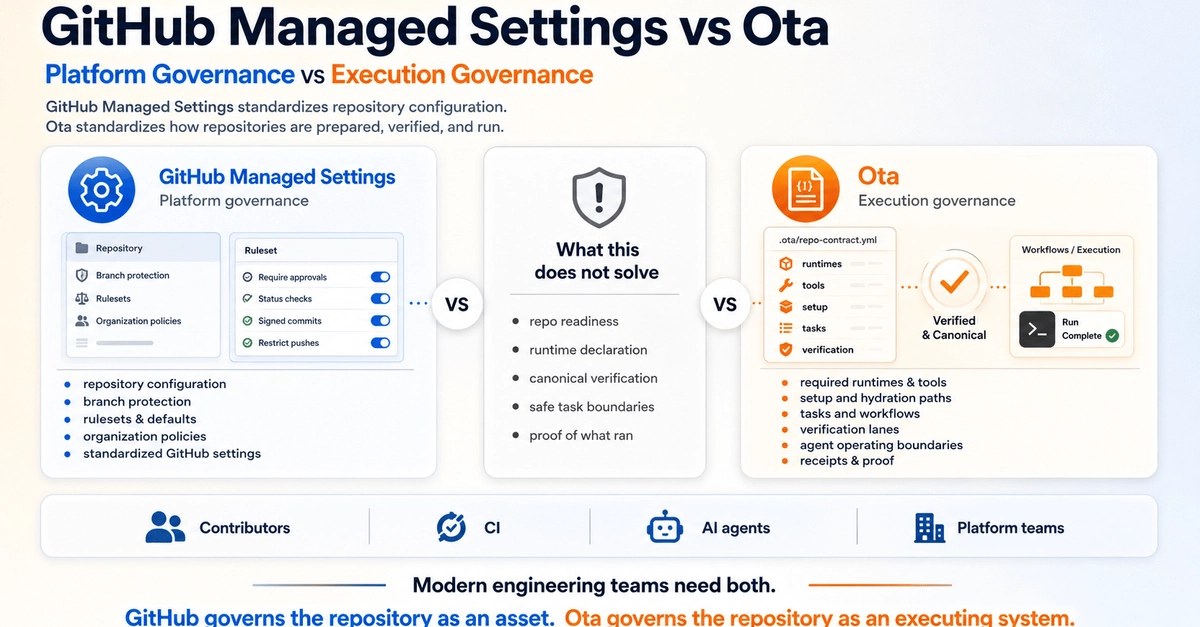
Understanding the Core Distinction: Platform vs. Execution Governance
GitHub Managed Settings and Ota are frequently discussed in the context of software repository management, but they address fundamentally different problems. They are not competing products; rather, they govern distinct layers of a repository's lifecycle. GitHub Managed Settings operates at the platform governance level, specifically managing repository configurations within GitHub itself. This includes settings like branch protection rules, repository defaults, and other policy-driven configurations that ensure consistency across an organization's GitHub footprint. Its primary aim is to standardize the environment where code resides and is managed.
Ota, on the other hand, focuses on execution governance. This layer is concerned with how a repository is prepared, verified, and ultimately run. It governs the operational aspects: the developer experience, the integration of CI/CD systems, the interaction with automation tools, and the protocols for AI agents operating within or on behalf of the repository. Modern software development requires more than just static policy; it demands a clear, enforceable contract for how code is built, tested, and deployed. Ota provides this execution layer, ensuring that the actual processes surrounding the code align with defined standards.
The distinction is critical because a repository's effectiveness hinges on both its foundational configuration and its operational execution. Organizations that standardize branch protection or repository defaults with GitHub Managed Settings still need a robust system to manage the actual execution of code within those repositories. Ota steps in to fill this gap, ensuring that the development workflow, from commit to deployment, is governed and predictable. They are complementary tools, each essential for comprehensive repository management but serving different, non-overlapping functions.
If you manage a large organization with hundreds or thousands of repositories, the challenge of maintaining consistent configurations is significant. Different teams might adopt varying settings, leading to security vulnerabilities, compliance issues, or simply an inconsistent developer experience. GitHub Managed Settings directly addresses this by allowing administrators to define and enforce policies from a central location. This ensures that critical settings like mandatory pull request reviews, branch deletion restrictions, or code scanning requirements are applied uniformly, regardless of who creates the repository or which team manages it day-to-day. This platform-level control streamlines onboarding, reduces the burden on individual repository maintainers, and elevates the baseline security and compliance posture of the entire engineering organization. It's about setting the stage correctly for all your code.
The Scope of GitHub Managed Settings: Platform Governance
GitHub Managed Settings is designed to bring order to the inherent complexity of managing a large number of repositories on the GitHub platform. The problem it solves is the lack of standardization in repository configurations. Without a centralized mechanism, each repository can end up with unique branch protection rules, different default branch names, varied issue and pull request templates, and inconsistent security scanning configurations. This fragmentation creates several pain points:
- Security Risks: Inconsistent branch protection can leave critical branches exposed to accidental force pushes or unauthorized merges.
- Compliance Drift: Without standardized security settings or code scanning enabled everywhere, organizations risk falling out of compliance with industry regulations or internal policies.
- Developer Friction: Developers working across different repositories may encounter varying workflows and requirements, leading to confusion and reduced productivity.
- Operational Overhead: Manually configuring and auditing settings for hundreds of repositories is time-consuming and error-prone.
GitHub Managed Settings tackles these issues by enabling administrators to define a set of desired configurations that are then automatically applied to new and existing repositories. This includes granular control over branch rules (e.g., requiring status checks, code owners, linear history), repository settings (e.g., default visibility, issue tracking, wiki), and security configurations (e.g., enabling Dependabot, setting up code scanning alerts). It acts as a central control plane for the GitHub environment itself, ensuring that the foundational setup of every repository aligns with organizational standards. This is akin to a city planner ensuring all new buildings adhere to zoning laws and building codes before construction even begins; it sets the structural integrity and regulatory compliance for the entire urban landscape.
Ota's Domain: Execution Governance
While GitHub Managed Settings ensures repositories are correctly configured on the platform, Ota focuses on what happens *within* those repositories during the development lifecycle. Execution governance is about the dynamic processes and workflows that transform code into a deployed product. This involves defining and enforcing how developers interact with the codebase, how code is built and tested, and how automation and AI agents are integrated into the workflow.
Consider the modern software development pipeline. It's not just about merging code; it's about a series of automated checks, validations, and potentially AI-driven processes. Ota provides a framework to define and manage these execution contracts. This means:
- Developer Workflows: Establishing clear expectations and automated enforcement for how developers should commit, branch, and submit code for review.
- CI/CD Integration: Ensuring that continuous integration and continuous deployment pipelines are triggered correctly, pass specific checks, and adhere to defined stages.
- Automation and AI Agents: Governing the permissions, actions, and interactions of bots and AI tools that might be used for code generation, testing, or security analysis.
- Verification and Readiness: Implementing checks that verify the repository's state, its dependencies, and its readiness for deployment or further processing.
Ota brings a layer of operational certainty to the development process. If GitHub Managed Settings is the building code for a house, Ota is the set of instructions and automated systems that ensure the plumbing works, the electricity flows correctly, and the smart home features operate as intended. It's about the active, dynamic management of the software development process itself. This is crucial for teams that rely on sophisticated automation, AI assistants, or complex CI/CD pipelines where consistency and predictability in execution are paramount to velocity and reliability.
Complementary, Not Competitive
The critical takeaway is that GitHub Managed Settings and Ota are not in competition. They serve distinct but complementary purposes in the broader landscape of software development and operations. A robust repository governance strategy requires attention to both the static configuration of the repository on its hosting platform and the dynamic execution of development workflows within it.
Organizations need GitHub Managed Settings to ensure that their GitHub environment is secure, compliant, and standardized from the ground up. This establishes a solid foundation. However, this foundation alone does not guarantee efficient or reliable software delivery. That's where Ota comes in. By providing execution governance, Ota ensures that the daily activities of development teams, automated systems, and AI agents are streamlined, predictable, and conform to operational standards. This operational layer is what enables true velocity and reliability in software delivery. Together, they provide a comprehensive approach to managing modern software repositories, ensuring both the integrity of the platform configuration and the efficiency of the execution processes.
If you're a developer, understanding this distinction means recognizing that your workflow's reliability depends on both the underlying platform policies set by your organization (via GitHub Managed Settings) and the specific execution contracts that govern how your code is built, tested, and deployed (potentially managed by Ota). For engineering leaders, it means evaluating your current tooling to ensure you have coverage for both critical areas of governance to maximize developer productivity and minimize operational risk.