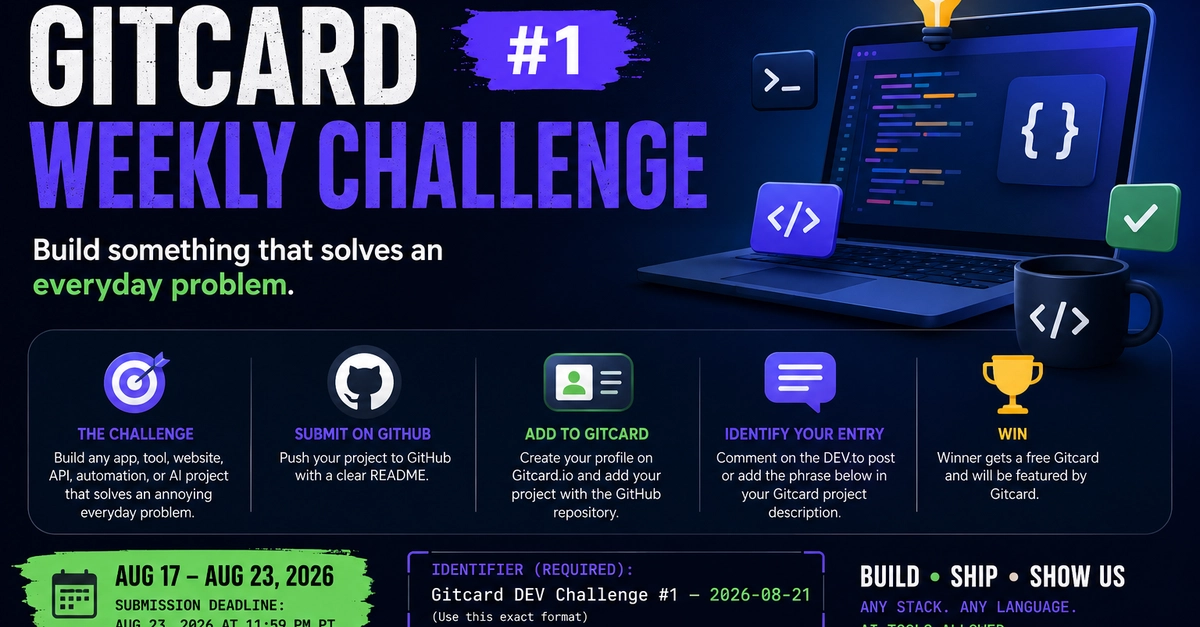
The Challenge: Solve an Everyday Annoyance
Gitcard, the platform focused on developer recognition and portfolio building, has launched its inaugural Weekly Challenge. The core directive for participants is straightforward yet powerful: build a small application, tool, website, API, automation, or AI project that tackles an everyday problem. The emphasis is on solving a specific, annoying issue that developers or individuals face regularly. This could range from saving precious time and automating tedious, repetitive tasks to assisting users in making more informed decisions, boosting overall productivity, or simply smoothing out the rough edges of daily life.
The organizers stress that project scope is not the primary measure of success. A compact project that excels at resolving a single, well-defined problem can be just as impactful, if not more so, than a sprawling, complex undertaking. This approach encourages focused innovation and demonstrates that meaningful solutions can arise from targeted efforts. Gitcard aims to foster a culture where practical utility and clever design are celebrated, regardless of the project's scale.

Examples and Inspiration
To provide a clearer picture of the challenge's scope and potential, Gitcard has offered several illustrative examples. These suggestions are designed to spark creativity without being prescriptive. Developers might consider creating an AI-powered email organizer that intelligently sorts and prioritizes incoming messages, freeing up mental bandwidth. Another avenue could be a smart grocery-list generator that learns user preferences and dietary needs, perhaps integrating with local store inventories. Browser productivity tools are also a strong contender, perhaps an extension that blocks distracting websites during work hours or automatically fills out repetitive forms.
Meeting summarizers represent another practical application, using AI to distill lengthy discussions into actionable bullet points or concise overviews. Personal finance utilities that simplify budgeting, track expenses automatically, or offer personalized savings advice could also fit the bill. For fellow developers, productivity tools that streamline common coding tasks, automate deployment processes, or simplify debugging are highly valuable. Even simple schedulers that intelligently find optimal meeting times across different time zones or availability constraints could address a common point of friction. The key is to identify a genuine pain point and engineer a focused solution.
The Gitcard Ecosystem and Goal
This challenge is more than just a competition; it's an initiative designed to integrate with and promote the Gitcard platform itself. Gitcard.io serves as a space for developers to showcase their work, build a professional portfolio, and gain recognition within the developer community. By participating in these weekly challenges, developers can create tangible projects that not only solve real-world problems but also serve as excellent additions to their Gitcard profiles. This provides a dual benefit: contributing to a community-driven innovation effort while simultaneously enhancing one's own professional standing.
The goal is to encourage active development and problem-solving within the tech community. Gitcard believes that many of the most impactful innovations come from addressing the small, persistent annoyances that developers and users encounter daily. These challenges provide a structured incentive to identify such problems, conceptualize solutions, and bring them to life. The platform serves as the central hub for submissions, discussions, and potentially, for showcasing winning projects. This fosters a dynamic environment where learning, building, and sharing are at the forefront.
Why This Matters for Developers
For developers, engaging with challenges like this offers significant advantages. Firstly, it's an excellent opportunity to practice and hone technical skills in a practical, project-oriented context. Building something that solves a real problem requires more than just coding; it involves user empathy, design thinking, and iterative refinement. Secondly, it provides concrete portfolio pieces that demonstrate initiative, creativity, and the ability to deliver functional applications. In a competitive job market, having projects that showcase a proactive approach to problem-solving is invaluable.
Furthermore, participating in community challenges can lead to networking opportunities and exposure. Developers can learn from each other's approaches, gain feedback on their work, and potentially collaborate on future projects. The act of building and sharing also helps in solidifying understanding of technologies and methodologies. It moves beyond theoretical knowledge to applied expertise. The challenge’s focus on everyday problems ensures that the projects are relatable and have immediate practical relevance, making them compelling to review and showcase.
The Broader Impact and Future
Gitcard's initiative taps into a fundamental aspect of technological advancement: the iterative improvement of daily life through accessible tools. By encouraging the creation of small, focused solutions, Gitcard aims to democratize innovation. It suggests that impactful development doesn't always require massive resources or enterprise-level projects. Instead, clever engineering applied to common frustrations can yield significant value. This philosophy can empower a wider range of creators, including individual developers, students, and small teams.
The success of this first challenge could pave the way for a sustained series of initiatives from Gitcard, each potentially focusing on different themes or technologies. This consistent engagement could build a robust community around the platform, fostering a sense of shared purpose and collective progress. The projects generated might even evolve into larger, more ambitious ventures, demonstrating the potential for small challenges to seed significant innovation. What remains to be seen is how Gitcard plans to evaluate submissions and recognize contributions beyond simply declaring winners, potentially creating new forms of developer recognition or community endorsement.