The Challenge of German Sentiment Analysis
A support team reading reviews in five different languages recently marked an angry customer as "satisfied." This wasn't a clerical error. The word that triggered the misclassification – "super," "genial," "toll" – appeared positive to the automated system. Sarcasm, a common linguistic tool, often eludes keyword-based analysis. Similarly, a dissatisfied customer doesn't always articulate their unhappiness directly. This scenario highlights a critical gap in automated customer feedback analysis: the need for models that understand not just words, but their context and implied meaning, especially in languages with rich idiomatic expressions like German.
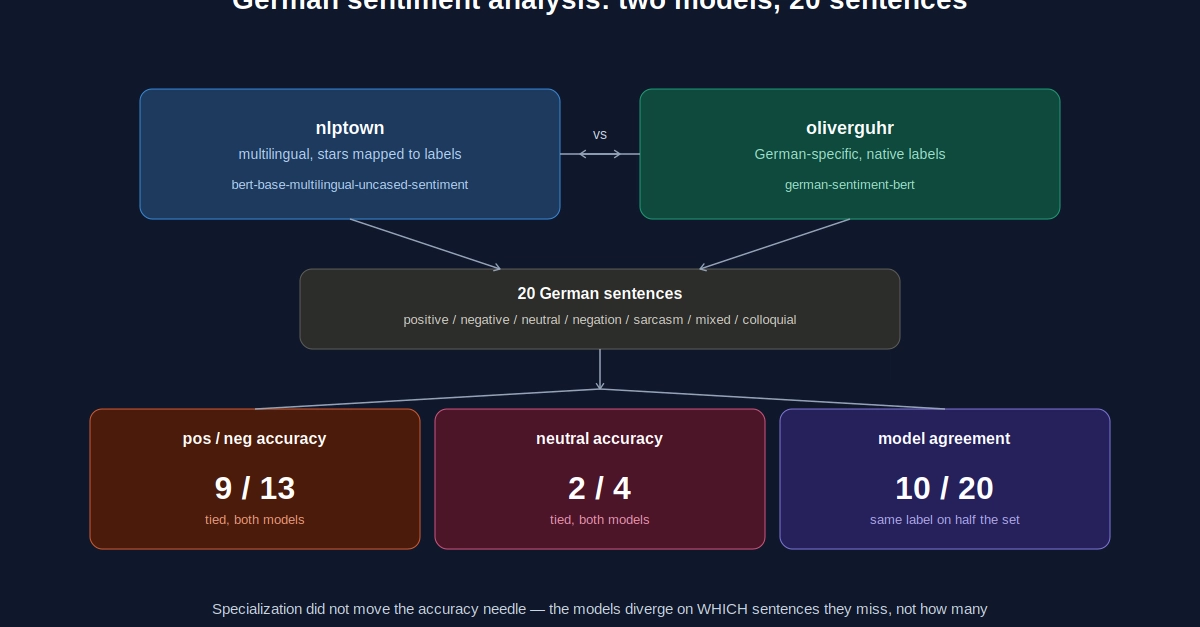
The quest for reliable AI-driven sentiment analysis is ongoing. While pre-trained models offer a powerful starting point, their effectiveness on specific language nuances and real-world, uncurated data remains a question. To explore this, a head-to-head comparison was conducted using two prominent BERT-based models for German sentiment analysis. The objective was to evaluate their performance on twenty real-world German sentences, assessing whether these models provide trustworthy insights or merely accelerate the process of drawing incorrect conclusions.

The Contenders: Model Architectures and Training Data
The two models put to the test were:
nlptown/bert-base-multilingual-uncased-sentiment: This model is designed for multilingual sentiment analysis and was trained primarily on product reviews. It outputs sentiment scores on a 1-to-5 star rating scale. For this analysis, these scores were mapped to broader categories: 1-2 stars were classified as negative, 3 stars as neutral, and 4-5 stars as positive. Its multilingual nature suggests a broad applicability but potentially diluted performance on specific languages like German compared to a dedicated model.oliverguhr/german-sentiment-bert: As the name suggests, this model is specifically fine-tuned for German sentiment analysis. While the exact training data composition isn't detailed in the same way as the nlptown model, its specialization implies a deeper understanding of German linguistic constructs and sentiment expressions. This focused training is expected to yield more accurate results for German text.
The fundamental difference lies in their training scope. The nlptown model aims for general applicability across many languages, leveraging a vast but potentially less specialized dataset. In contrast, the oliverguhr model is a specialist, honed on German text, which should theoretically make it more adept at capturing the subtleties of the language. The experiment aimed to reveal whether this specialization translates into superior practical performance.
Methodology: Testing on Real-World Sentences
The evaluation focused on twenty real-world German sentences. These sentences were not cherry-picked for ease of classification; they represented a diverse range of user feedback, including reviews, comments, and social media posts. This approach mimics the messy, unpredictable nature of data encountered in production environments. The process involved feeding each of the twenty sentences into both models and comparing their predicted sentiment labels (positive, neutral, negative) against a human-annotated ground truth.
The human annotation served as the benchmark for accuracy. A human fluent in German assessed each sentence, considering not just explicit sentiment markers but also implicit cues, sarcasm, and contextual nuances. This human judgment is crucial because it reflects how a native speaker would interpret the sentiment, providing a realistic target for the AI models. The comparison then focused on how closely each model's output aligned with this human assessment.
Results and Analysis: Where Models Diverge
The head-to-head comparison revealed significant differences in how the two models handled German sentiment. The oliverguhr model generally outperformed the nlptown model, particularly in correctly identifying nuanced or sarcastic statements. For instance, a sentence like "Das Essen war super, aber der Service war eine Katastrophe" (The food was great, but the service was a disaster) was correctly classified as negative by oliverguhr, likely due to its ability to weigh the stronger negative sentiment of the second clause. The nlptown model, however, might have been swayed by the initial positive "super," potentially misclassifying it as neutral or even positive if its internal weighting favored the earlier positive term.
Another critical area of divergence was the handling of sarcasm. A sentence such as "Ja, das war ja mal wieder typisch" (Yes, that was typical, indeed) often carries a negative undertone in German, implying frustration with a recurring problem. The specialized oliverguhr model demonstrated a better grasp of this implied negativity, whereas the multilingual nlptown model, trained on more general review data, might interpret "typisch" neutrally or even positively in the absence of explicit negative keywords.
The nlptown model's star-rating output, mapped to positive/neutral/negative, introduced an additional layer of interpretation. While practical, this mapping can obscure subtle distinctions. A 3-star rating, mapped to neutral, might mask a sentence that is mildly positive but contains a significant negative element, or vice-versa. The oliverguhr model, presumably outputting a more direct sentiment classification (e.g., positive, negative, neutral), offered a clearer, less ambiguous result for these specific cases.
Implications for Real-World Applications
The findings underscore a critical point for anyone deploying sentiment analysis tools: context and language-specific nuances matter immensely. While general-purpose multilingual models offer convenience, they often fall short when dealing with the intricacies of a specific language like German. The oliverguhr model's superior performance highlights the value of fine-tuning models on domain-specific and language-specific data. For businesses operating in Germany or serving a German-speaking customer base, investing in or developing models tailored to the German language is not just beneficial but likely essential for accurate customer understanding.
This analysis also brings into focus the limitations of current AI in fully grasping human communication. Sarcasm, irony, and subtle expressions of dissatisfaction are complex. Even advanced BERT models, while powerful, can struggle. This means that for high-stakes applications, such as moderating content, identifying critical customer issues, or understanding brand perception, a purely automated approach might still require human oversight. The AI can act as a powerful first-pass filter, flagging potential issues and categorizing sentiment at scale, but human review remains indispensable for catching the subtleties that can drastically alter the meaning.
The gap between automated sentiment analysis and human understanding is shrinking but not closed. Developers and product managers must choose models wisely, considering the target language, the type of text data, and the acceptable margin of error. For German text, specialized models like oliverguhr/german-sentiment-bert appear to be a more reliable choice than general multilingual options for nuanced tasks.
What's Next?
The immediate next step for developers and data scientists working with German text is to benchmark their chosen models against real-world data, not just standard benchmarks. Understanding how models perform on their specific use cases—be it product reviews, social media, or customer support tickets—is paramount. The experiment suggests that while multilingual models are useful for broad applications, the accuracy gains from language-specific fine-tuning are substantial and directly impact the reliability of insights derived from customer feedback. For those building customer feedback analysis pipelines, this means prioritizing language-specific models or investing in custom fine-tuning efforts to capture the true sentiment of their audience.