
The Double-Edged Sword of Genetic Algorithms in Trading
Genetic algorithms (GAs) offer a powerful, albeit often misused, approach to optimizing trading strategies. At their core, GAs are inspired by natural selection, evolving a population of potential solutions over generations to find the fittest. In trading, this means evolving sets of strategy parameters—like lookback windows, entry/exit thresholds, and position sizing—to maximize historical performance. However, a common pitfall is using GAs to simply find a strategy that performed well in the past, a process that inevitably leads to overfitting. The algorithm becomes exquisitely tuned to historical noise, producing a beautiful equity curve on backtests that will likely fail spectacularly in live trading. The technique itself isn't flawed; rather, it's the typical implementation that transforms it into the fastest overfitting machine ever invented.
The complexity arises from the search space of trading strategy parameters. This space is rarely a smooth, predictable landscape. Instead, it's often described as 'bumpy' and non-differentiable, meaning traditional calculus-based optimization methods (which rely on derivatives) are ineffective. You can't simply take a derivative of the strategy's performance with respect to a parameter and move in the direction of improvement. This is where GAs shine. They can navigate these complex, discontinuous landscapes by exploring many potential solutions simultaneously and iteratively refining them based on their performance.
Why GAs for Strategy Optimization?
A typical trading strategy involves numerous parameters. Consider a simple moving average crossover strategy: you might have two lookback periods for the short and long moving averages, a threshold for entry (e.g., how far the short MA must cross the long MA), a stop-loss percentage, and a take-profit level. If each parameter has just 10 possible values, and you have 5 such parameters, you're looking at 10^5 = 100,000 possible combinations. For more complex strategies with more parameters, this number balloons exponentially. Brute-forcing every combination becomes computationally infeasible very quickly. Even heuristic search methods can get stuck in local optima, finding a 'good enough' solution that isn't the true best.
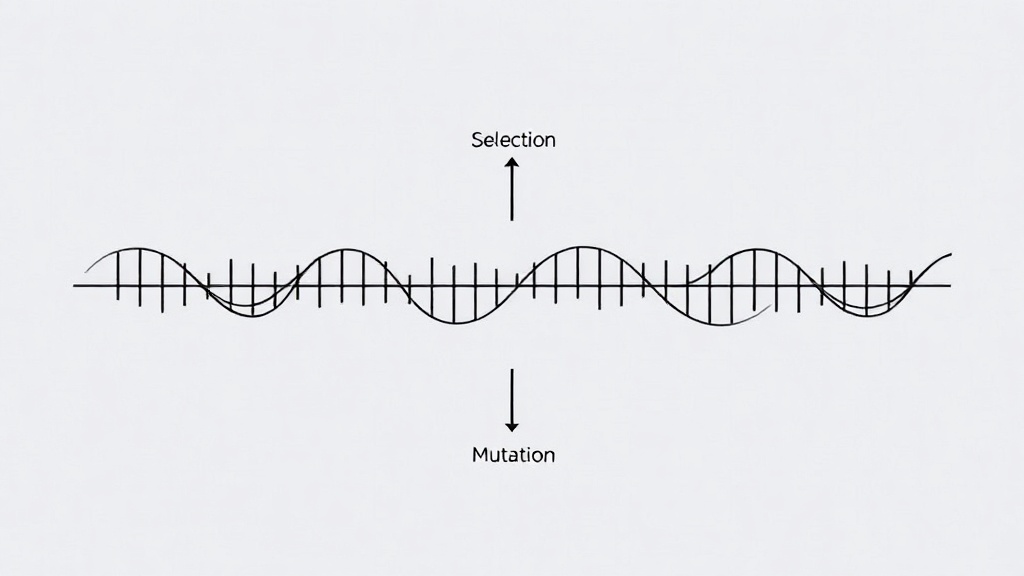
GAs overcome this by maintaining a diverse population of candidate solutions. Each individual in the population represents a complete set of strategy parameters. The algorithm evaluates each individual's 'fitness'—typically measured by its performance on historical data (e.g., total return, Sharpe ratio, profit factor). The fittest individuals are then selected to 'reproduce.' Reproduction involves two key genetic operators:
- Crossover: This operator combines genetic material from two parent solutions to create one or more offspring. For example, one parent might have a short MA period of 10 and a stop-loss of 2%, while the other has a period of 50 and a stop-loss of 5%. A crossover might result in an offspring with a period of 10 and a stop-loss of 5%, inheriting traits from both parents.
- Mutation: This operator introduces random changes to an individual's genetic material. A mutation might slightly alter a parameter value (e.g., changing a stop-loss from 2% to 2.1%). Mutation is crucial for introducing new genetic diversity into the population and preventing premature convergence on a suboptimal solution.
Over hundreds or thousands of generations, the population evolves towards better-performing parameter sets. This process effectively explores the vast search space without needing to evaluate every single point.
The Peril of Overfitting: Noise Farming
The primary danger with GAs in trading is overfitting. Historical data is inherently noisy. There are random fluctuations, market regime shifts, and specific events that, by chance, align perfectly with a particular set of parameters. A GA, tasked with maximizing performance on this historical data, will readily latch onto these noisy patterns. It's like training a model to predict the stock market based on the number of hot dog eating contest winners each year; you might find a correlation in past data, but it has no predictive power.
This is particularly true when GAs are applied to short backtest periods or to strategies with very high turnover. The algorithm finds parameters that exploit specific quirks of that limited historical data. The resulting 'optimized' strategy is not robust; it's a fragile construct built on a foundation of historical coincidence. The equity curve might look impressive, but it's a mirage, promising future profits that will never materialize.
Building a Real Edge: Discipline and Robustness
To use GAs effectively, discipline is paramount. The goal should not be to find the single best-performing strategy on a given dataset, but rather to find a *robust* strategy that demonstrates an edge across a variety of market conditions. This requires careful implementation and validation:
- Out-of-Sample Testing: This is non-negotiable. A GA should optimize parameters on one dataset (the in-sample period) and then be tested on a completely separate, unseen dataset (the out-of-sample period). If the performance degrades significantly, the strategy is likely overfit.
- Walk-Forward Optimization: This is a more advanced form of out-of-sample testing. The GA optimizes parameters on a rolling window of data, and then the strategy is tested on the subsequent period. This simulates how the strategy might perform if parameters were periodically re-optimized in a live trading environment.
- Parameter Sensitivity Analysis: Instead of just taking the single best parameter set, analyze the performance of neighboring parameter sets. A robust strategy will have a relatively broad 'plateau' of good performance, rather than a sharp, narrow peak.
- Realistic Assumptions: Incorporate realistic transaction costs, slippage, and market impact into the fitness function. Ignoring these factors can lead to strategies that look profitable in backtests but are uneconomical in practice.
- Simplicity Over Complexity: Often, simpler strategies with fewer parameters are more robust. A GA can help identify the optimal parameters for a *given simple model*, rather than trying to evolve an overly complex model from scratch.
The surprising detail here is not that GAs can overfit, but that the discipline required to prevent it—rigorous out-of-sample testing and walk-forward analysis—is so frequently overlooked. Many practitioners treat GA optimization as a black box that spits out a winning strategy, ignoring the critical validation steps.
The Future of GA in Trading
When implemented with discipline, GAs are a powerful tool for uncovering and optimizing real edges in financial markets. They can navigate complex parameter spaces far more effectively than manual methods or simple grid searches. The key is to view the GA not as a magic bullet for generating profits, but as a sophisticated search algorithm that requires careful guidance and validation. For developers and quantitative traders aiming to build resilient trading systems, mastering the art of GA implementation, with a heavy emphasis on robustness testing, is essential. The alternative is a fast track to creating strategies that are optimized for the past, but doomed for the future.