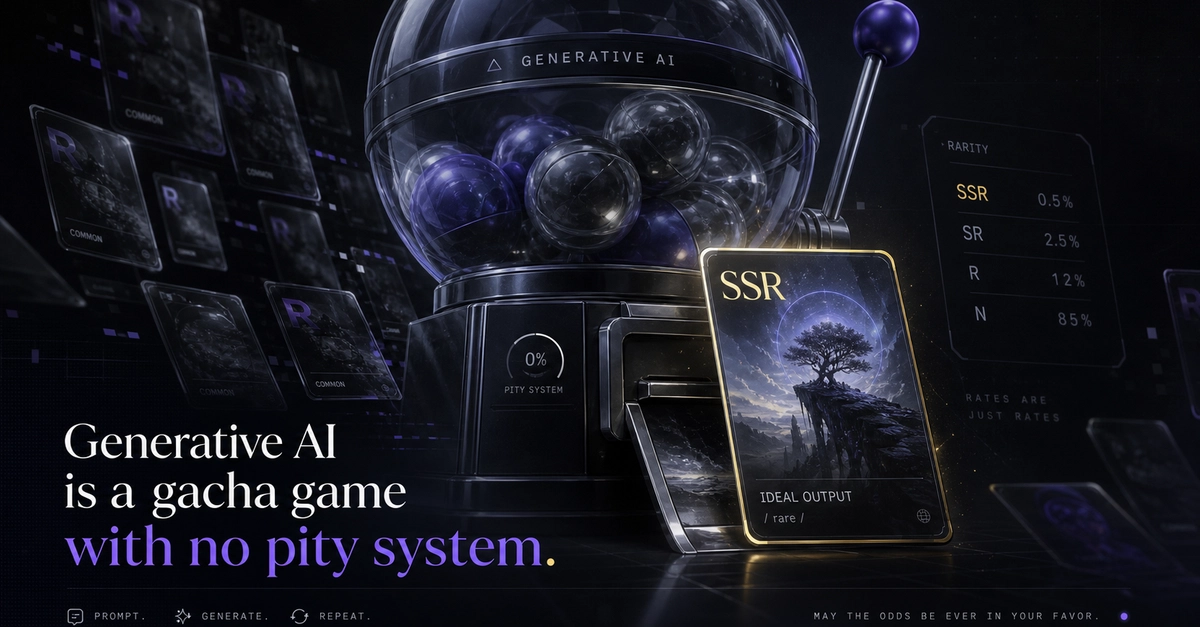
The Allure of the Unknown
Generative AI tools, from image generators to text models, promise boundless creativity and rapid problem-solving. They can draft emails, brainstorm ideas, create art, and even write code. Yet, beneath the surface of this powerful technology lies a core mechanic that feels eerily familiar to anyone who has ever spent money on a virtual loot box: a lack of guaranteed results.
Consider the experience of using a generative AI model. You input a prompt, a carefully crafted set of instructions designed to elicit a specific output. The AI processes this input and returns a result. Often, this result is impressive, exceeding expectations. Other times, it is nonsensical, irrelevant, or simply wrong. There's no inherent guarantee that your prompt, no matter how detailed, will yield the desired outcome. This unpredictability is the generative AI equivalent of pulling a virtual slot machine lever and hoping for the best.
Gacha Mechanics Explained
The term "gacha" originates from Japanese toy vending machines that dispense capsule toys. In the digital realm, gacha games leverage a similar mechanic: players spend in-game currency (often purchasable with real money) for a chance to receive random virtual items, characters, or upgrades. The core appeal, and the addictive nature of these games, lies in the thrill of the unknown and the potential for a rare, highly desirable drop. However, the flip side is the frequent disappointment of receiving common, less useful items. Many gacha systems include a "pity system" – a mechanism that guarantees a rare item after a certain number of pulls, mitigating some of the frustration and ensuring players eventually get a worthwhile reward.
Generative AI, particularly large language models (LLMs) and image generation models, operates without such a safety net. You input a prompt, and you get an output. There's no inherent guarantee of quality, relevance, or accuracy. Each interaction is a gamble. You might get a perfect piece of code on the first try, or you might spend hours refining prompts, only to receive outputs that are subtly flawed, conceptually bankrupt, or entirely off-topic. The AI doesn't "owe" you a good result just because you've asked it many times before or because you've used complex phrasing.

The Cost of Randomness
This lack of a pity system has tangible consequences. For developers, it means significant time spent iterating on prompts, testing variations, and debugging AI-generated code that may contain subtle errors. For content creators, it can involve numerous attempts to generate the perfect image or piece of text, leading to frustration and a feeling of wasted effort. The cost isn't just in time; for many AI services, it's also in computational resources, often billed on a per-token or per-generation basis. Burning through thousands of tokens on unsatisfactory results is a common, and often costly, experience.
This is precisely the scenario the author of the original Dev.to post experienced. After struggling with AI-generated content and consuming a significant number of tokens, they found that a human expert could provide a superior, more direct solution. This highlights a critical limitation: while AI can be a powerful tool, its current iteration often requires significant human oversight and iteration, much like trying to get the right item from a gacha machine without a guaranteed drop. The effort required to coax the desired output from the AI can sometimes outweigh the benefits of using the tool in the first place, especially when compared to human expertise.
Why No Pity System?
The fundamental architecture of current generative AI models explains this lack of a pity system. These models are trained on vast datasets and operate probabilistically. When you provide a prompt, the model predicts the most likely sequence of tokens (words, pixels, etc.) that should follow, based on its training. There isn't an internal counter tracking your "pulls" or a mechanism designed to force a specific, high-quality outcome after a certain number of attempts. The randomness is inherent to the generative process itself. Each generation is, in essence, a new, independent probabilistic calculation.
The concept of a pity system implies a form of memory or statefulness across generations that isn't native to how these models typically function. While some research explores stateful AI or mechanisms to improve prompt adherence, a universal, built-in guarantee of quality after a set number of failed attempts is not a current feature. Implementing such a system would likely require significant architectural changes and could potentially conflict with the models' core generative capabilities, possibly leading to less diverse or creative outputs in the long run.
The Human Element Remains Key
The analogy to gacha games is particularly apt because it captures the user's experience of hope, frustration, and occasional delight, all governed by chance. It underscores the need for users to approach generative AI with realistic expectations. It is not a magic wand, but a tool whose effectiveness is heavily dependent on the skill of the user in crafting prompts and their willingness to iterate. Furthermore, it highlights the enduring value of human expertise. When AI outputs are unpredictable and costly, turning to a human professional who can provide reliable, targeted assistance becomes a more efficient and effective strategy.
As generative AI continues to evolve, we might see the development of more predictable models or user-friendly interfaces that abstract away some of the randomness. However, for now, users should be aware that they are often engaging with a system that, while capable of producing remarkable results, operates much like a gacha game: you might get lucky, but there's no guarantee, and the cost of trying can add up.