Unified Document Parsing with Gemma 4
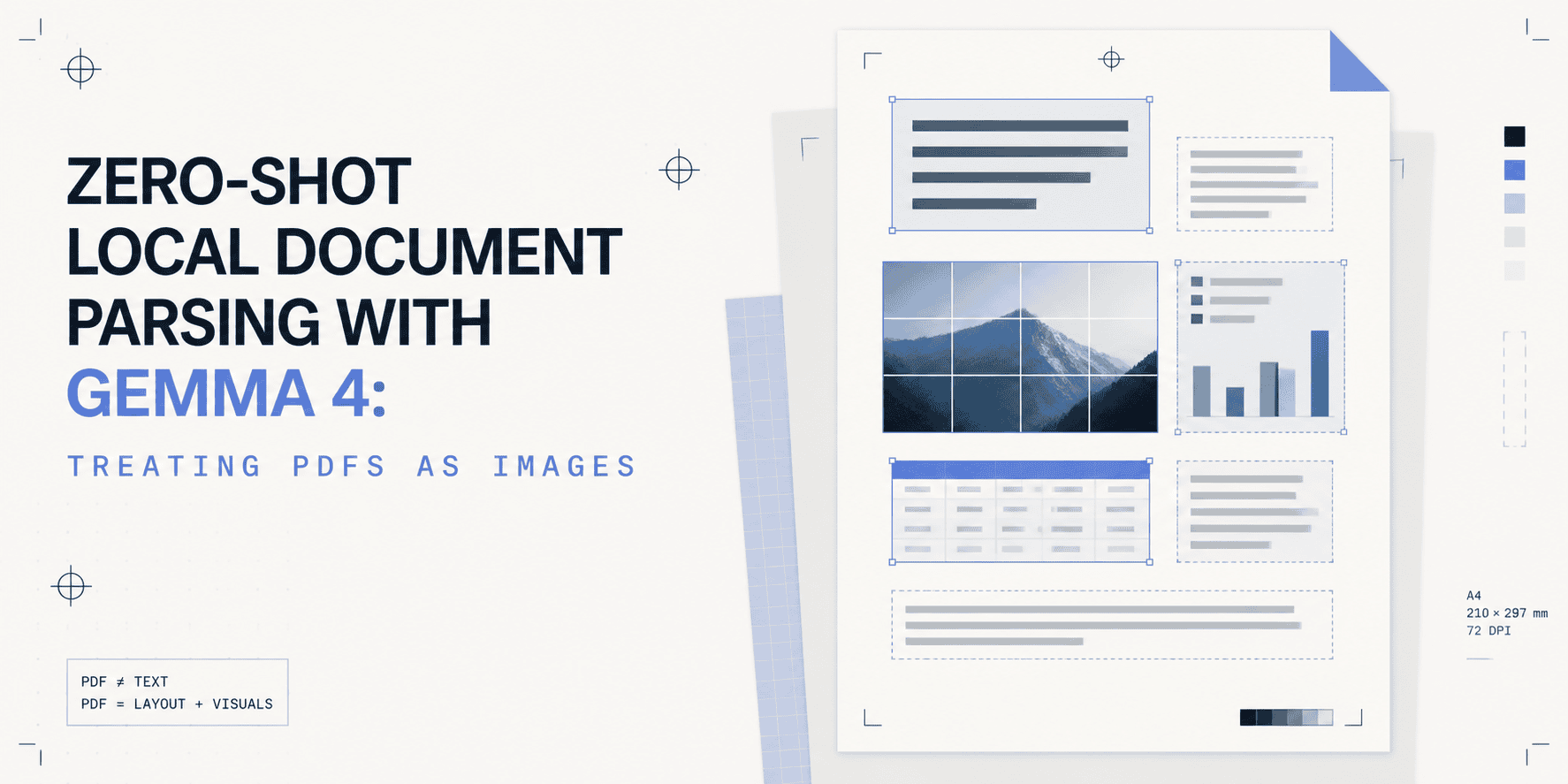
The persistent challenge in document processing has been the dichotomy between scanned documents, which are essentially images, and digitally native documents with embedded text. This distinction forces developers to maintain fragile, often complex pipelines that handle each type differently. A significant step towards unifying this process comes with the application of Google's Gemma 4 large language model (LLM) to treat PDF content as images. This approach dissolves the scanned-versus-digital barrier, promising a more robust and simplified solution for extracting and understanding information from a wide array of documents.
Traditional document parsing pipelines often involve multiple stages. For scanned documents, Optical Character Recognition (OCR) is a prerequisite to convert image-based text into machine-readable characters. This process is prone to errors, especially with low-quality scans, unusual fonts, or complex layouts. For digitally native PDFs, text can often be extracted directly, but this assumes the PDF structure is well-formed and accessible. When faced with mixed document sets, developers must build logic to detect document type and apply the appropriate parsing strategy, leading to increased development time and maintenance overhead. This new method bypasses these complexities by leveraging the visual understanding capabilities of advanced LLMs.
How Gemma 4 Handles PDFs as Images
The core innovation lies in reframing the problem. Instead of focusing on the underlying text data or the PDF's structural elements, the system renders each page of a PDF as an image. This image is then fed into Gemma 4, a multimodal LLM capable of processing both text and visual information. By treating the PDF page as a visual input, Gemma 4 can interpret the layout, identify text blocks, understand their spatial relationships, and even infer meaning from graphical elements, much like a human would visually scan a page. This visual-first approach inherently handles both scanned and digitally native PDFs identically, as both are represented as pixel data to the model.
This paradigm shift allows Gemma 4 to perform zero-shot local document parsing. "Zero-shot" means the model can perform tasks it hasn't been explicitly trained on, relying on its general understanding of visual and textual information. "Local document parsing" refers to the ability to extract specific pieces of information or understand the structure within a document, rather than just a global summary. For instance, if a user needs to extract invoice numbers, dates, and total amounts from a batch of invoices, the model can identify these elements based on their visual context and typical placement on an invoice, regardless of whether the PDF was generated from a scanner or a word processor.
Advantages Over Traditional Methods
The benefits of this image-based parsing approach are manifold. Firstly, it significantly simplifies the document processing architecture. The need for separate OCR engines and text extraction modules for different PDF types is eliminated. This reduction in complexity directly translates to faster development cycles and lower maintenance costs. Developers can focus on defining what information they need and how to interpret it, rather than wrestling with the intricacies of PDF formats and OCR accuracy.
Secondly, the robustness of the system is enhanced. OCR errors, which plague scanned document processing, are bypassed. While Gemma 4's visual interpretation isn't infallible, it's less susceptible to the specific types of noise and distortion that often trip up traditional OCR algorithms. The model learns to recognize patterns and context, making it more resilient to variations in font, image quality, and document layout. This means more consistent and reliable data extraction across a wider range of input documents.
A concrete analogy for this improvement: Imagine trying to read a book where some pages are printed clearly, and others are photocopied many times, making the text blurry. Traditional methods would require a special tool (OCR) for the blurry pages, and a standard reader for the clear ones. This new approach is like giving the reader a pair of advanced glasses that can clarify the blurry photocopies while still reading the clear pages, all with the same visual processing ability. The glasses don't care if the page was originally printed or copied; they just see the visual information and interpret it.
Potential Applications and Future Implications
The implications for industries heavily reliant on document processing are substantial. Financial services can leverage this for faster, more accurate processing of loan applications, insurance claims, and invoices. Healthcare providers can streamline the extraction of patient data from scanned medical records and digital forms. Legal professionals can improve the efficiency of reviewing contracts, court filings, and discovery documents. Even customer support can benefit from automatically extracting relevant details from user-submitted documents.
The ability of Gemma 4 to perform zero-shot parsing also opens doors for rapid prototyping and deployment of new document understanding tools. Instead of extensive fine-tuning or rule-based system development, teams can quickly adapt the model to new document types or extraction requirements by simply providing examples and clear instructions within the prompt, leveraging the model's inherent multimodal understanding. This agility is critical in dynamic business environments where document formats and data needs can change rapidly.
What remains to be seen is the scalability and cost-effectiveness of this approach for extremely high-volume document processing. While powerful, running large multimodal models can be computationally intensive. Determining the optimal balance between rendering quality, model inference cost, and extraction accuracy will be key for widespread adoption. Furthermore, the nuanced understanding of highly specialized or domain-specific jargon, which often requires fine-tuned models, will be an area to watch as this technology matures.