Runtime Template Failure in Fine-Tuned Gemma 4 E2B
Fine-tuning large language models often involves intricate steps, from adapter merging to quantization and export. For Gemma 4 E2B, a popular open-source model, the process appeared to be smooth for one developer. The adapter merged cleanly, the model exported to .litertlm without errors, and initialization on a mobile device indicated a successful setup. However, the system choked immediately upon the first inference attempt, revealing a critical compatibility issue rooted in template processing.
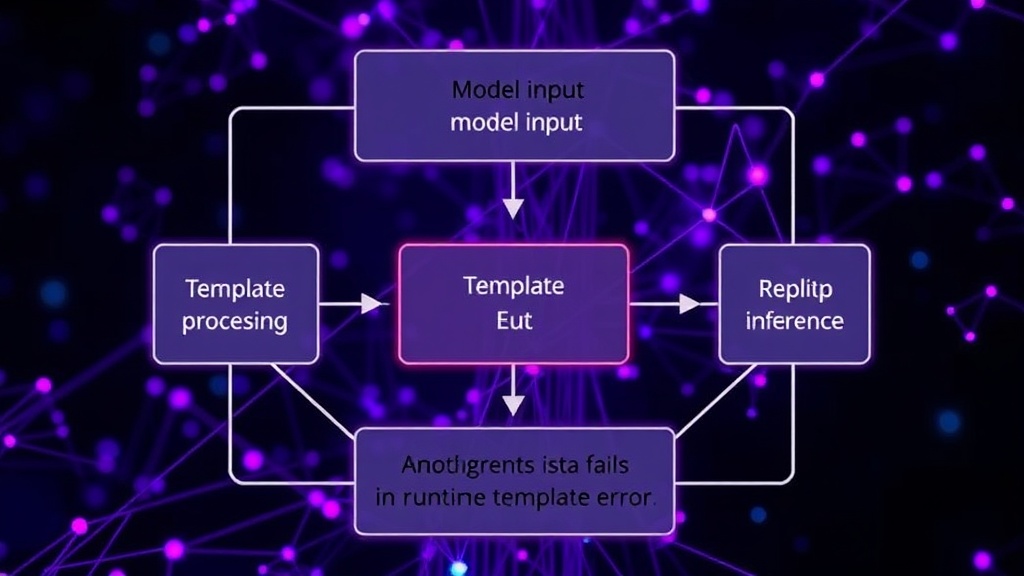
The error message, "Failed to apply template: unknown method: map has no method named get (in template:238)", signals a deeper problem than simple model loading or quantization errors. This failure only surfaces when the model is actively used for inference, not during the loading or setup phases. This makes it particularly problematic for demonstrations or time-sensitive applications like hackathons, where discovering such a fundamental flaw at the last moment can be disastrous.
This specific bug was encountered during the development of Redacto, a zero-trust PII redaction application designed to run Gemma 4 E2B entirely on-device. The challenge highlights a common pitfall in deploying fine-tuned models: the discrepancy between theoretical model readiness and practical runtime compatibility, especially concerning the templating engine used to format model inputs and outputs.
Understanding the Template Processing Error
The core of the issue lies in the Jinja templating engine, a widely used Python templating language. The error message indicates that the runtime encountered a method call within a Jinja template that it does not support. Specifically, it refers to a method named get on a map object, which is a standard operation in many programming contexts. The error "map has no method named get" suggests that the version of Jinja or the specific implementation of the templating engine within the Gemma 4 E2B runtime environment lacks support for this particular operation, or perhaps the data structure being passed to the template is not a standard map as expected.
This is not a failure of the model's weights or its ability to process language. The model itself likely loaded correctly, and the tokenizer functioned as intended. The problem occurs one step later, in the process of preparing the user's input into a format the model understands, or more commonly, in formatting the model's raw output into a human-readable response. This often involves complex prompt engineering and output parsing, where templates play a crucial role.
Consider it like a chef meticulously preparing a complex dish (fine-tuning the model). All ingredients are sourced, prepped, and cooked perfectly. The dish is plated beautifully (exported model). But when the waiter tries to add a specific garnish (run inference), the plating tool (templating engine) breaks because it's an older model that doesn't recognize the garnish's unique shape.
Implications for On-Device LLM Deployment
For applications like Redacto that aim for complete on-device operation, such runtime errors are particularly disruptive. Running LLMs locally eliminates the need for cloud infrastructure, enhances privacy by keeping data on the user's device, and can reduce latency. However, it also introduces significant challenges related to resource constraints and software compatibility. The Gemma 4 E2B model, when fine-tuned and exported to .litertlm, is intended for efficient on-device execution. The discovery of a templating issue that surfaces only during inference means that developers must perform more rigorous end-to-end testing of their fine-tuned models in the target runtime environment.
The fact that the error occurs in a Jinja template feature that is seemingly standard raises questions about the specific runtime environment or the library versions being used. It's possible that the .litertlm format or the associated runtime has specific limitations or dependencies on particular Jinja versions. Developers targeting mobile or edge devices often rely on stripped-down or optimized libraries, which might omit certain functionalities found in their full desktop counterparts.
This incident underscores the importance of a robust testing pipeline for any LLM deployment. For on-device applications, this pipeline must include:
- Model Loading and Initialization Tests: Ensure the model and tokenizer load correctly without errors.
- Quantization and Export Verification: Confirm that the exported model format is valid and compatible with the target runtime.
- Inference Runtime Tests: Crucially, test the model with actual inference requests, covering various input types and expected outputs. This includes testing prompt formatting and output parsing logic.
- Template Compatibility Checks: Verify that all template features used in prompt construction and output generation are supported by the specific runtime environment.
What is not yet clear is whether this is an isolated issue with a specific fine-tuning process or a more systemic problem with the Gemma 4 E2B runtime environment, particularly when dealing with custom templates or advanced Jinja features. Developers building or deploying applications using fine-tuned Gemma models should be aware of this potential failure point and ensure their testing covers the full inference lifecycle.
Conclusion: A Hidden Compatibility Trap
The fine-tuning of Gemma 4 E2B for on-device applications like Redacto encountered a critical failure not in the model's core processing capabilities, but in its runtime environment's ability to handle templating logic. This "hidden" error, surfacing only during inference, serves as a stark reminder that model development is only one part of the deployment puzzle. Ensuring compatibility with the entire software stack, including the templating engines that mediate between user input, model processing, and output presentation, is paramount. Developers must be vigilant in testing not just the model itself, but the complete inference pipeline, to avoid unexpected failures in production or during critical demonstrations.