A New Era for Benchmarking
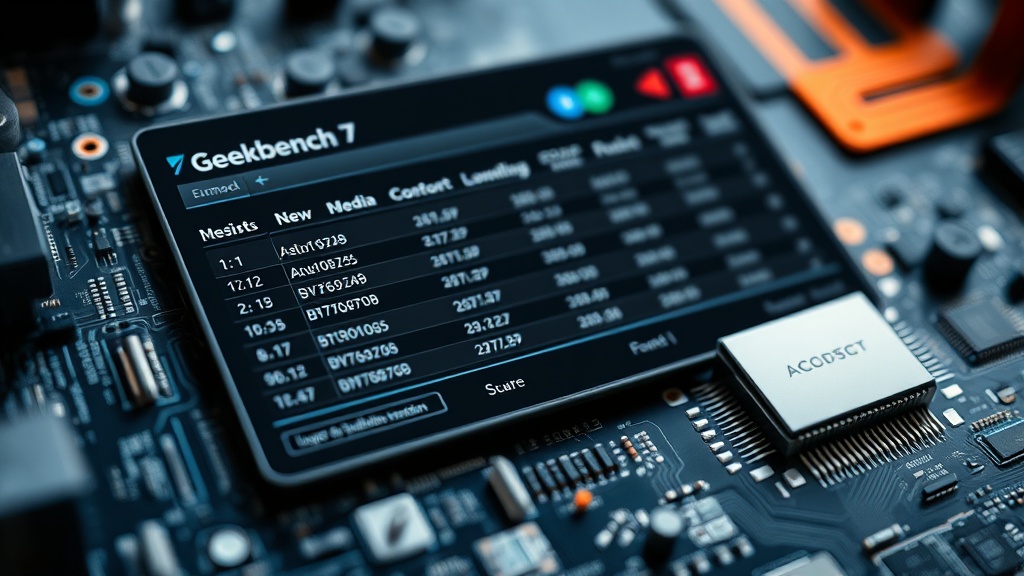
Geekbench, a staple in performance measurement for processors and graphics cards, has just unveiled its seventh iteration, marking its most substantial revision to date. The update aims to move beyond synthetic tests, introducing workloads that more closely mirror real-world application demands across various computing tasks. This strategic shift is designed to provide users, developers, and hardware manufacturers with a more accurate and relevant assessment of system performance.
For years, benchmarks have faced scrutiny for their synthetic nature, often failing to capture the nuances of how actual applications stress hardware. Geekbench 7 directly addresses this by integrating tasks that simulate common user activities. This includes updated testing for productivity applications, offering a clearer picture of performance in everyday computing scenarios. The emphasis is on delivering results that translate more directly to user experience, whether for content creation, general productivity, or demanding professional applications.
Enhanced Multi-Core and Media Workloads
The redesign of Geekbench 7's multi-core testing is a significant focal point. Instead of relying on simple thread scaling, the new version employs more sophisticated methods to evaluate how effectively a processor can manage simultaneous tasks. This reflects the reality of modern operating systems and applications, where numerous background processes and distinct application threads often run concurrently. The benchmark now attempts to simulate these complex interactions, providing a more nuanced understanding of how a CPU handles multitasking and parallel processing under more lifelike conditions.
Furthermore, Geekbench 7 introduces new media workloads. These tests are engineered to stress CPU and GPU capabilities in areas crucial for content creators and multimedia enthusiasts. This encompasses video encoding and decoding, image processing, and other computationally intensive tasks common in creative workflows. By simulating these operations, Geekbench 7 offers a more precise measure of performance for tasks like rendering video, editing high-resolution photos, or processing complex visual effects. The inclusion of larger datasets within these media benchmarks ensures that performance is evaluated under substantial load, preventing short-burst optimizations from skewing results.
The Rise of AI and GPU Acceleration
Perhaps the most forward-looking addition is the integration of AI-focused benchmarks. As artificial intelligence and machine learning become increasingly pervasive, from local inference tasks to complex model training, measuring hardware performance in these domains is critical. Geekbench 7 introduces specific tests designed to evaluate the efficiency and speed of processors and GPUs when running AI algorithms. This includes tasks related to neural network inference, a key component for many AI applications that run directly on user devices.
Complementing the AI advancements is the new support for CUDA, Nvidia's parallel computing platform. This allows Geekbench 7 to leverage the power of Nvidia GPUs for its benchmark computations, significantly expanding its scope beyond just CPU performance. For users with Nvidia hardware, this means more comprehensive system performance evaluations, particularly in areas where GPU acceleration is paramount, such as AI, scientific computing, and high-end media processing. The inclusion of CUDA support is a direct response to the growing importance of GPUs in modern computing architectures and the increasing trend of general-purpose computing on graphics processing units (GPGPU).
Implications for Hardware Evaluation
The overhaul in Geekbench 7 signifies a broader trend in performance testing: a move towards greater realism and application-specific relevance. By incorporating more complex, real-world scenarios, updated multi-core simulations, dedicated AI workloads, and GPU acceleration, Geekbench 7 provides a more holistic and accurate performance profile of modern computing systems. This update will be invaluable for developers optimizing their applications, reviewers providing hardware insights, and consumers making informed purchasing decisions. The ability to test not just raw processing power but also how that power is applied to contemporary tasks like AI inference and intensive media manipulation offers a much-needed layer of clarity in the often-confusing landscape of hardware performance metrics.
The addition of CUDA support specifically targets the vast installed base of Nvidia GPUs, ensuring that a significant portion of the market can benefit from the enhanced GPU testing capabilities. This also signals a potential future direction for benchmarks, where cross-platform GPU acceleration might become a more standard feature, though for now, it's an Nvidia-centric advantage. Developers and enthusiasts can now gain a more granular understanding of their system's capabilities, particularly in graphics-intensive and AI-driven workloads, making Geekbench 7 a more powerful tool than its predecessors.