The Illusion of Compliance Through Documentation
Many organizations believe that having a comprehensive privacy policy, a detailed data processing register, and a set of documented security procedures equates to GDPR compliance. While these documents are essential components, they represent only the intent behind compliance. The true test lies not in what is written, but in whether an organization's actual IT infrastructure and daily operations can support the stringent requirements of the General Data Protection Regulation. The harder question is whether their infrastructure can actually protect, recover, trace, and report personal data when something goes wrong.
GDPR compliance is frequently discussed as a legal project, a matter of drafting documents and ensuring legal teams are satisfied. However, in practice, many of its most challenging and impactful requirements depend entirely on the robustness and effectiveness of everyday IT operations. This disconnect between policy and practice is where many organizations fall short.
Consider the fundamental questions that define operational data protection: Can the organization recover personal data swiftly and reliably after a destructive incident, such as a ransomware attack or hardware failure? Can it precisely identify who restored, copied, accessed, or deleted a backup, providing an auditable trail of critical data manipulation? Can it detect suspicious activity in real-time or near real-time, enabling rapid response to support investigations into data breaches or misuse? Crucially, can the organization definitively demonstrate that its data protection controls are consistently and effectively applied across all its environments – whether on-premises, in the cloud, or in complex hybrid configurations?
Policies articulate the desired state, the 'what' and 'why' of data protection. Operational controls, on the other hand, provide the tangible evidence, the 'how' and 'if,' demonstrating that these intentions are realized in practice. Without these operational controls, policies are merely theoretical constructs, leaving data vulnerable and compliance claims unsubstantiated.
Availability: A Hidden Privacy Requirement
Privacy discussions under GDPR often gravitate towards consent, data minimization, and the rights of data subjects. However, a critical, yet often overlooked, aspect of privacy is data availability. The ability to access, restore, and manage personal data is not just an operational concern; it is a privacy requirement in disguise. If data cannot be recovered after an incident, or if its integrity is compromised, the data subject's rights are effectively nullified.
Imagine a scenario where a company suffers a ransomware attack. The ability to restore personal data from secure, immutable backups is paramount. If the recovery process is slow, incomplete, or fails entirely, the company cannot fulfill its obligation to protect personal data. This directly impacts the data subject, whose information may be lost forever or remain inaccessible.
Furthermore, the principle of accountability, a cornerstone of GDPR, necessitates robust logging and auditing capabilities. When personal data is accessed, modified, or deleted – whether legitimately or maliciously – there must be a clear, irrefutable record. This audit trail is vital for internal investigations, external audits, and demonstrating compliance to supervisory authorities. Without it, proving who did what with personal data becomes impossible, leaving a gaping hole in the compliance framework.
The Operational Backbone of GDPR
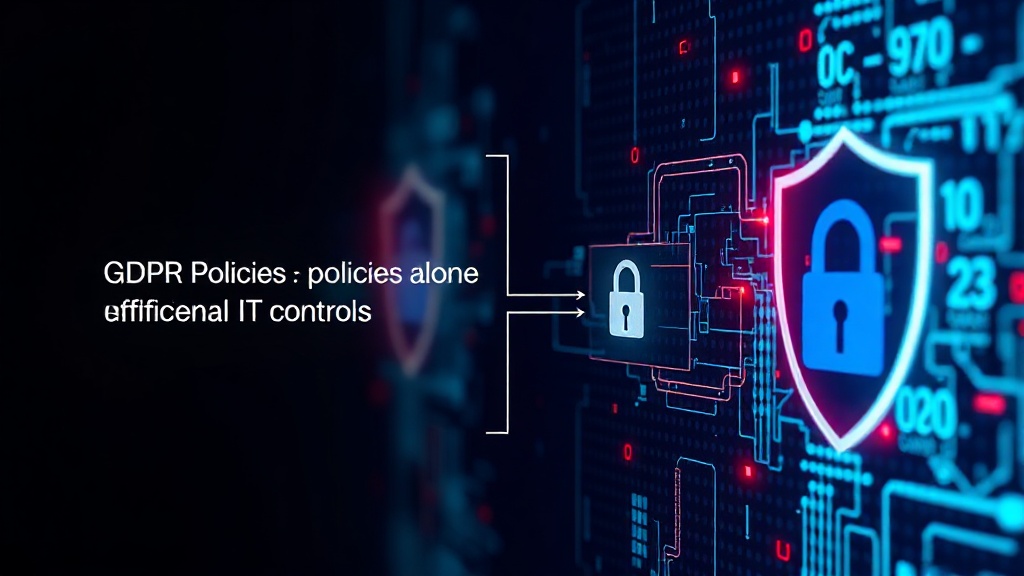
Achieving and maintaining GDPR compliance requires a deep integration of privacy principles into the IT operational fabric. This involves more than just implementing security software; it demands a strategic approach to data management, lifecycle, and access control.
Consider the lifecycle of personal data. From collection to storage, processing, transfer, and eventual deletion, each stage must be governed by controls that align with GDPR mandates. This includes implementing mechanisms for data subject access requests (DSARs), ensuring data is only retained for as long as necessary, and securely deleting data when requested or when its purpose has expired. These actions are not policy decisions; they are operational tasks that require precise execution within the IT environment.
Data recovery capabilities are also central to GDPR. Article 32 of GDPR mandates appropriate technical and organisational measures to ensure the ongoing confidentiality, integrity, availability, and resilience of processing systems and services. This directly translates to having robust backup and disaster recovery strategies in place. The ability to restore data quickly and reliably is not just about business continuity; it's about ensuring the continued availability of data for data subjects and for the organization's own compliance obligations.
Moreover, the concept of data minimization, while a policy principle, is operationally enforced by limiting the collection and retention of personal data. Systems must be designed to collect only what is necessary and to purge data automatically when it is no longer required. This requires careful configuration and ongoing management of databases, file systems, and cloud storage.
Bridging the Policy-Operations Divide
The most effective GDPR compliance strategies recognize that policies and operations are two sides of the same coin. Organizations must move beyond a purely legalistic approach and foster a culture where IT operations are intrinsically linked to privacy and data protection goals.
This requires several key shifts:
- Cross-functional collaboration: Legal, compliance, and IT teams must work in tandem. IT teams need to understand the 'why' behind privacy requirements, and legal teams need to understand the operational realities and constraints.
- Investing in technology: Implementing tools for data discovery, classification, access monitoring, automated deletion, and robust backup/recovery is essential. These are not optional extras but core components of a compliant infrastructure.
- Continuous monitoring and auditing: Compliance is not a one-time event. Regular audits of operational controls, log reviews, and penetration testing are necessary to ensure that controls remain effective and that policies are being followed in practice.
- Training and awareness: IT staff must be trained on GDPR principles and how they translate into their daily tasks. This ensures that operational decisions are made with privacy in mind.
Ultimately, GDPR compliance is only as strong as the operational controls that support it. A privacy policy gathering dust on a server is a liability, not an asset. True compliance means embedding data protection principles into the very fabric of an organization's IT infrastructure and daily workflows, providing verifiable evidence that personal data is protected, managed, and available as required by law.