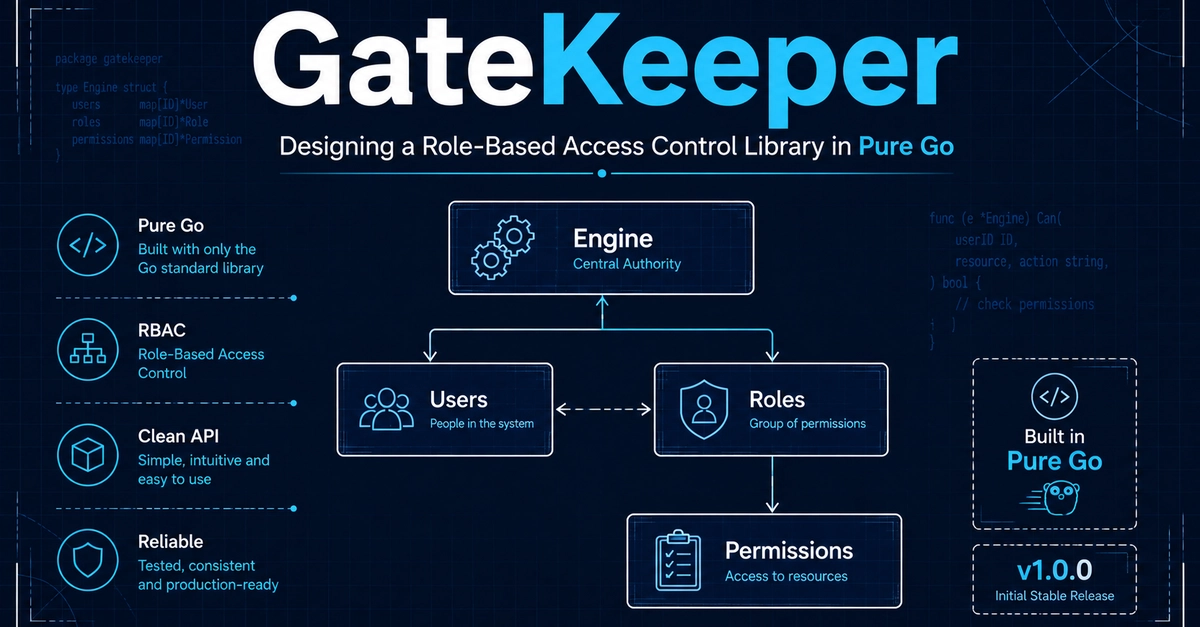
The Genesis of GateKeeper
In the daily grind of software development, authorization libraries are ubiquitous. They are the silent guardians of web applications, APIs, and internal tools, dictating precisely who can access what. Yet, for Dhaval Rasputala, a backend development novice, the inner workings of these essential tools remained a mystery. Rather than abstracting this complexity with an off-the-shelf solution, Rasputala embarked on a project to build his own Role-Based Access Control (RBAC) library from the ground up, using nothing but Go’s standard library. This endeavor culminated in the release of GateKeeper v1.0.0.
Motivations for a Custom Build
Rasputala’s decision to build his own RBAC library was driven by several key motivations. Primarily, as a beginner in backend development, he sought a deep, practical understanding of how public APIs function and the underlying engineering principles. This hands-on approach offered invaluable exposure to system design and implementation details often overlooked when using pre-built components. Furthermore, the exercise served as a rigorous test of his Go programming skills. The language’s strict error handling mechanisms, a common point of learning for newcomers, became a focal point, forcing him to confront and internalize best practices. More broadly, the project was an exercise in demystifying the engineering decisions that shape public libraries. Instead of passively consuming tutorials, Rasputala chose the active route of building, learning by doing and understanding the trade-offs involved in library design.
Project Goals and Design Philosophy
Before a single line of code was written, Rasputala established clear project goals. The primary objective was to create a robust RBAC library that adhered strictly to Go’s standard library. This constraint ensured a lean, dependency-free implementation, promoting portability and reducing potential vulnerabilities associated with third-party packages. The design prioritized clarity and simplicity, aiming for an API that was both intuitive for developers and easy to integrate into existing Go projects. Key considerations included efficient permission checking, flexible role management, and clear error reporting. The library needed to support common RBAC patterns, such as assigning multiple roles to users and defining hierarchical permissions, without introducing unnecessary complexity. The emphasis was on building a system that was not only functional but also a pedagogical tool, illuminating the principles of secure access control design for its creator and, by extension, its users.
GateKeeper Architecture and Core Components
GateKeeper’s architecture is built around a few fundamental concepts: Roles, Permissions, and Policies. A Role represents a collection of permissions. A Permission is a specific action that can be performed on a resource (e.g., `read:users`, `write:posts`). A Policy is the overarching structure that defines the relationships between roles, permissions, and the resources they apply to. The library uses a declarative approach to define these relationships. Developers define their roles and the permissions associated with each role. This definition is then used to construct a GateKeeper instance. The core of the library is the `Can` function, which takes a user (represented by their roles) and a requested permission, and determines if the user is authorized. Internally, GateKeeper efficiently checks if any of the user’s assigned roles possess the requested permission. This is achieved through optimized data structures that allow for quick lookups, avoiding linear scans of roles or permissions where possible. The library supports the concept of resource-specific permissions, allowing fine-grained control beyond simple action-based authorization. For instance, a user might have permission to `read:users`, but only for specific user IDs, adding another layer of security. Error handling is paramount, with specific error types returned for different failure conditions, such as invalid role definitions or insufficient permissions, aiding developers in debugging authorization logic.
Implementing Role-Based Access Control
The implementation of RBAC in GateKeeper follows a pattern familiar to many authorization systems but executed with Go’s idiomatic style. A central `GateKeeper` struct holds the defined policies. When a new `GateKeeper` is initialized, it accepts a map where keys are role names (strings) and values are slices of permissions (strings). For example, a `User` role might have `['read:profile', 'update:profile']` permissions, while an `Admin` role could have `['read:users', 'write:users', 'delete:users', 'read:profile']`. The library ensures that duplicate permissions within a role definition are handled gracefully, typically by deduplicating them upon initialization. The `Can` method is the primary interface for checking authorization. It accepts a slice of role names associated with the current user and the permission string being requested. The logic iterates through the user’s roles. For each role, it retrieves the associated permissions from the `GateKeeper`’s policy store. If the requested permission is found within any of the user’s roles, `Can` returns `true`. If the loop completes without finding the permission, it returns `false`. This process is straightforward but effective for many common use cases. Advanced features, such as nested roles or permission inheritance, were intentionally omitted in v1.0.0 to maintain simplicity, but the design allows for future extensions. The choice to use simple string slices for permissions is a trade-off between flexibility and performance; for extremely large permission sets, more optimized data structures like sets or bitmasks could be considered in future versions.
Handling Edge Cases and Future Considerations
During the development of GateKeeper, several edge cases were identified and addressed. One crucial aspect is the handling of undefined roles or permissions. The library’s initialization process includes validation to ensure that all referenced permissions exist within the defined roles, preventing runtime errors. If a user is passed with a role that hasn’t been defined in the policy, GateKeeper currently treats this as an empty set of permissions for that role, effectively denying any requests made under that unknown role. This is a safe default, prioritizing security. Another consideration is the performance implications of checking authorization. For applications with a very high volume of authorization checks, the current string-matching approach might become a bottleneck. Future versions could explore optimizing permission lookups using more advanced data structures, such as hash sets or bitmasks, especially if permissions can be enumerated and mapped to integers. The decision to rely solely on the Go standard library, while a strength for dependency management, means that features like complex attribute-based access control (ABAC) or integration with external policy engines are outside the scope of the current design. However, the foundational RBAC structure is extensible. Developers can potentially build upon GateKeeper by creating their own wrappers or extensions that incorporate these more advanced concepts. The library’s design is a testament to the power and sufficiency of Go’s standard library for building foundational software components.