
Introducing G#: A New Vision for .NET Development
The .NET ecosystem, a long-standing pillar of enterprise and application development, is getting a new contender: G#. This nascent programming language aims to bridge the gap between the established power of .NET and the developer-friendly ergonomics found in modern languages like Go, Kotlin, and Swift. The project, spearheaded by David Obando, envisions a language that is both powerful and pleasant to use, directly addressing common pain points and offering a fresh perspective on C# and its contemporaries.
G# is not an attempt to replace C#, but rather to offer an alternative that learns from the successes and failures of other languages. The core philosophy revolves around bringing a set of desirable features—conciseness, clarity, and modern concurrency primitives—into the .NET runtime. This means developers can potentially leverage the mature .NET ecosystem, including its vast libraries and tooling, while writing code that feels more aligned with the current generation of programming paradigms.
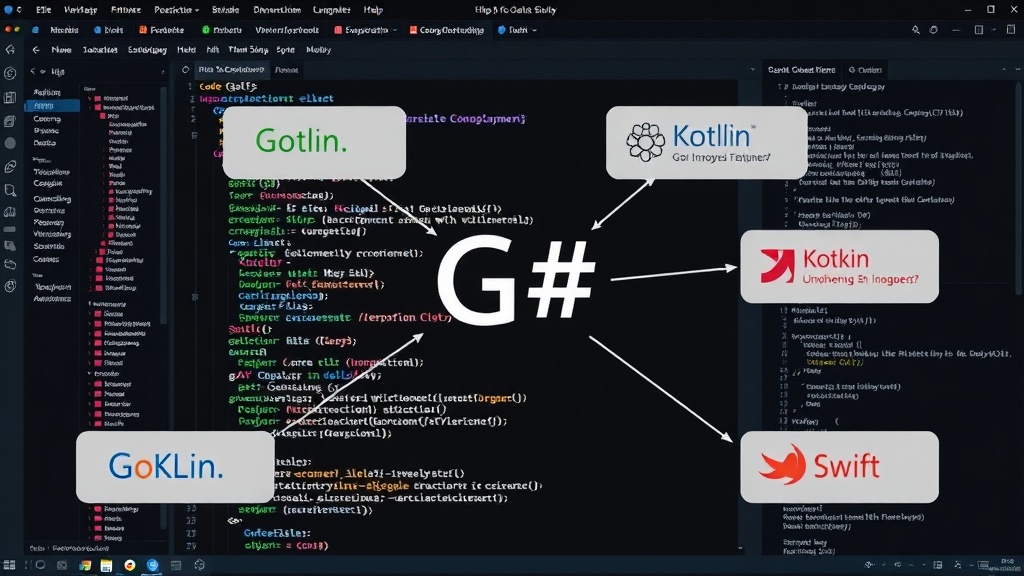
The inspiration is drawn directly from the strengths of languages that have gained significant traction. From Go, G# borrows the simplicity and explicit handling of concurrency, particularly its goroutine-like constructs for lightweight, concurrent execution. Kotlin's influence is visible in its null safety features and more expressive syntax, aiming to reduce boilerplate and prevent common runtime errors. Swift's impact can be seen in its focus on safety, modern control flow, and a clean API design, making common tasks more straightforward.
Key Ergonomic Features and Design Principles
At its heart, G# is designed around a few core principles: developer productivity, safety, and performance. The language strives to make common programming tasks easier and less error-prone. This is achieved through a combination of syntactic sugar and fundamental language design choices.
One of the most prominent features is its approach to concurrency. Drawing inspiration from Go's goroutines, G# aims to provide lightweight, concurrent execution units that are easy to spawn and manage. This contrasts with traditional threading models, offering a more scalable and manageable way to handle parallel operations. The language intends to make asynchronous programming feel more natural, reducing the cognitive overhead often associated with managing callbacks or complex async/await patterns.
Null safety is another critical area where G# takes cues from Kotlin. The language incorporates mechanisms to ensure that null references are handled explicitly, significantly reducing the dreaded `NullPointerException` or its .NET equivalent. This is achieved through nullable and non-nullable types, forcing developers to consider nullability at compile time rather than runtime. This proactive approach to safety is a hallmark of modern language design and a welcome addition for developers accustomed to such features.
Furthermore, G# adopts a more concise and expressive syntax. This includes features like type inference, simplified lambda expressions, and streamlined collection literals. The goal is to reduce the amount of code needed to express common logic, making code easier to read and write. This conciseness is particularly important for rapid development and for onboarding new developers to the .NET platform.
Interoperability and the .NET Ecosystem
A crucial aspect of G#'s design is its seamless integration with the existing .NET ecosystem. G# is intended to compile to .NET Intermediate Language (IL), meaning it can run on the .NET runtime and leverage the .NET Standard libraries and framework components. This interoperability is not an afterthought; it's a foundational requirement. Developers can call into existing C# libraries from G# and vice-versa, allowing for gradual adoption and integration into existing projects.
This approach provides significant advantages. Developers don't need to abandon their current .NET investments. They can start using G# for new components or refactor existing ones incrementally. The mature tooling within the .NET ecosystem, such as Visual Studio and VS Code with appropriate extensions, is also expected to support G#, providing familiar debugging, IntelliSense, and build experiences.
The ability to interoperate with C# also means G# benefits from the performance characteristics of the .NET runtime. While the language itself introduces ergonomic improvements, the underlying execution engine remains the highly optimized .NET runtime. This allows G# to offer performance comparable to C# for many workloads, without sacrificing developer experience.
Potential Impact and Future Outlook
G# enters a landscape where developers are constantly seeking tools that enhance productivity and reduce complexity. While C# remains the dominant language on .NET, languages like F# have carved out their niches, and the introduction of G# suggests a growing appetite for diverse programming paradigms within the .NET world.
The success of G# will likely depend on several factors. Firstly, the completeness and stability of the language and its compiler are paramount. Developers need confidence that the language is well-supported and will evolve predictably. Secondly, the community adoption will be key. A vibrant community can drive the development of libraries, tooling, and educational resources, making G# more attractive to a broader audience.
What remains to be seen is how G# will differentiate itself in practice. While the ergonomic inspirations are clear, the unique value proposition will emerge as developers start using it for real-world projects. Will its concurrency model truly simplify complex distributed systems on .NET? Will its null-safety features offer a tangible reduction in bugs compared to C#'s current approaches? The answers to these questions will shape G#'s trajectory.
For developers already invested in the .NET ecosystem, G# represents an exciting possibility. It offers a chance to experience modern language design principles without leaving the robust .NET environment. If G# can deliver on its promise of combining the power of .NET with the elegance of Go, Kotlin, and Swift, it could become a significant addition to the developer's toolkit.