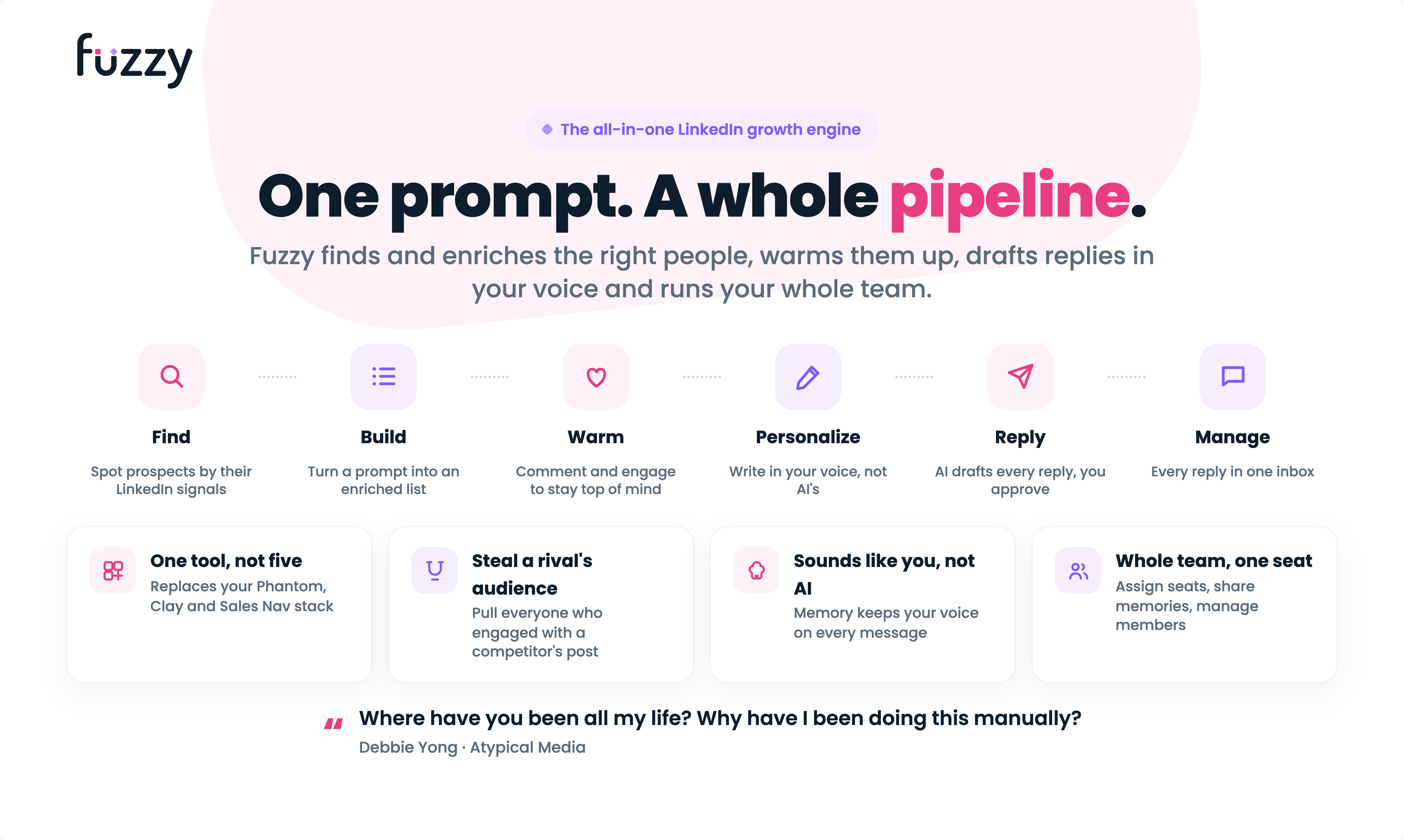
Fuzzy AI: Warming Up Prospects
Fuzzy AI is a new product designed to "warm up" prospects before sales outreach. The core idea is to engage potential customers in a meaningful way before a human sales representative makes contact. This approach aims to increase the effectiveness of sales pitches by ensuring that the prospect is already familiar with and receptive to the company or product.
The product's functionality appears to focus on pre-engagement strategies. While the specifics of how Fuzzy AI achieves this "warming up" are not detailed in the provided excerpt, the implication is that it automates or assists in creating initial touchpoints that build rapport or interest. This could involve personalized content delivery, automated engagement sequences, or intelligent interaction analysis to identify optimal times and methods for human outreach.
The goal is to make the subsequent sales conversation more productive. By reducing the friction of initial contact and establishing a degree of familiarity, Fuzzy AI seeks to improve conversion rates and shorten sales cycles. This aligns with a broader trend in sales technology towards leveraging automation and AI to streamline and enhance customer interactions at every stage of the funnel.
The platform is positioned as a solution for sales teams looking to optimize their prospecting efforts. It suggests a move away from cold, unsolicited outreach towards a more curated and informed approach. The effectiveness of such a tool would hinge on its ability to genuinely add value to the prospect's experience without feeling intrusive or overly automated.
Skippr AI: The Live AI Employee
Skippr AI takes a different approach, positioning itself as a "live AI employee inside your product." This suggests an embedded AI agent designed to interact directly with users within the product itself, providing real-time support, guidance, or engagement.
The concept of a live AI employee implies a persistent, interactive presence. Unlike a chatbot that might be accessed on demand, a live employee is always there, ready to assist. This could manifest in several ways: offering contextual help as a user navigates the product, proactively suggesting features based on user behavior, or even facilitating onboarding and training in real-time. The key differentiator here is the "inside your product" aspect, meaning it's not a separate tool but an integrated part of the user experience.
This embedded AI could serve multiple functions. For user support, it could answer frequently asked questions, troubleshoot common issues, or guide users through complex workflows, thereby reducing the load on human support teams and improving user satisfaction. For product teams, it could act as an intelligent assistant, helping users discover and leverage the full capabilities of the product, potentially increasing feature adoption and user retention. It might also gather user feedback implicitly by observing interaction patterns or explicitly by asking targeted questions.
The term "serving every user" suggests a scalable solution capable of handling a large user base simultaneously. This implies a robust AI infrastructure capable of personalized interactions at scale. The potential benefits include a more engaging and supportive user experience, leading to higher customer loyalty and reduced churn. It also opens up avenues for personalized user journeys and tailored feature recommendations.
Market Context and Implications
Both Fuzzy AI and Skippr AI represent the growing integration of artificial intelligence into customer-facing business processes. Fuzzy AI focuses on the top of the sales funnel, aiming to improve lead qualification and initial engagement. Skippr AI, on the other hand, operates within the product itself, enhancing the user experience and potentially driving deeper engagement and retention.
The market for AI-powered sales and customer success tools is rapidly expanding. Companies are increasingly looking for ways to leverage AI to automate repetitive tasks, personalize interactions, and gain deeper insights into customer behavior. Fuzzy AI taps into the need for more effective outbound sales strategies, while Skippr AI addresses the demand for seamless, in-product user support and engagement.
The success of these tools will depend on their ability to deliver tangible results. For Fuzzy AI, this means demonstrating a clear ROI in terms of improved lead conversion rates and reduced sales cycle times. For Skippr AI, it means showing a positive impact on user satisfaction, feature adoption, and customer retention. The underlying AI models and the user experience they provide will be critical factors.
The emergence of these specialized AI tools highlights a trend towards more granular AI applications. Instead of broad AI platforms, companies are developing highly focused solutions for specific business problems. This allows for deeper expertise and potentially more effective outcomes in niche areas like pre-sales engagement or in-product user assistance.
A key question for both products is how they handle the balance between automation and human interaction. For Fuzzy AI, the transition from AI-warmed prospect to human sales rep needs to be seamless. For Skippr AI, the AI employee must enhance, not detract from, the user experience, providing helpful assistance without becoming an annoyance or a barrier. The ethical implications of AI-driven engagement and support also warrant consideration as these tools become more sophisticated and pervasive.