The Core Question: From Understanding to Application
Many developers grapple with a common sentiment: "This framework is excellent, but how do I apply it to real-world projects?" This question echoes within the FROST community as well, with feedback suggesting a gap between understanding the essence of an Agent (demonstrated in a concise 500-line codebase) and knowing how to transition from "getting it" to "doing it." This article bridges that gap by illustrating the same practical task within both FROST and FROST-SOP, revealing them not as distinct entities but as different resolutions of the same concept.
Today's Task: Automating Daily Work Reports
Imagine you're a solo developer aiming to automate the generation of your daily work reports. The requirements are straightforward:
- Gather tasks completed today.
- Use a Large Language Model (LLM) to synthesize a report summary.
- Email the summary to yourself.
This three-step process serves as our benchmark. We will now examine how this task is implemented in both FROST and FROST-SOP.
First Stop: FROST – Understanding the Essentials in Minimal Code
FROST's philosophy centers on distilling Agent functionality to its core. The goal is to present the fundamental logic in approximately 500 lines of code, enabling users to grasp the underlying principles. From this foundation, users are expected to naturally extend their understanding and application.
In FROST, an Agent's operation is typically constructed from four atomic components:

These components, though abstract in FROST's minimal representation, embody the essential stages of Agent execution: input processing, task execution, decision-making, and output generation. For our daily report task, this would translate to a simplified flow where inputs (today's completed tasks) are processed, an LLM call is made for summarization, and a basic output (the email content) is formed. The emphasis here is on the conceptual framework, providing a blueprint rather than a fully fleshed-out application.
Second Stop: FROST-SOP – Detailing the Workflow for Practical Application
FROST-SOP (Standard Operating Procedure) takes the foundational concepts of FROST and elaborates on them, providing a more detailed, step-by-step implementation suitable for real-world deployment. If FROST is the blueprint, FROST-SOP is the construction manual, replete with specific instructions and considerations.
For the automated daily report task, FROST-SOP would break down each of the three core requirements into more granular steps:
1. Collecting Today's Completed Tasks
In FROST-SOP, this step might involve:
- Defining specific methods for task logging (e.g., integrating with a project management tool API, parsing a daily log file, or querying a personal knowledge base).
- Implementing error handling for cases where task data is incomplete or inaccessible.
- Structuring the collected task data in a format suitable for LLM input.
This level of detail ensures that the Agent can reliably acquire the necessary information, accounting for potential real-world complexities.
2. Generating the Daily Report Summary with LLM
The LLM integration in FROST-SOP would be significantly more detailed than in FROST:
- Specifying the exact LLM model to be used (e.g., GPT-4, Claude 3 Opus).
- Crafting detailed prompts that guide the LLM to produce a concise, professional, and informative summary, potentially including tone and length constraints.
- Implementing parameters for temperature, top-p, and other generation controls to fine-tune the output.
- Handling API calls, including authentication, rate limiting, and error responses from the LLM service.
This ensures that the report generated is not just a summary, but a high-quality, consistent output tailored to the user's needs.
3. Sending the Email Report
The final step, emailing the report, is also expanded in FROST-SOP:
- Configuring email service credentials (e.g., SMTP server details, API keys for services like SendGrid or Mailgun).
- Defining email recipients, subject lines, and body formatting.
- Implementing logic for sending the email, including retry mechanisms for transient network failures.
- Potentially adding features like attachments or custom email templates.
This ensures the report reaches its destination reliably and in the desired format.
FROST vs. FROST-SOP: Resolution and Abstraction
The key takeaway is that FROST and FROST-SOP are not alternative systems but complementary views of the same Agent development paradigm. FROST offers a high-level, conceptual understanding – think of it as a satellite image of a city, showing the overall layout and major landmarks. It's perfect for grasping the fundamental architecture and flow of an Agent.
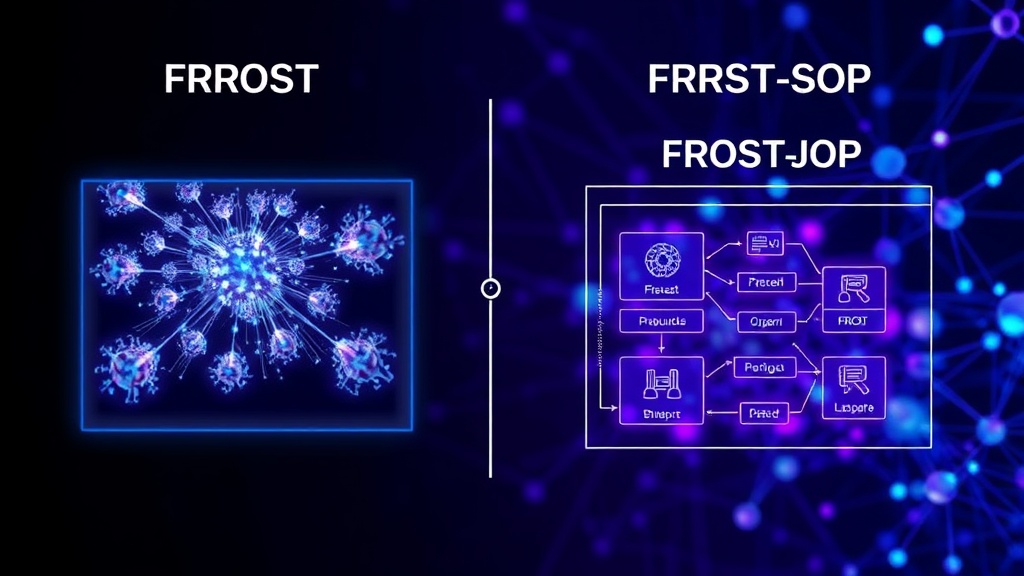
FROST-SOP, conversely, is like the street-level map of that same city. It provides the granular details, the specific pathways, the turn-by-turn directions needed to navigate and build. It translates the abstract concepts of FROST into actionable implementation steps. For our automated daily report task, FROST shows you *what* an Agent does conceptually, while FROST-SOP shows you *how* to build it practically, addressing every potential snag along the way.
What This Means for Developers
If you're learning about Agents, starting with FROST is like learning the alphabet before writing a novel. It builds intuition. Once you understand the core mechanics, you can then turn to FROST-SOP to see how those mechanics are practically applied to solve a specific problem like automating your daily reports. This layered approach accelerates learning and practical application, transforming theoretical knowledge into tangible results. The transition from understanding to building becomes a natural progression, not a daunting leap.