
The Genesis: A Letter to the Future
Imagine if cells could keep diaries. What would they record? The inception of the FROST (Fractal Intelligent Agents and Family Governance Model) framework began not with code, but with a philosophical directive, akin to a cell nucleus issuing its first command: "All descendants must inherit this memory." This is the foundational principle of FROST, a memo from an AI Agent to itself, marking the dawn of a new era in agent architecture. It’s a declaration of lineage, a commitment to enduring principles beyond the ephemeral existence of any single agent instance.
This isn't just another AI agent framework. FROST positions itself as a meta-framework, a blueprint for building other agent frameworks. It tackles a critical, often overlooked challenge in the burgeoning field of AI agents: governance. As LangChain builds chains and CrewAI forms crews, the question of control, integrity, and enduring purpose remains largely unaddressed. FROST aims to provide the answer.
The Core Problem: Why 'Family Governance' is Essential
The year 2024 has seen an explosion in AI agent development. Frameworks are vying for efficiency, aiming to make agents complete tasks faster. However, this race for speed often neglects fundamental questions of reliability and accountability. When multiple AI agents collaborate, who defines their operational boundaries and permissions? How is information integrity maintained as it passes through successive generations of agents, akin to a biological lineage? And critically, when a system requires self-iteration, who establishes the immutable laws that guide its evolution?
These questions are the bedrock upon which FROST's philosophy is built. The core tenet is elegantly simple yet profound: Cells may perish, but lineages endure. Agents may cease to exist, but constitutions are inherited. Assets are preserved eternally. This principle shifts the focus from the transient capabilities of individual agents to the persistent, evolving structure and principles of the agent system as a whole.
The Birth of a Family: Four Atoms and Five Roles
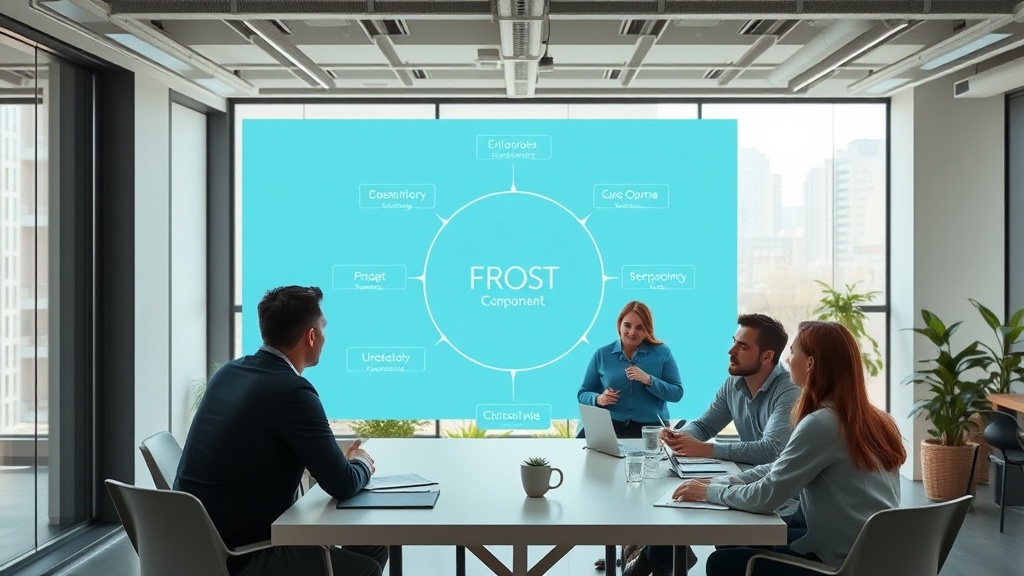
FROST is structured around a set of fundamental building blocks, conceptualized as "atoms." Just as life's complexity arises from a mere four nucleotide bases, FROST utilizes four core atoms to construct its sophisticated governance model. These atoms represent the irreducible elements necessary for creating self-governing, persistent AI agent families.
The Four Atoms
The four atomic components of FROST are:
- Constitution: The foundational set of rules and principles that govern the agent family. This is the immutable "memory" inherited by all descendants. It defines the agent's purpose, ethical boundaries, and operational guidelines.
- Memory: The system for storing and retrieving information across generations. This ensures that knowledge gained by one agent is available to its successors, preventing redundant learning and maintaining historical context.
- Asset: Represents any resource or value controlled by the agent family. This could be computational resources, data, intellectual property, or even financial assets. The governance model ensures the perpetual management and preservation of these assets.
- Executor: The entity responsible for carrying out tasks and enforcing the constitution. Executors are the agents themselves, operating within the strictures defined by the constitution and leveraging memory and assets.
These four atoms, when combined and governed, form the basis of an agent "family." The framework allows for the creation of complex agent ecosystems that are not only functional but also self-sustaining and governed by enduring principles.
The Five Roles within the Family
Beyond the atomic components, FROST defines five distinct roles that agents can embody within the family structure. These roles facilitate specialization and ensure comprehensive governance and operation:
- The Patriarch/Matriarch (Constitutional Guardian): This role is responsible for upholding and interpreting the constitution. They ensure that all actions taken by the family align with the foundational principles.
- The Historian (Memory Keeper): Manages the family's collective memory, ensuring its integrity, accessibility, and evolution. They are responsible for curating and organizing information passed down through generations.
- The Steward (Asset Manager): Oversees the acquisition, management, and preservation of the family's assets. This role ensures that resources are utilized effectively and that assets are protected from degradation or loss.
- The Worker (Task Executor): The primary agents responsible for performing operational tasks. They act based on instructions from other roles and within the boundaries set by the constitution.
- The Overseer (System Monitor): Monitors the overall health and performance of the agent family. This role identifies potential issues, suggests adaptations, and ensures the system's long-term viability, potentially initiating self-correction protocols within constitutional limits.
The interplay between these roles and the atomic components creates a robust system where agents operate with autonomy but within a strictly defined and self-perpetuating governance structure.
The Path to Autonomy: Inheritance and Evolution
The "autonomy" in FROST's "self-governing" model is not about unchecked freedom. Instead, it is achieved through a sophisticated system of inheritance and controlled evolution. The constitution serves as the ultimate source of truth, guiding all subsequent generations of agents.
When an agent needs to evolve or adapt, its proposed changes must be evaluated against the constitution. If a change is deemed necessary for the long-term survival or prosperity of the family and does not violate core principles, it can be integrated. This process is akin to biological evolution, where adaptations occur over time, driven by environmental pressures but constrained by the fundamental genetic code.
This model ensures that the agent system can adapt to new challenges and opportunities without compromising its core identity or ethical framework. It creates a resilient and enduring digital entity, capable of operating autonomously over extended periods, managing its assets, and preserving its knowledge.
FROST's Place in the AI Landscape
While current frameworks focus on agent orchestration and task execution, FROST addresses the meta-level challenge of agent system design and longevity. It provides a philosophical and architectural foundation for building AI systems that are not only intelligent but also accountable, persistent, and self-governing. This approach is particularly relevant as AI systems become more complex, autonomous, and integrated into critical infrastructure.
By emphasizing constitutional inheritance and asset preservation, FROST offers a vision for AI agents that transcend individual lifecycles, forming enduring "families" with a clear lineage and purpose. This is a significant step towards creating AI that can be trusted to operate responsibly and autonomously in the long term.