The Double-Edged Sword of AI Control
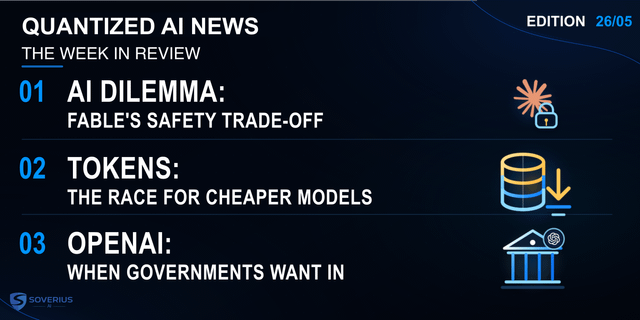
The rapid advancement of artificial intelligence, particularly in the realm of large language models (LLMs) and other frontier AI systems, has sparked a critical debate: how do we ensure these powerful tools are developed and deployed safely and ethically? This discussion often centers on control mechanisms – the guardrails, safety filters, and alignment techniques designed to prevent misuse and unintended consequences. However, a recent analysis, "Quantized AI News 26/05: The Price of Control in Frontier AI," highlights a significant, often overlooked, consequence of this control imperative: a tangible degradation in model performance and capability. The drive for safety, it appears, is not a free upgrade; it comes with a substantial price tag in terms of what these models can actually do.
The core argument presented is that the very processes used to make AI models safer and more controllable inherently limit their potential. This isn't a minor bug or an easily patched issue; it's a fundamental trade-off. When developers implement extensive safety protocols, fine-tune models to refuse certain prompts, or quantize model parameters to reduce computational overhead and potential for emergent dangerous behaviors, they are, in effect, clipping the wings of these advanced systems. The result is that models designed with maximum control may be less capable of complex reasoning, creative generation, or nuanced understanding compared to their less restricted counterparts.
Quantization: A Performance Bottleneck
One of the key techniques discussed is quantization. In the context of AI, quantization refers to the process of reducing the precision of the numbers used to represent a model's parameters (weights and activations). Typically, models are trained using high-precision floating-point numbers (like 32-bit floats). Quantization reduces this precision, often to 8-bit integers or even lower. The primary motivations for quantization are manifold: reducing memory footprint, decreasing computational requirements (leading to faster inference and lower energy consumption), and, crucially in the context of frontier AI, potentially mitigating risks associated with model instability or emergent capabilities that are difficult to predict or control.
However, this reduction in precision is not without cost. Lower precision means less granular representation of the model's learned knowledge. Think of it like trying to describe a subtle color gradient using only a few basic crayon colors instead of a full spectrum. The finer details, the subtle distinctions, are lost. For LLMs, this can translate into a diminished capacity for complex logical deduction, a reduced ability to generate highly creative or novel text, and a less nuanced understanding of context. The analysis suggests that the benefits of quantization in terms of efficiency and control might be directly countered by a loss in the very intelligence and capability that make frontier AI so promising.

The Spectrum of Control and Capability
The article posits that there exists a spectrum, with one end representing highly controlled, potentially less capable models, and the other end representing highly capable, but potentially riskier, less controlled models. Frontier AI developers are constantly navigating this spectrum. The pressure from regulators, the public, and internal safety teams pushes them towards the controlled end. Yet, the pursuit of AI's ultimate potential – solving complex scientific problems, driving unprecedented economic growth, or achieving artificial general intelligence – requires pushing towards the capable end.
This tension creates a challenging environment. If a company releases a model that is deemed too unsafe, the backlash can be severe, leading to regulatory scrutiny, public distrust, and significant financial repercussions. Conversely, if a company releases a model that is overly restricted, it may be perceived as falling behind competitors, failing to deliver on the transformative promise of AI, and potentially missing out on critical research breakthroughs that could have widespread benefits. The 'price of control' is therefore not just a technical one, but also a strategic and market-facing one.
Alignment Tax: A Broader Concern
The concept of the 'price of control' aligns closely with the broader AI research concept known as the "alignment tax." This term refers to the performance degradation that occurs when models are fine-tuned or otherwise modified to align with human values and safety guidelines. Techniques like Reinforcement Learning from Human Feedback (RLHF), which is widely used to make LLMs more helpful, honest, and harmless, are prime examples. While RLHF has been instrumental in making models more user-friendly and less prone to generating harmful content, studies have indicated that it can also reduce a model's raw capabilities, such as its ability to perform complex mathematical reasoning or generate diverse creative outputs.
The "Quantized AI News" piece seems to suggest that quantization is a particularly potent form of this alignment tax, especially in the context of frontier models. It's a method that directly impacts the model's internal representation of knowledge and computation, potentially leading to more fundamental limitations than some other alignment techniques. The question then becomes: how much performance are we willing to sacrifice for safety? And, more importantly, is the trade-off truly effective, or are we merely creating a facade of safety while potentially losing valuable capabilities?
The Unanswered Question: Is There a True Equilibrium?
What remains an open question is whether a true equilibrium can be found between AI capability and control. Can we develop novel architectures, training methodologies, or alignment techniques that offer robust safety without significantly compromising performance? Or are we destined to operate on a spectrum where every step towards greater safety is a step away from maximum potential? The current trajectory suggests a difficult balancing act, with the risk of over-correction leading to AI systems that are perhaps safe, but ultimately too limited to fulfill their most ambitious promises.
For developers and researchers working on the cutting edge, understanding this trade-off is paramount. It influences architectural choices, training strategies, and the very definition of success for a frontier AI model. The pursuit of AI's full potential may require a re-evaluation of current control paradigms, exploring methods that are less about restriction and more about steerability and understanding emergent behaviors, rather than simply suppressing them. The future of AI development hinges on navigating this complex landscape, ensuring that our quest for control does not inadvertently hobble the very intelligence we are striving to create.