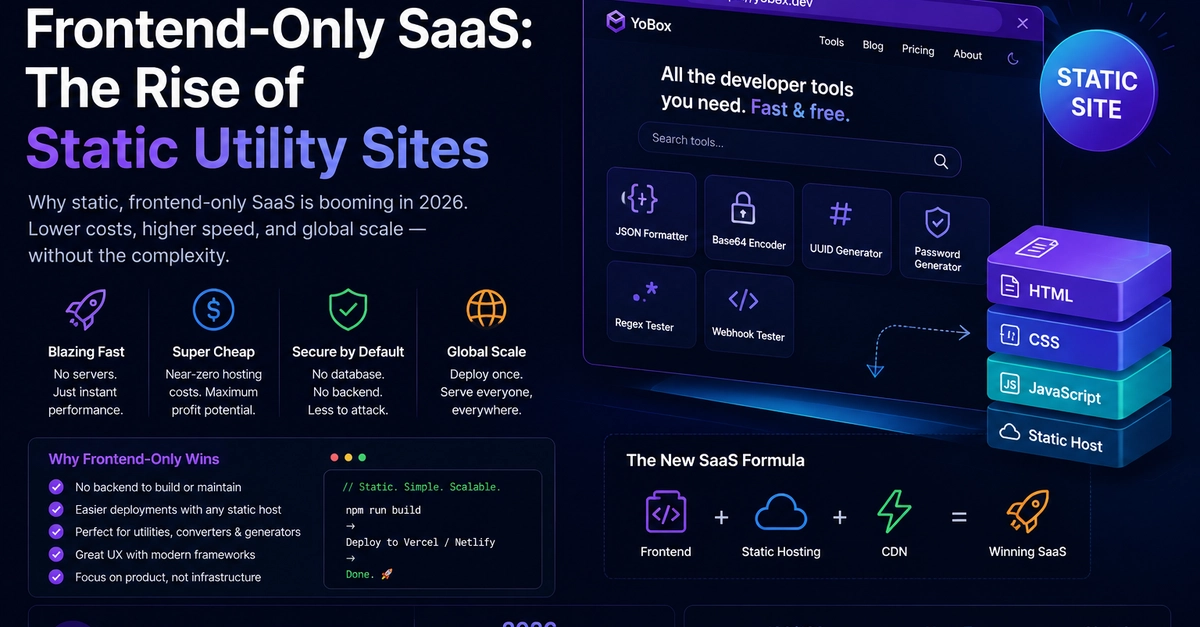
The Frontend-Only SaaS Revolution
The landscape of Software as a Service (SaaS) is undergoing a significant shift, driven by the maturation of web browser capabilities and the proliferation of robust third-party APIs. What was once a niche concept, often limited to simple landing pages that funneled users to a traditional backend, is now a legitimate and powerful development paradigm. This new wave of "frontend-only SaaS" allows developers to ship serious, functional developer tooling and utility applications without provisioning a single server or managing a database. The core of this transformation lies in the browser itself becoming a capable runtime environment.
Five years ago, the idea of a frontend-only SaaS was largely aspirational. Applications requiring any significant processing, state management, or user data would inevitably necessitate a backend. However, the browser's evolution has dramatically changed this equation. Modern browser APIs such as Web Crypto for generating high-quality cryptographic entropy, Web Workers for offloading computationally intensive tasks, and WebAssembly for running near-native code have equipped frontend developers with tools previously confined to server-side environments. Complementing these native browser capabilities are generous and accessible third-party APIs, like those offered by mail.gw for email services or webhook.site for testing webhooks, further reducing the need for custom backend infrastructure.
What You Save: Infrastructure Costs and Complexity
The most immediate and tangible benefit of the frontend-only SaaS model is the drastic reduction in infrastructure overhead. By eliminating the need for servers, developers sidestep the complexities of managing Node.js processes, scaling server fleets, and dealing with the associated operational costs. This means no more worrying about server uptime, patching operating systems, or optimizing server performance. The operational burden of maintaining a backend is effectively removed from the developer's plate.
Furthermore, the reliance on client-side storage, primarily localStorage, handles user-scoped state. For utility tools, where data is often personal and ephemeral, localStorage proves to be a surprisingly capable solution for persisting user preferences, session data, or application settings. This eliminates the need for a dedicated database, saving on database hosting fees, maintenance, and the engineering effort required to design and manage a database schema. The complexity of database administration, from backups to query optimization, simply vanishes.
Authentication, a common hurdle in traditional SaaS development, is often unnecessary for many frontend-only utility tools. For applications focused on a single user performing a specific task, robust authentication mechanisms can be overkill. If authentication is required, solutions like OAuth with services that can be integrated directly on the frontend, or even simple API key management handled client-side for specific service integrations, can suffice without a dedicated backend authentication service.
What You Lose (And When to Reintroduce It)
While the benefits are compelling, the frontend-only approach does come with trade-offs. The primary sacrifices are typically centralized analytics, multi-device synchronization, and robust abuse rate-limiting. Without a backend server, collecting aggregated user analytics becomes more challenging. Implementing comprehensive tracking requires client-side solutions, which can be less reliable and more prone to ad-blocker interference. Similarly, synchronizing data across multiple devices for a single user is not natively supported by localStorage and would require a backend synchronization service.
Abuse prevention is another area that requires careful consideration. While client-side validation can deter casual misuse, sophisticated attackers can bypass frontend controls. For tools that might be subject to abuse, such as API testing utilities or automated task runners, implementing rate-limiting and other abuse mitigation strategies would necessitate a backend component. The crucial insight here is that these features are not necessarily lost forever; they are simply deferred. The strategy is to launch lean and add these capabilities only when the tool achieves sufficient popularity and demonstrates a clear need for them. This is a form of progressive enhancement for the business model itself.
YoBox, a prime example of this paradigm, has transitioned to a pure static Single Page Application (SPA). Built with Vite, a modern frontend build tool, it can be hosted on virtually any affordable shared hosting plan, underscoring the minimal infrastructure requirements. This move signifies a commitment to the frontend-only architecture for a tool that previously might have been assumed to require a backend.
Why Frontend-Only SaaS is Suddenly Viable
The convergence of several technological advancements has made frontend-only SaaS a reality in 2026. The browser has transformed from a simple document renderer into a powerful and versatile computing platform. Web APIs have matured significantly, offering capabilities that were once exclusive to server-side environments. Web Crypto API provides secure and efficient cryptographic operations, essential for tasks ranging from data encryption to secure key generation. Web Workers allow for background execution of JavaScript, preventing the UI from freezing during heavy computations like complex data parsing or intricate algorithms. WebAssembly (Wasm) opens the door to running code written in languages like C++, Rust, or Go directly in the browser at near-native speeds, enabling performance-critical applications.
The proliferation of well-documented and accessible third-party APIs further bolsters this trend. Services that provide email delivery, webhook reception, cloud storage, and even specialized processing capabilities can be integrated directly into frontend applications. This modular approach allows developers to assemble sophisticated applications by orchestrating various services, with the browser acting as the central hub. The development effort shifts from building and maintaining monolithic backends to integrating and managing frontend logic and API connections. This architectural shift significantly lowers the barrier to entry for creating and deploying complex web applications, making the frontend-only SaaS model an attractive option for solo developers and small teams looking to build and monetize utility tools efficiently.