The Microscopic World of Vinyl Playback
Vinyl records, a seemingly analog medium, harbor a complex microscopic world where physics dictates sound reproduction. Frieve Vinyl, a project detailed on GitHub, offers an unprecedented look into this interaction through a microscopic stylus/groove physics simulation. This isn't just about how a needle tracks a groove; it's a granular exploration of the forces, deformations, and energy transfers happening at the nanometer scale between the stylus tip and the vinyl surface.
The simulation aims to bridge the gap between theoretical understanding and practical audio fidelity. While we often talk about the warmth or character of vinyl, the underlying mechanism is a precise mechanical dance. Tiny imperfections in the groove, the material properties of the vinyl, and the geometry of the stylus all play critical roles. Frieve Vinyl attempts to model these elements to quantify their impact on the audible signal. This level of detail is crucial for understanding phenomena like intermodulation distortion, frequency response limitations, and even the wear characteristics of both the stylus and the record.
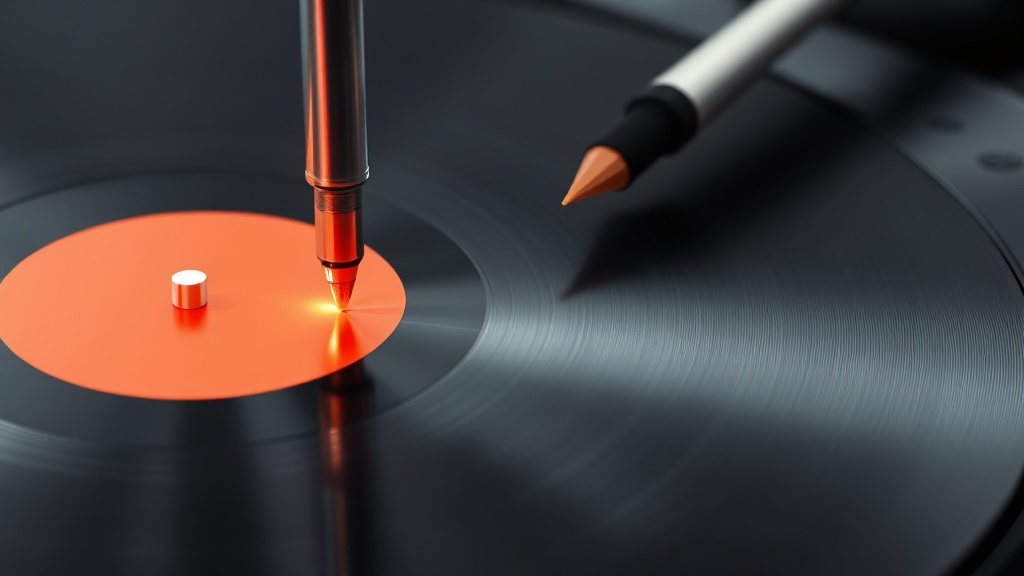
At its core, the simulation likely employs principles from solid mechanics, tribology (the science of friction, wear, and lubrication), and wave propagation. The stylus tip, often a complex shape like a Shibata or MicroLine, interacts with the modulated walls of the vinyl groove. As the stylus moves, it experiences forces that cause it to deform the surrounding vinyl material. This deformation isn't static; it's a dynamic process that generates vibrations. These vibrations are what eventually get amplified and reproduced as sound. The simulation's granularity allows for the study of how the stylus tip's shape, the vinyl's elasticity and plasticity, and the tracking force all influence these vibrations.
Simulating Stylus-Groove Dynamics
The simulation tackles several key aspects of stylus-groove interaction. Firstly, it models the physical deformation of the vinyl. Unlike a rigid track, vinyl is a viscoelastic material. This means it deforms under the stylus pressure, but it also retains some of that deformation and exhibits energy loss during the process. The simulation likely accounts for this by using material models that capture both elastic (recoverable) and plastic (permanent) deformation, as well as damping characteristics. This is vital because the way the vinyl deforms directly influences how the stylus is guided and how energy is dissipated.
Secondly, the simulation must accurately represent the stylus tip's geometry and its interaction with the groove walls. Different stylus profiles are designed to make contact with specific parts of the groove to optimize tracking and minimize wear. For instance, advanced profiles aim to maximize the contact area with the groove walls rather than the groove bottom, which can lead to better high-frequency retrieval and reduced distortion. The simulation would need to calculate the forces exerted by the groove walls on the stylus and the resulting forces from the stylus back onto the groove. These forces are not constant; they vary dynamically with the modulation of the groove.
A critical component of the simulation is the calculation of tracking force and its distribution. The vertical tracking force (VTF) applied by the tonearm is essential for keeping the stylus in the groove. However, this force, combined with the lateral forces generated by the groove modulations, creates complex stress distributions at the contact point. The simulation would need to resolve these forces to predict how the stylus moves and how much energy is transferred into the vinyl material as heat and deformation.
Beyond Simple Tracking: Distortion and Wear
The implications of such a simulation extend far beyond basic tracking. One of the primary goals is to understand and potentially mitigate distortion. Intermodulation distortion (IMD), for example, occurs when different frequencies interact within the groove, creating unwanted sum and difference frequencies. This simulation can help identify the specific physical mechanisms that lead to IMD, such as the stylus being forced to move in a way that is not linearly proportional to the recorded signal, or nonlinearities in the vinyl material's response.
Wear is another significant factor. Both the stylus and the record groove are subject to wear over time. The simulation can provide insights into how different stylus shapes, tracking forces, and vinyl formulations affect the rate and pattern of wear. Understanding wear at a microscopic level can inform the design of more durable styli and records, and help audiophiles make informed decisions about cartridge alignment and stylus replacement. The friction between the stylus and the groove also generates heat, which can further affect the vinyl's properties and contribute to wear.
The project's focus on physics simulation suggests a desire to move beyond anecdotal evidence and subjective listening tests. By providing a quantitative, physics-based model, Frieve Vinyl aims to offer objective data on audio performance. This could lead to more informed cartridge design, better turntable setup recommendations, and a deeper appreciation for the engineering involved in analog audio reproduction. What remains to be seen is how directly the simulation's outputs can be correlated with audible differences in sound quality and how accessible this simulation is to the broader audiophile and engineering communities.
The Future of Vinyl Simulation
The Frieve Vinyl project represents a sophisticated approach to understanding analog audio. By simulating the microscopic physics of stylus-groove interaction, it opens new avenues for research and development in the field of vinyl playback. This detailed modeling can help engineers optimize stylus profiles, material choices, and playback parameters. For enthusiasts, it offers a glimpse into the intricate mechanics that contribute to the unique sound of vinyl. The challenge ahead lies in translating these microscopic insights into tangible improvements in sound reproduction and longevity for vinyl enthusiasts worldwide.