The Problem with Deployed Web Assets
Deploying web applications involves pushing code and static assets to servers. Once deployed, there's a critical need to ensure that what's running on the server is precisely what was intended. Accidental file modifications, incomplete uploads, or even subtle corruption can lead to bugs, security vulnerabilities, or broken user experiences. Traditional methods often rely on manual checks, basic file existence verification, or complex CI/CD pipeline checks that only happen during the build process, leaving a gap for post-deployment integrity issues.
This is where FreshDeploy steps in. Developed by [Developer Name, if available, otherwise omit or use 'a developer'], FreshDeploy is an open-source tool designed to provide a robust solution for verifying the integrity of web deployments after they have been released. It addresses the post-deployment blind spot by offering a mechanism to confirm that the files served to users match the expected state.
Core Functionality: File Integrity Verification
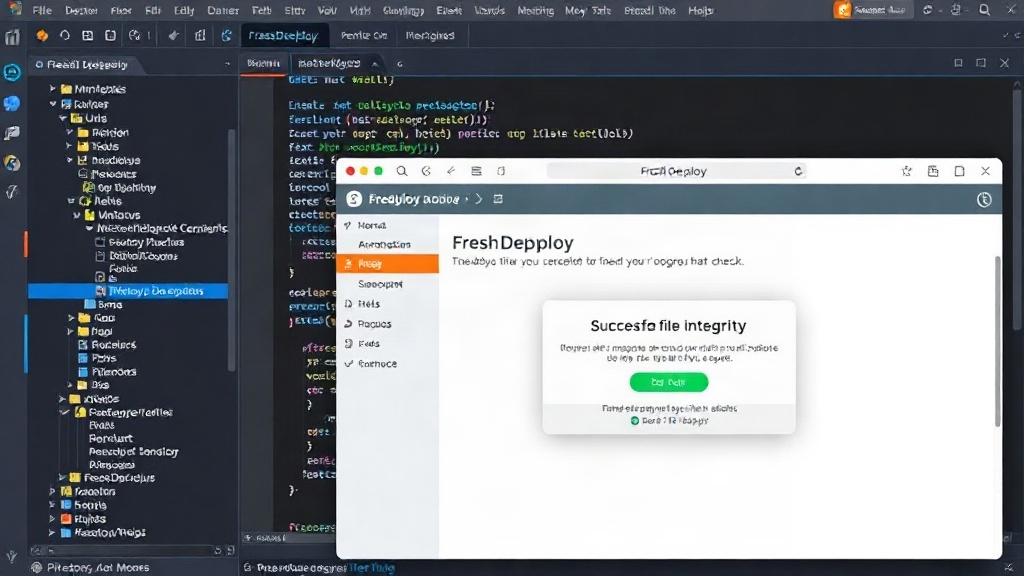
At its heart, FreshDeploy operates by comparing the files present in a deployed environment against a known, trusted source. This trusted source is typically a manifest file generated during the build process, containing checksums (like MD5 or SHA256 hashes) for each file that should be deployed. When FreshDeploy runs, it reads this manifest and calculates the checksums of the corresponding files on the live server. If any checksum does not match, FreshDeploy flags an integrity failure.
This process is analogous to a diligent librarian meticulously checking each book in a returned stack against a master inventory list. If a book is missing, damaged, or replaced with a different edition, the librarian immediately knows something is amiss. Similarly, FreshDeploy acts as that vigilant auditor for your web assets.
The tool can be configured to scan specific directories or a defined set of files. It supports various hashing algorithms, allowing users to choose the level of security and performance they require. The output clearly indicates which files have passed verification and which have failed, providing the specific discrepancies found. This granular detail is crucial for quickly pinpointing the source of any deployment issues.
Detecting Changes and Restoring State
Beyond simple verification, FreshDeploy can also detect changes that have occurred since the last check. If a file was modified without authorization or if an expected file is missing, FreshDeploy will report this. The example provided in the initial documentation shows a scenario where a file was modified and then restored. FreshDeploy successfully detected the modification and, upon restoration, confirmed the file's integrity. This capability is invaluable for security audits and for ensuring that the deployed state remains consistent over time.
Consider a scenario where a critical configuration file is accidentally altered by a system administrator or an automated process. Without a tool like FreshDeploy, this change might go unnoticed until it causes a critical failure. FreshDeploy can be scheduled to run periodically, acting as an automated watchdog that alerts you to any unauthorized or unintended modifications to your deployed application files. This proactive detection mechanism significantly reduces the risk of encountering unexpected downtime or security breaches stemming from configuration drift.
Optional Monitoring Widget
Recognizing that real-time visibility is often desired, FreshDeploy offers an optional monitoring widget. This widget can be embedded directly into the web application's frontend. It provides users with a subtle, non-intrusive indicator of the application's deployment status or integrity. While not a replacement for comprehensive backend monitoring, this widget can offer end-users a visual cue about the application's health, potentially reducing support tickets related to perceived outages or performance issues.
The widget's implementation is designed to be lightweight, ensuring it does not negatively impact the performance of the application it's monitoring. Its primary purpose is to provide an additional layer of transparency. For instance, if FreshDeploy detects an integrity issue on the backend, the widget could visually change to indicate a degraded service status to the end-user. This immediate feedback loop can manage user expectations during incidents and provide them with assurance when the application is operating correctly.
Use Cases and Implementation
FreshDeploy is particularly useful for applications where the integrity of static assets is paramount. This includes content management systems, e-commerce platforms, single-page applications, and any web service that relies on a consistent set of files being served to clients. Developers can integrate FreshDeploy into their CI/CD pipelines, using it as a final verification step before marking a deployment as complete. Alternatively, it can be run as a standalone service or a cron job on the server for continuous monitoring.
The open-source nature of FreshDeploy means it can be customized and extended to fit specific project requirements. Its simplicity makes it accessible for developers looking for a straightforward solution without the overhead of larger monitoring suites. The tool's effectiveness hinges on the generation of an accurate manifest file during the build process. This manifest acts as the single source of truth against which all deployed files are validated.
The Unanswered Question: Scalability and Performance at Scale
While FreshDeploy offers a compelling solution for verifying web deployments, a key question remains: how does it perform under extreme load or with massive deployment sizes? The current documentation and examples focus on relatively small-scale verifications. What are the performance characteristics when dealing with tens of thousands of files or terabytes of static assets across geographically distributed servers? Understanding its scalability limits and potential bottlenecks will be crucial for enterprises considering its adoption for large-scale, mission-critical applications.
Conclusion
FreshDeploy emerges as a valuable open-source utility for web developers and operations teams. By automating the verification of deployed file integrity and offering an optional monitoring widget, it addresses a critical gap in the post-deployment lifecycle. Its straightforward approach, combined with the flexibility of open-source, makes it a practical tool for ensuring that what is deployed is precisely what is running.