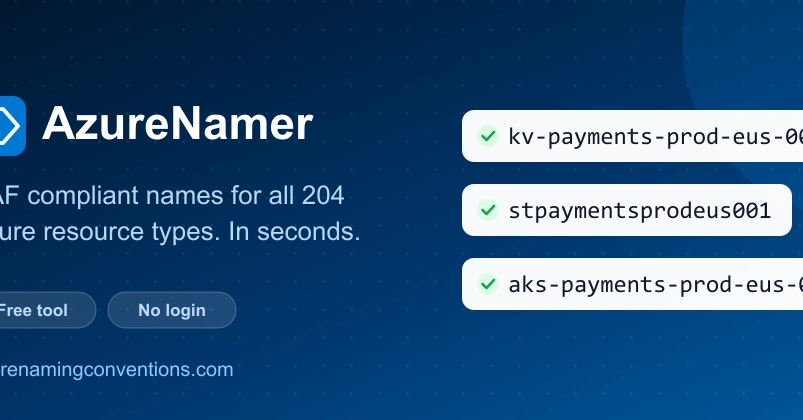
AzureNamer Solves Naming Convention Headaches
Azure teams often struggle with Microsoft's Cloud Adoption Framework (CAF) naming conventions. The framework provides a solid structure, but the actual rules and constraints for each of the hundreds of Azure resource types are scattered across documentation and frequently change. This fragmentation leads to frustrating name errors during deployment, forcing developers to constantly cross-reference documentation. Storage accounts require 3 to 24 lowercase characters without hyphens, must be globally unique, and cannot contain hyphens. Key Vaults have a 24-character limit, and their names are reserved for 90 days after deletion due to soft delete functionality. Container registries are restricted to alphanumeric characters only.
Tushar Verma, a developer, experienced this friction firsthand and decided to build a solution. The result is AzureNamer, a free, open-source tool designed to automate the generation of CAF-compliant names for Azure resources.
Core Functionality and Supported Resource Types
AzureNamer is built to handle the complexity of Azure's naming requirements. It currently supports 204 distinct Azure resource types, each with its specific length limitations and character restrictions meticulously integrated. The tool doesn't just generate names; it enforces the real-world rules that Azure imposes. This means users can be confident that the names generated will pass validation checks, saving significant time and reducing deployment friction.
The tool's intelligence lies in its deep understanding of these nuances. For instance, it knows the precise character limits for services like Azure Kubernetes Service (AKS) clusters, Azure SQL Databases, or virtual machine scale sets, and applies the correct allowed character sets – whether alphanumeric, lowercase, or a combination thereof. This granular control prevents common errors such as exceeding length limits, using disallowed characters (like hyphens where they are not permitted), or failing global uniqueness checks for certain resource types.
Export Options for Seamless Integration
A critical aspect of AzureNamer is its flexibility in exporting generated names. Recognizing that Azure deployments are managed through various Infrastructure as Code (IaC) tools and workflows, Verma has included multiple export formats. Users can export their compliant naming sets as:
- Terraform files
- Bicep files
- JSON files
- Markdown files
- CSV files
This broad range of export options ensures that AzureNamer can fit into virtually any existing cloud management workflow. Whether a team is standardizing on Terraform for multi-cloud deployments, using Bicep for Azure-specific solutions, or simply needs a quick reference list in Markdown or CSV, the tool provides the necessary output.
Parameterized Mode for Environment Management
The Terraform and Bicep export options offer a particularly powerful feature: parameterized mode. This mode goes beyond simply generating a static list of names. It produces code that includes variable blocks and derived name expressions. This allows a single IaC file to generate correct, compliant names for different environments like development, staging, and production.
For example, a Terraform export in parameterized mode might define a root variable for an environment name (e.g., `"dev"`, `"prod"`) and then use that variable to construct unique names for resources. If a generated name needs to be shortened to meet Azure's constraints, AzureNamer ensures this is done literally with a clear comment explaining the modification, rather than silently truncating the name, which could lead to confusion or unintended collisions. This level of detail prevents silent failures and provides transparency in the naming process across different deployment stages.
The Problem Solver's Motivation
Verma's motivation stems from a common pain point for cloud engineers and developers: the sheer effort required to maintain naming consistency and compliance. Manually tracking the rules for every resource type is tedious and error-prone. The time spent looking up documentation or debugging name validation errors could be better spent on building and deploying infrastructure. AzureNamer directly addresses this by centralizing the knowledge of these rules into a single, easy-to-use tool.
By providing a free, accessible solution, Verma aims to help teams of all sizes improve their Azure resource management practices. The tool's focus on CAF compliance aligns with Microsoft's best practices, promoting a more organized and scalable cloud environment. The open-source nature of AzureNamer also invites community contributions, potentially expanding its support for more resource types or adding further enhancements in the future.
Broader Implications for Azure Resource Management
The availability of tools like AzureNamer is crucial for the maturation of cloud governance and management practices. As organizations scale their Azure footprints, maintaining order and consistency becomes paramount. Naming conventions are a foundational element of this order, impacting everything from resource identification and cost allocation to security auditing and automation scripting.
AzureNamer addresses a specific, yet significant, operational bottleneck. By automating a complex and often overlooked task, it empowers engineers to focus on higher-value activities. Its ability to integrate with popular IaC tools further solidifies its utility, making it a practical addition to the developer's toolkit for anyone working with Azure. The tool serves as a strong argument for the value of developer-led solutions to common infrastructure challenges.