The Low-Precision Imperative: FP8 and FP4 Take Center Stage
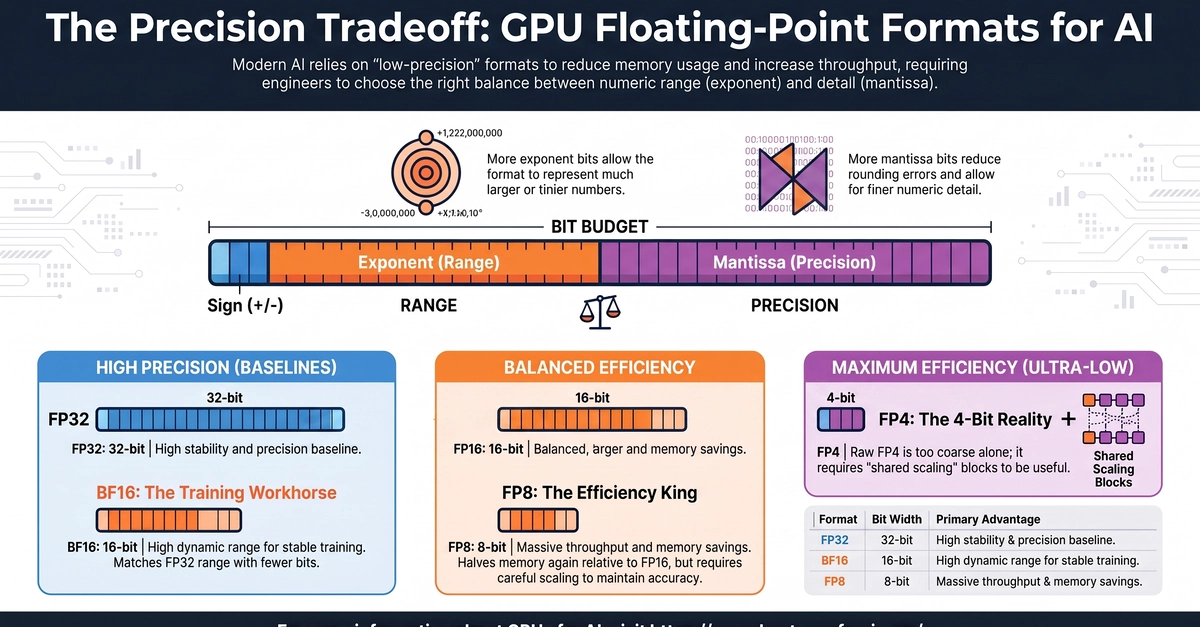
By mid-2026, the landscape of large-scale AI development has fundamentally shifted, with FP8 and FP4 formats becoming essential tools for efficiency. These low-precision numerical representations are no longer experimental but are critical for enabling the training and inference of ever-larger models on existing hardware. Traditional formats like BF16 and FP16, while once the standard, are giving way to these more aggressive precision levels that dramatically reduce memory footprints and boost computational throughput on modern GPUs.
The driving force behind this adoption is the substantial performance uplift. FP8, for instance, offers roughly a 2x memory saving compared to its predecessors. NVIDIA’s NVFP4 format pushes this even further, utilizing 4-bit values and a sophisticated micro-block scaling mechanism. This involves shared FP8 scales for every 16 elements, augmented by a tensor-level scale. The result is a potential memory saving of up to 3.5x. Beyond memory, these formats unlock higher Tensor Core performance and improve energy efficiency, making them indispensable for both training massive foundational models and deploying them at scale for inference.
Understanding FP8 Formats: E4M3 vs. E5M2
FP8 itself is not a monolithic standard; it encompasses distinct formats tailored for different aspects of the AI pipeline. The two primary formats are E4M3 and E5M2. E4M3, characterized by 4 exponent bits and 3 mantissa bits, is optimized for scenarios demanding higher precision on activations and weights. This format is particularly effective where the delicate balance of weights and intermediate computations is paramount, ensuring that subtle nuances in the model’s understanding are preserved.
Conversely, E5M2, with 5 exponent bits and 2 mantissa bits, is designed for a wider dynamic range, making it ideal for handling gradients during the training process. Gradients can often span a wide spectrum of values, and E5M2’s extended range helps prevent overflow or underflow issues that could derail training. The choice between E4M3 and E5M2 often depends on the specific layer, the phase of training or inference, and the model architecture itself. Frameworks supporting FP8 typically allow for mixed-precision strategies, intelligently deploying the appropriate FP8 format where it yields the greatest benefit without compromising model accuracy.
NVIDIA's NVFP4: Pushing the Boundaries of 4-Bit Precision
NVIDIA’s NVFP4 format represents a significant leap in low-precision quantization, moving beyond the typical FP8 implementations. By leveraging 4-bit values, NVFP4 drastically reduces the memory footprint, enabling models that would previously be impossible to fit into GPU memory to become viable. The innovation lies not just in the bit-width reduction but in the intelligent scaling mechanisms employed.
NVFP4 utilizes micro-block scaling, where a single FP8 scale is shared across a small block of 16 elements. This shared scale helps to normalize the range of these elements, mitigating some of the precision loss inherent in 4-bit representation. Furthermore, a tensor-level scale provides an additional layer of dynamic range management for the entire tensor. This hierarchical scaling approach allows NVFP4 to maintain a surprisingly high degree of accuracy and stability, even with such aggressive quantization. The trade-off, as with any quantization, involves a reduced numerical range and potential precision degradation. However, for many large language models and computer vision tasks, the performance gains and memory savings offered by NVFP4 are substantial enough to outweigh these concerns, particularly when combined with techniques like mixed-precision training and quantization-aware fine-tuning.
Framework Support: PyTorch, JAX, and TensorFlow Adapt
The widespread adoption of FP8 and FP4 is contingent on robust support within major AI frameworks. By mid-2026, PyTorch, JAX, and TensorFlow have all integrated these low-precision formats, making them accessible to developers. PyTorch, through its `torch.amp` (Automatic Mixed Precision) module, offers granular control over FP8 usage, allowing developers to specify which operations should leverage E4M3 or E5M2 formats. This integration enables seamless transitions for existing codebases, minimizing the refactoring effort required to harness the benefits of FP8.
JAX, known for its functional programming paradigm and powerful compilation capabilities, provides first-class support for low-precision formats through its `pmap` and `jit` transformations. Developers can leverage JAX’s composable function transformations to automatically handle quantization and dequantization, often with minimal code changes. TensorFlow has also evolved its `tf.keras` API and `tf.experimental.numpy` module to include comprehensive FP8 and FP4 support. This includes optimized kernels for various hardware accelerators and tools for quantization-aware training, ensuring that models trained with these formats maintain their accuracy and performance characteristics. The availability of these formats across major frameworks democratizes their use, allowing researchers and engineers to experiment and deploy more performant AI systems.
The Trade-offs: Precision vs. Performance
While the benefits of FP8 and FP4 are significant, they come with inherent trade-offs. The most apparent is the reduction in numerical range and precision. With fewer bits dedicated to representing numbers, the granularity of values that can be stored decreases, and the overall span of representable numbers shrinks. This can lead to several issues:
- Accumulation of errors: In deep neural networks, computations are often sequential. Small precision errors can accumulate over many layers, potentially leading to a noticeable degradation in model accuracy.
- Gradient instability: During training, gradients can sometimes become extremely small or large. With reduced precision, these gradients might underflow (become zero) or overflow (exceed the maximum representable value), halting or destabilizing the learning process.
- Sensitivity to outliers: Models that are sensitive to outliers in their data or intermediate activations might perform poorly when quantized to lower precision, as these outliers may fall outside the limited dynamic range.
To mitigate these issues, developers employ several strategies. Quantization-aware training (QAT) is a common technique where the model is trained with simulated quantization noise, allowing it to adapt and learn to be more robust to precision loss. Mixed-precision training, which intelligently combines FP16, FP8, and FP4 operations, is also crucial. This involves using lower precision for operations where it has minimal impact on accuracy (like matrix multiplications) and higher precision for sensitive operations (like summation or normalization layers). Furthermore, careful selection of FP8 formats (E4M3 vs. E5M2) and the use of dynamic scaling techniques, as seen in NVFP4, help manage the dynamic range and maintain stability.
The Future: Beyond FP8 and FP4
As AI models continue to grow in size and complexity, the push for even greater efficiency will not cease. While FP8 and FP4 represent the current state-of-the-art in widely supported low-precision formats, research is already exploring new frontiers. This includes further reductions in bit-width, potentially down to 2-bit or even binary representations for specific use cases, and the development of more sophisticated quantization algorithms that can preserve accuracy with even more aggressive compression. Hardware innovations will also play a role, with future accelerators likely to feature specialized units designed to accelerate ultra-low-precision computations even more effectively. The journey towards hyper-efficient AI is ongoing, with FP8 and FP4 serving as critical milestones on the path to democratizing advanced AI capabilities.