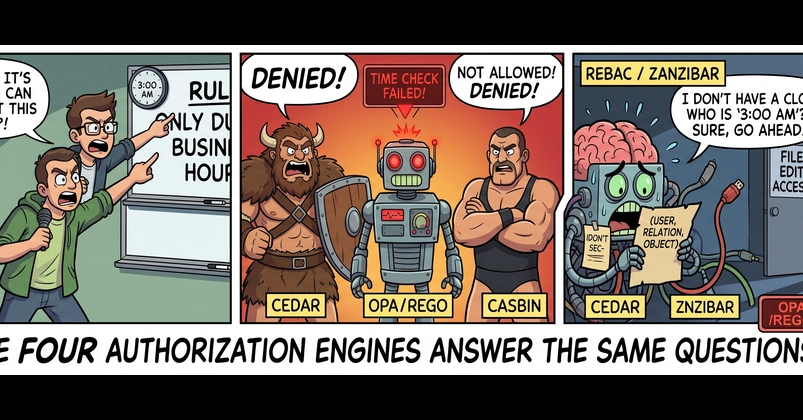
The Problem with Abstract Comparisons
Choosing an authorization engine often involves wading through tables and descriptions that highlight theoretical strengths. Cedar is presented as analyzable, Rego as expressive, and Zanzibar as relationship-based. While accurate, these descriptions rarely convey the practical, day-to-day experience of implementing and managing authorization rules. Developers need to understand how these engines behave when faced with identical, real-world scenarios.
To bridge this gap, one developer took a hands-on approach. They built a project to test four popular authorization engines—Cedar, Open Policy Agent (OPA) with Rego, and two Zanzibar-inspired systems—against the exact same set of authorization rules and requests. The goal was to move beyond theoretical discussions and observe how these different systems handle the same logic in practice.
This experiment aimed to provide concrete, observable differences in how each engine processes requests, defines policies, and exposes its decision-making process. The live demo and repository offer a transparent look at the methodology and results, allowing others to replicate or build upon this comparative analysis.
Methodology: A Unified Rule Set
The core of the project involved defining a common set of authorization rules that could be translated into the syntax of each engine. This is a non-trivial task, as each engine has its own paradigms and strengths. The developer focused on a typical application scenario, likely involving user roles, resource access, and potentially contextual information. By forcing all engines to adhere to the same logical requirements, any observed differences would stem directly from the engine's architecture, language, and underlying model.
The test cases likely included a variety of request types, from simple 'allow/deny' decisions to more complex queries that might involve checking relationships between users, resources, and groups. The process of translating rules across these distinct systems is where the first practical challenges emerge. For instance, a relationship-based model like Zanzibar might require explicit definition of group memberships and resource ownership, while a more expressive language like Rego could potentially infer some of these relationships or handle them through complex conditional logic.
The experiment then executed every possible request against all four engines simultaneously. This parallel processing is crucial for a fair comparison. It ensures that each engine is evaluated under identical conditions, eliminating variables related to timing, network latency, or external factors that could skew results. The output for each request would then be compared to identify discrepancies in decisions, performance, or the clarity of the reasoning provided.
The Engines Under Scrutiny
The selection of engines represents a cross-section of modern authorization approaches:
- Cedar: Developed by AWS, Cedar is designed for fine-grained authorization and emphasizes analyzability. Its structure aims to make it easier to understand and audit policies.
- Rego (Open Policy Agent - OPA): Rego is a declarative language used by OPA. It's known for its expressiveness and flexibility, allowing for complex policy definitions and integration into various systems.
- Zanzibar: Google's foundational system for managing authorization at scale. It's characterized by its relationship-based approach, focusing on users, roles, relationships, and resources.
- A Second Zanzibar-Inspired System: The inclusion of another system inspired by Zanzibar suggests an exploration of different implementations or interpretations of the core Zanzibar concepts, potentially highlighting variations in performance or feature sets within that architectural family.
Each of these systems tackles authorization from a different angle. Cedar's focus on analyzability suggests a structured, almost code-like approach to policy definition. Rego, on the other hand, offers a powerful query language that can express intricate logic. Zanzibar's model is built around the idea of 'permissions as relationships,' which can be very intuitive for certain types of access control.
Observing the Divergence
The results of this rigorous testing reveal the practical differences that abstract descriptions often miss. While all engines are designed to answer authorization questions, the way they arrive at those answers, the clarity of their responses, and the effort required to define the rules can vary significantly.
One key observation is likely to be the differing levels of complexity in defining equivalent policies. A rule that is straightforward in one engine might require a more convoluted expression or additional data structures in another. This directly impacts developer productivity and the maintainability of the authorization system. For example, managing group memberships or hierarchical resource structures could be native concepts in one system but require explicit modeling in another.
Performance is another critical differentiator. While not always the primary concern, significant performance disparities can impact user experience, especially in high-throughput applications. The experiment would highlight which engines are faster for specific types of queries or policy structures. This is particularly relevant when comparing a pure relationship-based system against a more logic-driven one.
Furthermore, the 'analyzability' factor that Cedar promotes would likely manifest in how easy it is to debug or understand why a specific request was allowed or denied. Some engines might provide richer diagnostic information or more human-readable explanations of their decision process than others. This is crucial for security auditing and troubleshooting.
The experiment implicitly raises the question: what is the 'right' way to model authorization? The answer clearly depends on the specific application's needs, the team's expertise, and the desired trade-offs between expressiveness, analyzability, and performance. This hands-on comparison provides the data needed to make informed decisions rather than relying on marketing material or theoretical benchmarks.
What This Means for Developers
For developers tasked with implementing authorization, this kind of direct comparison is invaluable. It moves the decision-making process from abstract feature lists to concrete operational differences. Understanding how easily a specific authorization pattern can be implemented, how performant it is, and how auditable the resulting policies are, allows teams to select the engine that best fits their project's constraints and goals.
If you're evaluating authorization solutions, this project offers a practical lens. Instead of just reading about 'expressiveness,' you can see how expressiveness translates into actual code and decision-making. The project serves as a call to action: test your chosen engine with your own rules and data to truly understand its capabilities and limitations within your specific context.