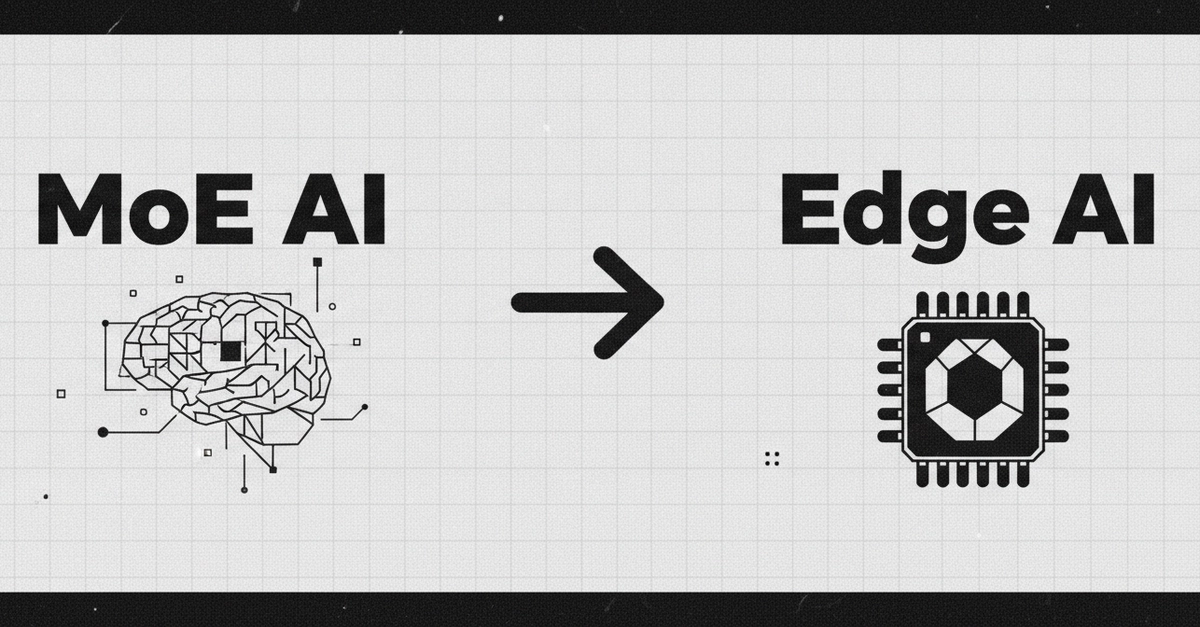
Understanding Mixture of Experts (MoE)
The recent demonstration of a 35-billion parameter language model running on an iPhone with minimal memory usage has sparked considerable interest. This feat, achieved by the Edge0 project, highlights a sophisticated technique called Mixture of Experts (MoE). While the result is impressive on-device AI, it's crucial to distinguish MoE from Edge AI itself. They are related, but fundamentally address different aspects of AI model development and deployment.
At its core, a Mixture of Experts (MoE) model is a type of neural network architecture designed for efficiency and scalability. Unlike traditional dense models, which activate all parameters for every input, MoE models comprise multiple smaller neural networks, known as experts. Each expert specializes in processing specific types of data or tasks. A gating network within the MoE architecture intelligently routes each input to a select subset of these experts, often just one or two, for processing. This selective activation means that only a fraction of the model's total parameters are used for any given inference, dramatically reducing computational cost and memory requirements compared to a dense model of equivalent total parameter count.
Think of an MoE model like a large consulting firm. Instead of having every partner work on every client issue, the firm has specialized departments (experts) for finance, law, engineering, and marketing. When a new client project arrives, a smart intake system (the gating network) directs the project to the partners most qualified to handle it. This ensures that specialized knowledge is applied efficiently, and the firm doesn't waste resources by involving partners who aren't relevant to the specific problem. This selective engagement is what allows MoE models to achieve high performance with significantly lower computational overhead.

The primary benefit of the MoE architecture is its ability to scale model capacity without a proportional increase in computational cost during inference. A 35B MoE model might have a total of 35 billion parameters, but its inference cost could be closer to that of a much smaller dense model, perhaps only activating 5-10 billion parameters per token. This makes it feasible to deploy larger, more capable models in resource-constrained environments.
Defining Edge AI
Edge AI, on the other hand, refers to the deployment and execution of artificial intelligence algorithms directly on edge devices. These devices can range from smartphones and IoT sensors to embedded systems in vehicles and industrial machinery. The core principle of Edge AI is to process data locally, rather than sending it to a centralized cloud server for computation. This offers several key advantages:
- Reduced Latency: Processing data at the edge eliminates the round-trip delay to the cloud, enabling real-time decision-making critical for applications like autonomous driving or industrial automation.
- Enhanced Privacy and Security: Sensitive data can be processed and anonymized locally, reducing the risk of data breaches during transmission or storage in the cloud.
- Improved Reliability: Edge AI applications can function even with intermittent or no internet connectivity, ensuring continuous operation.
- Lower Bandwidth Costs: By processing data locally, the need to transmit large volumes of raw data to the cloud is significantly reduced, saving bandwidth and associated costs.
Edge AI is an environmental or deployment strategy. It dictates where the computation happens. The AI models running on the edge can be of various architectures: traditional dense neural networks, recurrent neural networks, or, as demonstrated by Edge0, MoE models.
The Intersection and Distinction
The confusion between MoE and Edge AI often arises because MoE architectures are exceptionally well-suited for Edge AI applications. The efficiency gains offered by MoE models, particularly their ability to achieve high performance with lower computational and memory footprints, make them ideal candidates for deployment on devices with limited resources, such as smartphones. The Edge0 project's success in running a large language model on an iPhone is a prime example of this synergy.
However, it's crucial to remember that MoE is an architectural choice for building AI models, while Edge AI is a deployment paradigm. You can deploy a traditional dense neural network on an edge device, making it an Edge AI application. Conversely, you can train and run a large MoE model in the cloud, which would not be considered Edge AI. The Edge0 project leverages MoE for Edge AI, but MoE does not inherently mean Edge AI.
What nobody has addressed yet is how the specific routing mechanisms of MoE gating networks might be further optimized for the heterogeneous and often unpredictable resource availability of diverse edge hardware. Current gating networks are typically trained end-to-end with the experts. Adapting these to dynamic edge environments, where processing power or memory might fluctuate, could unlock even greater efficiency and robustness.
The success of running large models on edge devices hinges on continued innovation in both model architectures like MoE and efficient deployment strategies like Edge AI. As these fields mature, we can expect to see increasingly powerful AI capabilities becoming accessible directly on the devices we use every day, without the need for constant cloud connectivity.